
An industrial reverse osmosis (RO) system isn’t just one machine, it’s a team of carefully engineered parts working together. They deliver pure water, consistently. Every single component is vital for how well the system works, how long the membranes last, what it costs to run, and how reliable it is over time.
You need to understand these industrial RO system parts. It’s key for picking the right system, running it well, and keeping it maintained. This is especially true in industrial settings where downtime costs a lot of money.
This guide breaks down every major part you’ll find in today’s industrial RO plants and explains why each one matters.
Industrial RO System Components – Feed Water Intake and Raw Water Handling
Source Water Entry and Initial Screening
Industrial RO systems usually treat water from:
-
City water supply
-
Borewell or groundwater
-
Surface water
-
Seawater or brackish water
Before it even gets to the pre-treatment section, raw water goes through basic screens or strainers. This removes big junk and stops it from damaging equipment further down the line.
Read more: Industrial Reverse Osmosis Systems & Water Treatment Systems
Pre-Treatment Systems in Industrial RO Plants
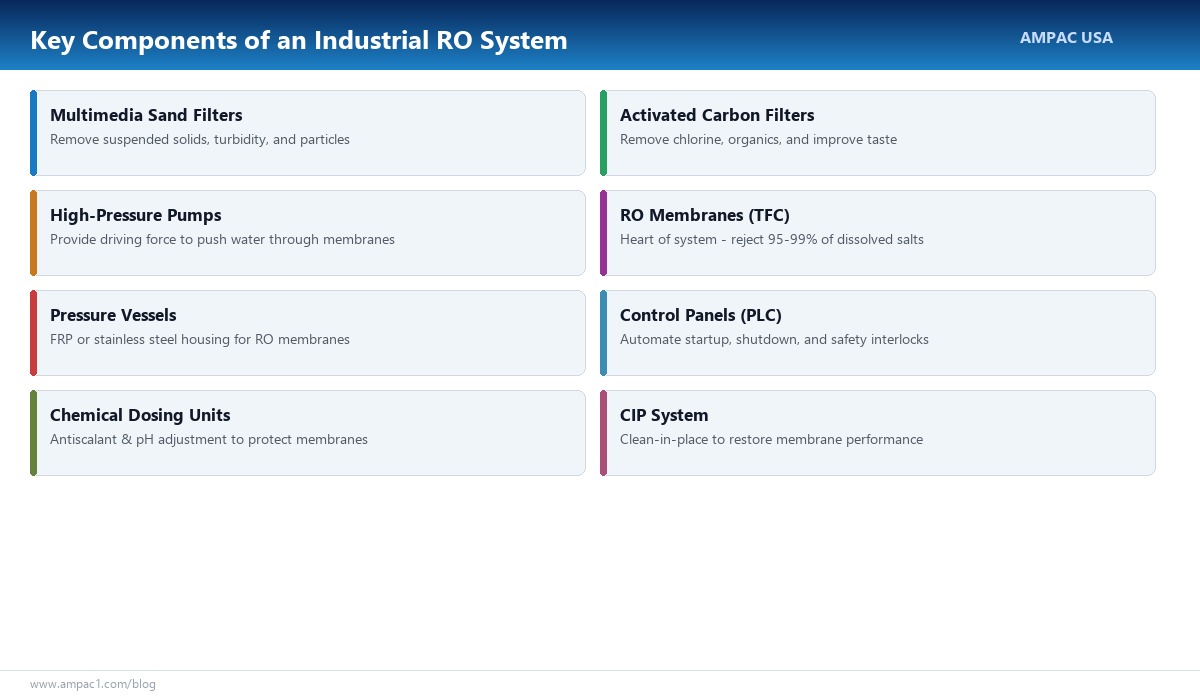
Multimedia Sand Filters
Multimedia filters grab suspended solids, cloudiness, and tiny particles from the feed water. These filters protect RO membranes by cutting down on fouling and making the whole system more stable.
Here’s why they’re great:
-
Membranes last longer
-
Less pressure drop
-
Steady permeate flow
Activated Carbon Filters
Activated carbon filters get rid of:
-
Free chlorine
-
Organic stuff
-
Bad smells and color
Removing chlorine is super important. If you don’t, chlorine can permanently damage RO membranes.
Water Softeners
Water softeners make water less hard by removing calcium and magnesium ions. This means less scaling on your RO membranes and better recovery rates, especially with really hard water.
Cartridge Filters
Cartridge filters give you a final, fine filtration, usually catching particles 1-5 microns big, before water hits the RO membranes. They’re the last physical guard against suspended particles.
Read More: How Industrial Wastewater Affects Clean Water Sources
High-Pressure Pump Systems
Role of High-Pressure Pumps in Industrial RO
High-pressure pumps are the muscle, pushing water through those semi-permeable RO membranes. The pump has to overcome the water’s osmotic pressure, which changes depending on how many dissolved solids are in the water.
Pump Selection Considerations
Think about these things:
-
How salty is the feed water?
-
What operating pressure do you need?
-
What’s the flow rate?
-
How energy efficient is it?
Picking the right pump really impacts your total operating cost and how much energy you use.
Reverse Osmosis Membranes and Pressure Vessels
Industrial RO Membranes
Industrial RO membranes are the heart of the system. Most industrial setups use Thin Film Composite (TFC) membranes because they reject contaminants so well and they’re tough.
Membranes remove:
-
Dissolved salts
-
Heavy metals
-
Bacteria and microorganisms
-
Organic contaminants
Pressure Vessels
Pressure vessels hold the RO membranes. They’re built to handle high operating pressures. You’ll usually see them made from fiberglass-reinforced plastic (FRP) or stainless steel, depending on what you’re using them for and the water’s chemistry.
Read more: Industrial Carbon Water Filtration: The Ultimate Solution for Pure and Safe Water
RO Skid and Piping Assembly
Skid-Mounted System Design
Industrial RO systems often come mounted on a skid. This means:
-
Compact installation
-
Faster setup
-
Easier to move around
Skid systems combine pumps, membranes, piping, and instruments all onto one platform.
High-Grade Piping and Valves
We pick piping materials based on:
-
Pressure rating
-
How well it resists corrosion
-
Chemical compatibility
Good piping design means no leaks and a system that lasts a long time.
Instrumentation and Monitoring Devices
Pressure Gauges and Flow Meters
These tools watch:
-
Feed pressure
-
Permeate flow
-
Reject flow
They give you instant info on your system’s health and how it’s performing.
Read More —Importance of Industrial RO Water Purifiers in Power Plants
Conductivity and TDS Sensors
Conductivity sensors measure the quality of the treated water. They help catch membrane damage or performance drops right away.
Control Panels and Automation Systems
PLC-Based Control Panels
Programmable Logic Controllers (PLCs) automate:
-
Starting and stopping the system
-
Handling alarms
-
Safety locks
Automation cuts down on human errors and makes operations more reliable.
SCADA Integration
Advanced industrial RO systems can hook up to SCADA platforms for:
-
Remote monitoring
-
Data recording
-
Predictive maintenance
What’s the best way to keep things running smoothly?
Chemical Dosing Systems
Antiscalant Dosing Units
Antiscalants stop minerals from building up on RO membranes, especially in systems that recover a lot of water.
pH Adjustment Systems
Adjusting the pH helps membranes work better and protects system parts from corrosion or scaling.
Clean-In-Place (CIP) System
Purpose of CIP in Industrial RO
CIP systems bring membrane performance back up by removing fouling and scaling through a controlled chemical cleaning process.
When CIP Is Required
You’ll know you need CIP when you see:
-
Increased pressure drop
-
Less permeate flow
-
Worse salt rejection
A good CIP system makes your membranes last longer and keeps performance steady.
Permeate Storage and Post-Treatment (Optional)
Permeate Tanks
Treated water sits in permeate tanks for:
-
Use in your process
-
Distribution
-
Further polishing
Post-Treatment Options
Depending on what you need, post-treatment might include:
-
UV disinfection
-
Polishing filters
-
Mineral adjustment
Why Component Quality Matters in Industrial RO Systems
Impact on Performance and Cost
High-quality components:
-
Mean less frequent maintenance
-
Lower operating costs
-
Improve system uptime
-
Extend membrane lifespan
Cheap components often break down too soon, use more energy, and give you inconsistent water quality.
Why Choose AMPAC USA?
AMPAC USA is a trusted leader in advanced water treatment. We build high-quality industrial and commercial reverse osmosis systems that deliver performance, reliability, and long-term value. With smart engineering, tough components, customizable systems, and great after-sales support, AMPAC USA makes sure you get cleaner water, better efficiency, and cost-effective operation for any application.
References:
-
Water Quality Association (WQA) – Industrial RO component standards
-
American Water Works Association (AWWA) – Water treatment engineering practices
-
RO membrane manufacturers- technical documentation
Related Articles
- Reverse Osmosis Systems
- RO Treatment
- Treatment Plant RO System
- Treatment Chemicals
Frequently Asked Questions
Why is pre-treatment crucial for industrial RO system longevity and efficiency?
Pre-treatment systems are vital for protecting the delicate RO membranes from fouling, scaling, and chemical damage. Components like multimedia filters, activated carbon, and water softeners remove suspended solids, chlorine, and hardness, ensuring stable permeate flow, extended membrane life, and reduced operating costs. This proactive approach prevents costly downtime and maintains system reliability.
How do activated carbon filters specifically protect RO membranes?
Activated carbon filters are critical for removing free chlorine and organic compounds from the feed water. Chlorine can cause irreversible damage to RO membranes, leading to premature failure and costly replacements. Effective chlorine removal is a non-negotiable step to maintain membrane integrity and ensure long-term system performance.
What is the specific role of cartridge filters in an industrial RO system?
Cartridge filters serve as the final physical barrier before water enters the RO membranes, providing fine filtration typically between 1 and 5 microns. They capture any remaining suspended particles that could otherwise foul or damage the membranes. This ensures optimal performance and protection, safeguarding the most critical component of the RO system.
What is the primary function of high-pressure pumps in an industrial RO system?
High-pressure pumps are the driving force behind the reverse osmosis process, pushing water through the semi-permeable membranes. They must generate sufficient pressure to overcome the natural osmotic pressure of the feed water, which varies significantly based on its Total Dissolved Solids (TDS) levels. Proper pump selection is crucial for efficient permeate production.
What diverse raw water sources can AMPAC USA industrial RO systems treat?
AMPAC USA industrial RO systems are engineered to purify a wide range of raw water sources, including municipal supply, borewell/groundwater, surface water, and even challenging seawater or brackish water. Initial screening removes large debris, preparing diverse feedwaters for advanced purification. Our 30+ years of field experience spans installations treating varied sources globally.
AMPAC USA engineers custom water purification systems for commercial, industrial, and emergency applications — from 500 GPD to multi-million GPD. Trusted by municipalities, military, and industry worldwide.