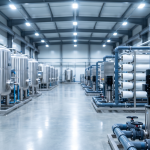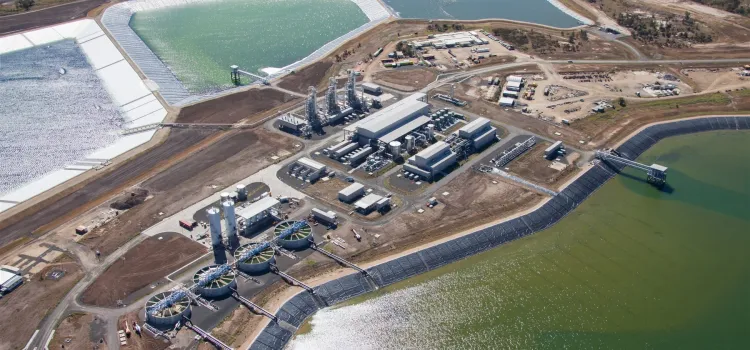

Industrial reverse osmosis systems give factories, pharmaceutical companies, food processors, and power plants incredibly pure water. They work by stripping out 97–99.5% of dissolved salts, heavy metals, bacteria, and organic gunk from your raw water supply. Since 1993, AMPAC USA has built industrial RO systems, from 6,000 to 500,000 gallons per day, for facilities in over 40 countries.
- Removes 97–99.5% of TDS, heavy metals, bacteria, and organics
- Flow capacity: 6,000 GPD to over 500,000 GPD
- Operating pressure: 150–800 PSI, depending on your water’s TDS
- Water recovery: 65–85% (only 15–35% waste brine)
- Membrane life: 3–7 years with proper pre-treatment
- Industries served: pharmaceutical, power, food & beverage, semiconductor, military
- Certifications: NSF/ANSI 58 certified parts; ISO 9001:2015 manufacturing
Why Industrial Facilities Can’t Live Without Reverse Osmosis Water Treatment
Water has been vital to factories since the very first ones popped up in the 1760s. But today, you can’t just pull raw water from the city or a well and use it as-is. Modern industrial jobs-like making drugs, building semiconductors, generating power, or processing food-need water with a very specific, high quality. Only advanced treatment can get you there.
Industrial reverse osmosis (RO) is the workhorse for making process water today. It’s not just simple filtering or chemical softening. RO membranes work at a tiny, molecular level, pushing away dissolved salts, tiny particles, microbes, and organic stuff all at once. What you get is water that meets strict standards, whether it’s for USP Purified Water, ASME boiler feed water, or FDA food-grade purity. It all depends on how we build the system.
The Global Water Intelligence 2023 Market Report says the industrial water treatment market is worth over $11 billion each year. Reverse osmosis takes the biggest slice of that pie. Demand for RO is only growing as rules get tougher, water gets scarcer, and product quality standards become stricter in every industry.
AMPAC USA started in 1993. We run ISO 9001:2015 certified manufacturing facilities and have designed and put in industrial RO systems for power companies, drug makers, US military bases, and food and beverage producers in over 40 countries. This guide will walk you through the clear, real benefits that industrial RO systems bring to different applications.
Benefit 1: A Huge Drop in Total Dissolved Solids (TDS)
Raw water-from city pipes, wells, rivers, or the ocean-has dissolved minerals, organic compounds, heavy metals, and tiny contaminants. You can’t see them, but they cause big problems for industrial processes, equipment, and products.
Total Dissolved Solids (TDS) is how we measure all that dissolved stuff. City water usually has 200–800 mg/L TDS. Brackish groundwater often ranges from 1,000–10,000 mg/L TDS. Seawater averages 35,000–45,000 mg/L TDS in open oceans, and up to 38,000–55,000 mg/L in places with high evaporation, like the Arabian Gulf.
Industrial RO membranes knock down TDS by 97–99.5% in just one pass. A system that treats city water with 500 mg/L TDS will give you permeate water at 5–15 mg/L TDS. A brackish water RO system treating 5,000 mg/L will deliver permeate below 100 mg/L. For industries where TDS directly impacts product quality or how long equipment lasts, this reduction isn’t just nice-to-have, it’s absolutely essential.
Check out AMPAC USA’s complete water treatment systems, built for all sorts of TDS reduction needs.
Benefit 2: Protecting Your Expensive Equipment from Scale and Corrosion
Untreated or poorly treated water causes two main kinds of equipment damage: scaling from mineral buildup and corrosion from dissolved ions and harsh chemicals.
Scaling Damage
When you heat or evaporate water in boilers, heat exchangers, cooling towers, or steam generators, dissolved calcium and magnesium salts turn into hard mineral scale on metal surfaces. Calcium carbonate scale is a terrible insulator-it has a thermal conductivity of just 0.3–1.0 W/m·K, compared to carbon steel at 50 W/m·K. That means it dramatically cuts down how well heat transfers. The US Department of Energy figures a 1.5mm layer of scale can make industrial boilers burn 15–25% more fuel.
Industrial RO systems get rid of the calcium, magnesium, sulfate, silica, and barium that cause scale. This gives you softened, low-TDS water that stops mineral buildup throughout your entire system. Facilities using RO-treated boiler feed water report cutting chemical descaling treatments by up to 90% and making their equipment last much longer.
Corrosion Prevention
Dissolved chlorides, sulfates, and oxygen in raw water eat away at metals through electrochemical corrosion. Chloride ions are especially bad; they break down the protective oxide layer on stainless steel, causing pitting that leads to early equipment failure. RO membranes remove chlorides and other aggressive ions, greatly lowering the chance of corrosion in pipes, pressure vessels, and processing equipment.
Find out more about industrial water treatment applications where stopping corrosion is key.
Benefit 3: Consistent Product Quality in Process Industries
In industries where water is a direct ingredient or touches the product, inconsistent water quality means inconsistent product quality. Industrial RO systems give you water with steady, predictable chemistry, no matter how much your source water quality changes with the seasons. That’s a huge deal in regulated industries.
Pharmaceutical Manufacturing
USP Purified Water needs conductivity below 1.3 µS/cm at 25°C and TOC below 500 ppb. Drug makers use RO as the first big step in purification, before mixed-bed deionization or electrodeionization (EDI), to meet USP rules. If you don’t meet USP specs, you’re looking at regulatory fines and potentially tossing out entire batches-losses that can hit millions of dollars per incident.
AMPAC USA’s reverse osmosis systems are regularly chosen for pharmaceutical facilities that need Purified Water and Water for Injection (WFI).
Food and Beverage Processing
Water for brewing, bottling, dairy, and food manufacturing has to meet FDA 21 CFR Part 110 standards. Beyond just following rules, water chemistry directly impacts taste, texture, carbonation, and how long products last on the shelf. Breweries use RO to create a “blank slate” water profile they can then precisely mineralize for different beer styles. Beverage companies use RO to make sure every batch tastes the same, even if city water quality changes.
Semiconductor and Electronics Manufacturing
Ultrapure water (UPW) for making computer chips must have a resistivity of 18.2 MΩ·cm-basically no ionic content at all. This level of purity needs many stages, with RO as the main step to remove bulk salts, followed by EDI, mixed-bed DI, and UV treatment. Even tiny contamination, at parts-per-trillion levels, can ruin semiconductor devices. So, ultra-high-purity RO systems aren’t just an option in this field; they’re a must-have.
Benefit 4: Big Savings on Chemical Treatment Costs
Facilities that only use ion exchange softening for water treatment face ongoing costs for chemicals (usually salt, hydrochloric acid, or caustic soda), replacing resin, and getting rid of wastewater from regeneration. Industrial RO drastically cuts or eliminates these chemical costs in a few ways.
When you put an RO system before ion exchange resin beds, it removes 97–99% of the dissolved solids before the water even hits the resin. This means you regenerate your ion exchange systems 75–90% less often, cutting chemical use by the same amount. For a facility running 100,000 GPD through softeners, that can save $40,000–$120,000 per year just on regeneration chemicals.
RO-treated water also needs less chemical dosing to stop corrosion and scale in cooling towers and boilers. Why? Because less mineral load means a lower Langelier Saturation Index (LSI) and less chance for biological growth. Facilities report total chemical treatment savings of 40–70% after putting in industrial RO for pre-treatment.
Check out AMPAC USA’s brackish water treatment systems for places dealing with high-TDS source water and big chemical bills.
Benefit 5: Scalable Capacity for Any Industrial Application
One of the best practical things about industrial RO is its modular design. You can easily scale it up or down. Unlike some water treatment tech that needs a whole new system when your capacity needs change, you can expand RO systems by just adding more membrane modules and pressure vessels, either in parallel or in series.
AMPAC USA builds industrial RO systems in these capacity ranges:
| System Size Category | Flow Rate (GPD) | Typical Application |
|---|---|---|
| Small Industrial | 6,000 – 30,000 | Breweries, labs, small manufacturing |
| Mid-Scale Industrial | 30,000 – 100,000 | Pharmaceutical, food processing, hospitals |
| Large Industrial | 100,000 – 500,000 | Power plants, large manufacturing, municipal |
| Ultra-Large / Custom | 500,000+ | Utility-scale, military base, desalination projects |
Every AMPAC USA industrial system comes with stainless steel frames, tough high-pressure pumps, PLC automation with remote monitoring, and NSF/ANSI 58 certified parts. This means they meet all the rules and will run reliably for years.
Benefit 6: Water Recovery and Sustainability
Today’s industrial RO systems are really good at water recovery, typically hitting 65–85%. That means 65–85% of the water you put in becomes clean, purified product water (permeate), while only 15–35% leaves as concentrate (brine). This high recovery rate matters a lot for both your wallet and the environment.
For facilities with limited water access or operating in water-stressed regions, high recovery means less raw water withdrawal per unit of product water produced. For facilities paying for municipal water, high recovery directly reduces supply costs. For facilities discharging to sewer or surface water, lower brine volume reduces wastewater disposal costs and regulatory compliance complexity.
Advanced system designs incorporating energy recovery devices (ERDs) — such as pressure exchangers or turbochargers — recover up to 40% of the energy from the high-pressure brine stream, substantially reducing operating energy costs. AMPAC USA incorporates ERDs in large-scale systems processing seawater or high-TDS brackish water feeds. Explore our seawater desalination solutions using energy recovery technology.
Benefit 7: Compliance with Regulatory Requirements
Industrial water quality is governed by an increasingly complex web of federal, state, and international regulations. Industrial RO systems help facilities meet these requirements across multiple dimensions:
- FDA 21 CFR Parts 110, 111, 129 — Food, dietary supplement, and bottled water manufacturing water quality standards
- USP <1231 and <643 — Pharmaceutical water system validation and quality requirements
- ASME Boiler and Pressure Vessel Code — Boiler feed water quality guidelines for steam generation equipment
- EPA Clean Water Act NPDES — Discharge permit requirements for industrial wastewater
- ISO 9001:2015 — Quality management system standards that mandate documented water quality control procedures
AMPAC USA’s systems are designed with documentation packages supporting FDA facility validation, including IQ/OQ/PQ protocols, material traceability records, and compliance with NSF/ANSI 58 for drinking water components.
Industrial RO System Applications by Sector
Power Generation
Power plants — whether fossil fuel, nuclear, or combined cycle — require ultrapure boiler feed water to prevent scaling and corrosion in high-pressure steam circuits. Even trace mineral contamination in boiler water causes catastrophic turbine blade damage. Industrial RO systems treat raw water to below 1 µS/cm conductivity as the primary step before mixed-bed polishing. AMPAC USA has supplied water treatment systems to power generation facilities in North America, the Middle East, and Southeast Asia.
Chiller and HVAC Makeup Water
Commercial and industrial HVAC systems require treated makeup water to prevent biological fouling, scale formation, and corrosion in chiller circuits and cooling towers. Industrial RO combined with chemical dosing programs reduces total cost of ownership for large HVAC systems. See AMPAC USA’s chiller makeup water treatment solutions.
Military and Defense Applications
AMPAC USA holds US military and government contracts for deployable water purification systems. Military field operations require compact, ruggedized RO systems capable of treating seawater, brackish groundwater, or surface water to potable quality in austere environments. AMPAC USA’s ROWPU (Reverse Osmosis Water Purification Unit) systems have been deployed with US military units and allied forces across multiple operational theaters worldwide.
Oil and Gas
Oil and gas operations generate large volumes of high-TDS produced water requiring treatment before reuse or disposal. Industrial RO systems treat produced water for reinjection into reservoirs (enhanced oil recovery) or for surface discharge under EPA permits. The technology also supports hydraulic fracturing water management, where recycled water quality directly impacts well productivity.
Comparison: Industrial RO vs. Alternative Water Treatment Technologies
| Technology | TDS Removal | Energy Use | Chemical Use | Best Suited For |
|---|---|---|---|---|
| Industrial Reverse Osmosis | 97–99.5% | Medium (0.5–3 kWh/m³) | Low (antiscalant only) | High-volume, high-purity process water |
| Ion Exchange Softening | Hardness only | Very Low | High (salt regeneration) | Hardness removal only; small volumes |
| Thermal Distillation (MED/MSF) | 99.9%+ | Very High (7–15 kWh/m³) | Low | Locations with waste heat; ultra-high purity |
| Electrodialysis (EDR) | 50–90% | Medium-High | Low | Moderate TDS feeds; specialized applications |
| Nanofiltration (NF) | 40–70% | Low-Medium | Low | Softening without full desalination |
For high-volume industrial applications requiring both high TDS rejection and reasonable energy efficiency, reverse osmosis offers the best combination of performance, operational cost, and regulatory compliance. Explore the full range of AMPAC USA water treatment systems or visit our applications page to find the right system for your industry.
How to Size an Industrial RO System for Your Facility
Step 1: Complete a Source Water Analysis
Request a full ion panel analysis from a certified water laboratory: TDS, conductivity, pH, hardness, alkalinity, silica, iron, manganese, LSI, SDI (Silt Density Index), turbidity, TOC, and biological indicators. This analysis determines system design parameters and membrane selection.
Step 2: Define Flow Rate Requirements
Calculate average daily demand (ADD) and peak hourly demand (PHD) for all process water uses. Add a 20–25% buffer for future expansion and maintenance downtime. Size the RO system to meet PHD with one pressure vessel offline for cleaning.
Step 3: Select Pre-Treatment Train
Pre-treatment protects RO membranes from fouling and extends membrane life. Standard pre-treatment includes multi-media filtration (for SDI reduction), activated carbon filtration (for chlorine removal), and antiscalant dosing. High-iron or biological water may require additional treatment steps.
Step 4: Determine Post-Treatment Requirements
After RO, determine whether post-treatment polishing is needed. For boiler feed water, mixed-bed deionization achieves <0.1 µS/cm. For pharmaceutical applications, EDI produces Type 1 purified water to USP standards. For potable applications, UV disinfection and pH adjustment complete the treatment train.
Step 5: Contact AMPAC USA for Engineering Review
AMPAC USA provides complimentary feasibility assessments, including source water analysis review, technology recommendation, preliminary sizing, and capital cost estimation for qualified projects. Contact our engineering team to discuss your facility’s requirements.
Frequently Asked Questions: Industrial Reverse Osmosis Systems
What industries require industrial reverse osmosis systems?
Industrial RO systems are required in any sector where process water quality directly affects product quality, equipment reliability, or regulatory compliance. Key industries include pharmaceutical and biotech manufacturing, food and beverage processing (brewing, bottling, dairy), power generation (boiler feed water), semiconductor and electronics fabrication (ultrapure water), oil and gas (produced water treatment), and military field operations. AMPAC USA, founded in 1993, has served all of these industries with ISO 9001:2015 certified systems deployed in 40+ countries.
How much does an industrial RO system cost?
Industrial RO system capital costs vary significantly by flow rate, feed water quality, and pre-treatment requirements. Small industrial systems (6,000–30,000 GPD) typically range from $15,000–$80,000. Mid-scale systems (30,000–100,000 GPD) range from $80,000–$250,000. Large utility-scale systems (100,000+ GPD) are engineered-to-order with custom pricing. Operating costs include energy (0.5–3.0 kWh/m³ of permeate), membrane replacement (every 3–7 years), antiscalant ($0.01–0.05/m³), and annual maintenance. Contact AMPAC USA for a project-specific cost estimate.
What is the difference between industrial and commercial RO systems?
Industrial RO systems are engineered for continuous high-volume duty at flow rates typically above 6,000 GPD, with robust stainless steel frames, industrial-grade high-pressure pumps, multi-stage pre-treatment, PLC automation, and compliance documentation for regulated industries. Commercial RO systems serve lower-flow applications (200–5,000 GPD) such as restaurants, offices, hotels, and light manufacturing where simpler pre-treatment and standard components are adequate.
How long do industrial RO membranes last?
With proper pre-treatment and operating conditions, industrial RO membranes typically last 3–7 years. Membrane life is maximized by maintaining feed SDI below 3, keeping free chlorine below 0.1 mg/L, controlling biological fouling with periodic membrane cleaning (CIP), and operating within manufacturer flux guidelines. AMPAC USA provides membrane performance monitoring and replacement programs as part of service contracts.
What pre-treatment does an industrial RO system require?
Standard pre-treatment for industrial RO includes: multi-media filtration (reduces turbidity and SDI), activated carbon filtration (removes chlorine and organics that degrade membranes), water softening or antiscalant dosing (prevents calcium and silica scale on membranes), and 5-micron cartridge filtration as a final guard before the membranes. Additional pre-treatment steps (iron removal, biological treatment, pH adjustment) are added based on source water analysis. Inadequate pre-treatment is the leading cause of premature RO membrane failure.
Can industrial RO systems treat seawater?
Yes. Seawater reverse osmosis (SWRO) systems are a specialized category of industrial RO designed to handle the high TDS (35,000–45,000 mg/L) and high osmotic pressure (350–400 PSI) of seawater. SWRO systems operate at 800–1,200 PSI with membranes specifically rated for seawater rejection. AMPAC USA designs SWRO systems for coastal and offshore applications, including marine vessel watermakers and land-based seawater desalination plants. See our seawater desalination systems.
How do I maintain an industrial RO system?
Industrial RO maintenance includes: daily monitoring of permeate flow, conductivity, and differential pressure; weekly pre-filter inspection and replacement as needed; monthly antiscalant dosing system check; quarterly or semi-annual CIP (clean-in-place) membrane cleaning with acid and alkaline cleaning solutions; annual system performance normalization and membrane integrity testing; and periodic membrane element replacement on a 3–7 year cycle. AMPAC USA offers comprehensive maintenance service contracts, spare parts kits, and operator training. Contact us for a maintenance program tailored to your system.
Get Started with Industrial RO Water Treatment
AMPAC USA has been engineering industrial reverse osmosis systems since 1993. With ISO 9001:2015 certified manufacturing, NSF/ANSI 58 certified components, and a global installation base spanning 40+ countries, AMPAC USA delivers industrial-grade water treatment systems engineered to your facility’s exact requirements.
Whether you need a compact 10,000 GPD system for a pharmaceutical laboratory or a 250,000 GPD multi-train installation for a power plant, our engineering team provides complete system design, manufacturing, installation support, and post-installation service.
Contact AMPAC USA for a complimentary feasibility assessment and preliminary system sizing. Learn more about our full range of reverse osmosis systems, industry applications, and company background.
Related Articles
- Why is Industrial Reverse Osmosis different from the home?
- Effective Reverse Osmosis Water Filter for Microplastics in Industrial Applications
- Boiler Feedwater Reverse Osmosis: Treatment Guide for Industrial Boilers
- Boiler Feed Water Treatment: Why Industrial Facilities Need Reverse Osmosis
Conclusion
This post highlighted how emergency and military-grade water purification systems provide safe drinking water rapidly in the most challenging field conditions. For organizations requiring deployable water treatment capability, AMPAC USA engineers portable and trailer-mounted systems built to perform wherever they are needed. Contact our team at info@ampac1.com or (909) 548-4900 to discuss your emergency water treatment requirements.
AMPAC USA engineers custom water purification systems for commercial, industrial, and emergency applications — from 500 GPD to multi-million GPD. Trusted by municipalities, military, and industry worldwide.