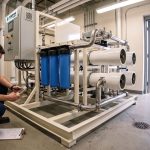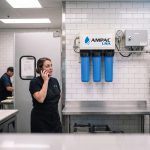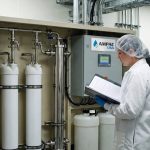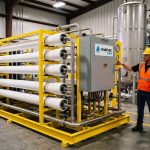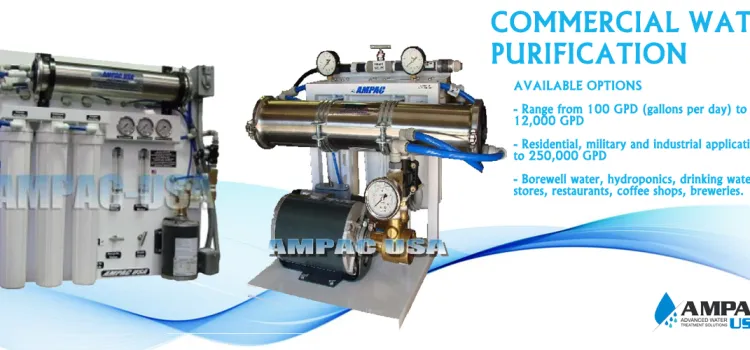

Commercial Reverse Osmosis System is large capacity water purifiers that require extra care while being handled. Because the filters are supposed to carry out water treatment for more than 6,000 GPD at times, it is necessary to note that these systems also require special care so that they are an aid rather than a hassle. For ensuring that the commercial reverse osmosis system runs smoothly, it is important for you to know how to start off and what to do so that it gives more run time than breakdown and maintenance. Here are a few tips to consider before you buy your RO system.
- Capacity:
This is the first thing and parameter that comes to mind considering that we buy commercial ROs when we need more water to be treated. But it is also essential to select a system that suffices your needs, not more nor less. So, if your requirement is 2,500 GPD, it is okay for you to buy a 3,000 GPD system and not a 1,000 GPD or 6,000 GPD. The lesser capacity with hinder your operations and the larger capacity will cost you in maintenance.
- Important Parameters:
Some important parameters to check while purchasing such a big system are system recovery and element recovery. System recovery rate is a cumulative recovery given by cumulative permeate flow rate of membrane elements/feed flow rate to the system X 100%. Element recovery is single element recovery rate and is given by permeate flow rate of a single element/feed flow rate to the single element X 100%. These parameters will let you know three major points. The performance of the system, chances of maintenance and efficiency.
- Customer Support:
Another aspect, it is important that the company you buy the system from offers you customer support whenever it is needed. After all, we are not experts in the systems ourselves and need to run a business. So, do enquire how often does the company send experts for regular servicing and checks, what is their availability in case of any breakdown, how much documentation is required and what is the time required by them.
An additional bonus tip would be to get someone who knows these RO systems in and out to be with you at all times in your company. This way it is easy for them to help you out in case something is required at your end. Ampac USA is one such manufacturer of high-quality Commercial Reverse Osmosis Systems with round the clock customer support for its clients.
Commercial Property Reverse Osmosis Buying Guide
This commercial property reverse osmosis buying guide covers everything property managers and business owners need to know when selecting an RO system. A reverse osmosis ro system forces water through a ro membrane and semi permeable membrane to remove total dissolved solids, heavy metals, chlorine, fluoride, and other contaminants – delivering purified water and treated water to your facility.
Before purchasing, conduct a water test to determine TDS, hardness, and contaminant levels in your incoming water supply. High hardness means water softeners may be needed as pre-treatment. The system should be sized for your peak demand; undersized systems degrade water quality over time. Key components: multi-stage pre-filters, high-rejection membrane, storage tank, and booster pump for adequate water supplied pressure. Dissolved salts and minerals are rejected by the membrane, extending equipment life and improving water quality long term. Contact AMPAC USA for a complete commercial RO consultation.
Frequently Asked Questions
How do I determine the correct capacity for a commercial reverse osmosis system?
The correct capacity for a commercial RO system should closely match your property’s daily water treatment needs. For instance, if your requirement is 2,500 GPD, selecting a 3,000 GPD system is optimal. Choosing a system with significantly less capacity will hinder operations, while a much larger system will incur unnecessary maintenance costs and inefficiency.
What key technical parameters should I evaluate when purchasing a commercial RO system?
Prioritize evaluating the system recovery rate and element recovery rate. System recovery indicates the overall efficiency (cumulative permeate flow / feed flow x 100%), while element recovery focuses on individual membrane performance. These parameters are crucial indicators of the system’s performance, potential maintenance frequency, and overall operational efficiency.
Why is robust customer support essential for commercial reverse osmosis systems?
Robust customer support is critical because commercial RO systems are complex and require specialized knowledge for optimal operation and maintenance. A reliable provider like AMPAC USA offers expert servicing, prompt breakdown assistance, and clear documentation, ensuring your business experiences minimal downtime and consistent water quality. Enquire about expert availability and response times before purchase.
How can I maximize the run time and minimize breakdowns for my commercial RO system?
To maximize run time and minimize breakdowns, select a system with appropriate capacity and ensure regular, expert servicing. Understanding key parameters like system and element recovery helps predict performance and maintenance needs. AMPAC USA emphasizes proactive care and offers comprehensive support to ensure long-term reliability for systems treating over 6,000 GPD.
What are the most important considerations when buying a commercial reverse osmosis system?
When purchasing a commercial RO system, prioritize matching the system’s capacity precisely to your GPD requirements to avoid inefficiency or excessive costs. Critically evaluate technical parameters like system and element recovery rates, which indicate performance and maintenance needs. Finally, ensure the vendor provides comprehensive customer support, including expert servicing and rapid breakdown assistance, as offered by AMPAC USA.
Related Articles
- Commercial vs. Residential Reverse Osmosis Systems: Ampac USA
- Top 5 Commercial Reverse Osmosis Systems by AMPAC USA
- All You Need To Know About A 5 Stage Reverse Osmosis System – AMPAC USA
- Commercial Reverse Osmosis Installation Los Angeles | AMPAC USA
Conclusion
Contact our team at info@ampac1.com or (909) 548-4900 to discuss your water treatment needs.
AMPAC USA engineers custom water purification systems for commercial, industrial, and emergency applications — from 500 GPD to multi-million GPD. Trusted by municipalities, military, and industry worldwide.