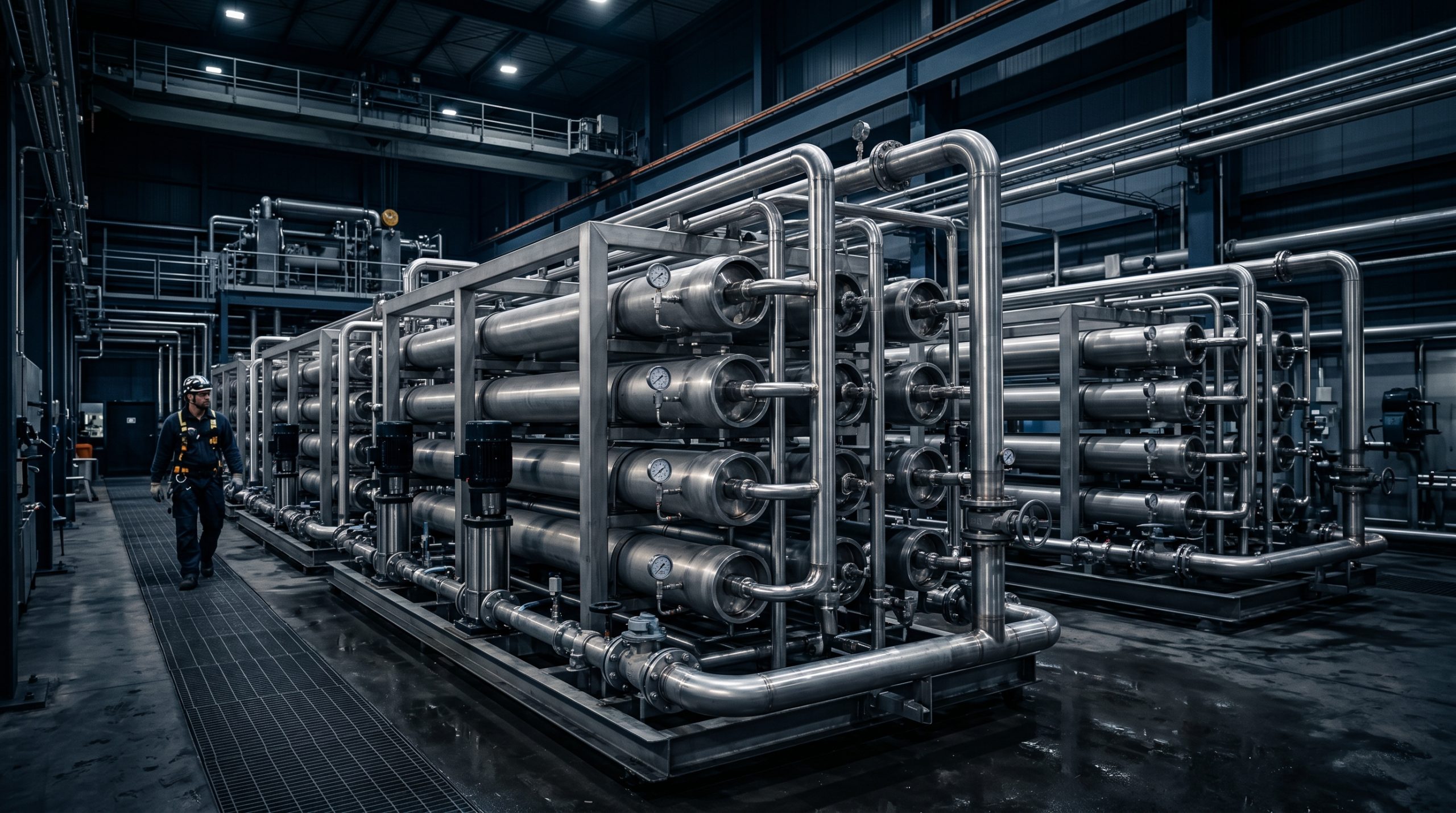

Businesses, municipalities, and industrial facilities that evaluate commercial reverse osmosis systems are typically responding to one of three pressures: deteriorating source water quality, rising costs from bottled or delivered water, or regulatory requirements for process water purity. RO addresses all three — and does so with lower long-term costs than most alternatives.
What a Commercial RO System Actually Does
A reverse osmosis system forces pressurized water across a semi-permeable membrane, rejecting dissolved salts, heavy metals, nitrates, PFAS compounds, bacteria, and organic contaminants. The purified water — called permeate — passes through; the concentrated contaminants are discharged as reject water. A properly designed commercial RO system achieves 95–99% rejection of total dissolved solids (TDS) in a single pass.
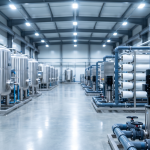
Commercial systems — defined here as systems producing 1,000 to 100,000 gallons per day — are engineered for specific applications. A food-service operation, a hospital, a pharmaceutical facility, and a manufacturing plant all require different pre-treatment configurations, membrane element counts, and post-treatment steps, even if they share the same core RO technology.
Key Advantages of Commercial Reverse Osmosis Systems
1. Consistent, Measurable Water Quality
Municipal water quality varies seasonally and by source. During agricultural runoff events, after flooding, or during infrastructure maintenance, TDS and contaminant levels can spike unpredictably. A commercial RO system buffers against this variability — the output quality is determined by the membrane and the system design, not by what arrives at the tap. This is critical for industries where water quality directly affects product consistency: beverage production, pharmaceuticals, electronics manufacturing, and commercial laundries.
2. Significant Cost Reduction vs. Delivered Water
Delivered bottled or bulk water typically costs $0.50–$2.00 per gallon at commercial scale, depending on volume and region. A well-maintained RO system produces water at $0.001–$0.01 per gallon once capital costs are amortized. For a facility consuming 5,000 gallons per day, the difference is $2,500–$9,750 per day in operational savings — meaningful on any payback analysis. The American Water Works Association consistently identifies on-site purification as the lowest lifecycle-cost option for high-volume commercial water users.
3. Regulatory Compliance for Process Applications
Pharmaceutical manufacturers must meet USP Purified Water standards (conductivity ≤1.3 µS/cm at 25°C, TOC ≤500 ppb). Boiler feed water must meet specific hardness and silica limits to prevent scaling and corrosion. Semiconductor fabrication requires ultrapure water with resistivity approaching 18.2 MΩ·cm. Commercial RO, followed by application-specific post-treatment (EDI, mixed-bed deionization, UV), is the established path to meeting these specifications reliably.
4. Reduced Chemical Scaling and Corrosion in Equipment
Hard water — water with high calcium and magnesium content — accelerates scale buildup in heat exchangers, cooling towers, boilers, and steam systems. Scale acts as thermal insulation, reducing heat transfer efficiency and increasing energy consumption. Removing hardness and silica with RO pre-treatment extends equipment life, reduces chemical descaling costs, and improves energy efficiency across the facility. The US Department of Energy estimates that 1mm of scale on a heat transfer surface increases energy consumption by 10–15%.
5. Reduced Environmental Footprint
On-site RO eliminates the transportation, plastic packaging, and logistics overhead of delivered water. For facilities with sustainability goals or ESG reporting requirements, replacing bottled or trucked water with on-site purification is a quantifiable carbon and waste reduction with straightforward third-party verification.
6. Scalable to Facility Growth
Commercial RO systems are modular. A facility that starts at 5,000 gallons per day can add membrane vessels and high-pressure pump capacity to scale to 20,000 or 50,000 gallons per day without replacing the core infrastructure. This scalability makes RO a sound long-term infrastructure investment rather than a fixed-capacity solution.
AMPAC USA Commercial RO Systems
AMPAC USA engineers commercial reverse osmosis systems from 1,000 to 1,000,000 gallons per day for food service, pharmaceutical, industrial, municipal, and military applications. Each system is configured to your source water chemistry and output quality specification — not a standard catalog product adapted to fit. Contact AMPAC USA to discuss your commercial water purification requirements.
Frequently Asked Questions
What is the typical payback period for a commercial RO system?
Most commercial facilities see full payback on a commercial RO system within 12–36 months when replacing delivered or bottled water, depending on volume and the cost of the alternative supply. Industrial applications with high water quality requirements often see payback within 6–18 months when accounting for reduced equipment maintenance and chemical costs.
How much maintenance does a commercial RO system require?
Routine maintenance includes pre-filter cartridge replacement (every 3–12 months depending on source water quality), membrane cleaning (annually or as indicated by normalized permeate flow data), and RO membrane replacement every 3–7 years under normal operating conditions. Most facilities manage routine maintenance with in-house personnel and schedule manufacturer service contracts for annual system audits.
Can a commercial RO system handle well water or brackish source water?
Yes. Commercial RO systems are commonly deployed on well water, surface water, and municipal supplies. Brackish source water (TDS 1,000–10,000 ppm) requires higher-pressure membranes and more robust pre-treatment than municipal feed water, but the technology is well-proven for these applications at commercial scale.
Sources: American Water Works Association | US Pharmacopeia | US Department of Energy | NSF International
Related Articles
- Whole House Reverse Osmosis System for Commercial & Industrial Water Treatment
- Cannabis Water Treatment: Why Commercial Grows Use Reverse Osmosis
- Commercial Reverse Osmosis System Buyer's Guide: 100 to 10,000 GPD
- Does Reverse Osmosis Remove PFAS? What Commercial Operators Need to Know
Conclusion
This post explored how reverse osmosis technology delivers high-purity water across a wide range of residential, commercial, and industrial applications. For businesses and organizations requiring reliable RO purification, AMPAC USA engineers custom systems tailored to your specific water quality requirements and flow demands. Contact our team at info@ampac1.com or (909) 548-4900 to discuss your water treatment needs.
See the full range of AMPAC commercial RO systems built for these applications.
AMPAC USA engineers custom water purification systems for commercial, industrial, and emergency applications — from 500 GPD to multi-million GPD. Trusted by municipalities, military, and industry worldwide.