
If you’ve spent any real time at sea, you know the score. Fresh water isn’t just a convenience; it’s a lifeline. Imagine being miles offshore, the vast ocean stretching endlessly, and your freshwater tanks start running low. That’s a problem. Hauling bulky water stores eats into your fuel economy and valuable space. Who wants to cut a voyage short just to resupply? This is precisely why reliable marine watermakers are non-negotiable for serious mariners. But with so many options, how do you pick the right one? We’ve got decades of experience.
How Does A Watermaker Help?
We’ve seen it time and again: running out of fresh water offshore creates a significant operational challenge. Beyond the obvious need for drinking and hygiene, consider the sheer logistics. Water weighs 8.3 pounds per gallon. Storing hundreds or thousands of gallons means carrying thousands of pounds of deadweight, directly impacting your vessel’s fuel efficiency and payload capacity. It’s a simple fact of physics. Our marine watermakers eliminate this problem entirely. They use advanced reverse osmosis technology to convert abundant seawater into potable fresh water right onboard. They reduce total dissolved solids (TDS) from typical seawater levels (around 35,000 ppm) to less than 500 ppm, well within WHO drinking water guidelines.
How Do I Know If Mine Is The Perfect Watermaker?
Every vessel is unique. A superyacht cruising the Mediterranean has different demands than a fishing trawler off the Alaskan coast. Crew size, power availability, operational range – these all factor into your water needs. So, how do you determine if a watermaker is truly right for your operations? Here’s what we look for, based on decades of field installations:
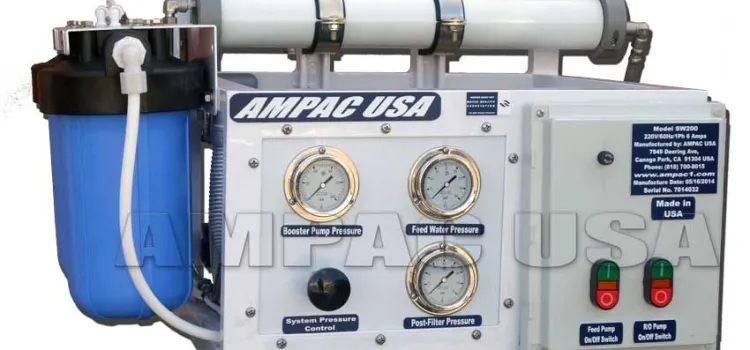
- Open-Frame Design: For us, an open-frame system is critical. Why? Easy visual inspection and quick access for routine maintenance. When you’re offshore, complicated troubleshooting is a luxury you can’t afford. What we’ve found is that enclosed systems often hide problems until they become catastrophic.
- Robust Materials: We insist on high-grade alloys like 316L stainless steel and marine-grade bronze for all critical components. This ensures corrosion resistance in harsh saltwater environments. We’ve seen cheaper systems crack and fail in less than a year.
- Commercial-Grade Components: Motors and electrical enclosures should be marine-coated for superior corrosion protection. Beyond that, every component should be standard, commercially available. Many buyers overlook this; proprietary parts mean costly delays and limited repair options far from port.
- Low RPM Operation: A well-engineered system uses low RPM high-pressure pumps. This significantly reduces wear, extends membrane life, and minimizes frequent filter changes, even with varying seawater salinities. Less downtime, fewer consumables.
- Value, Not Just Price: A watermaker isn’t a commodity. Is it built to last, delivering the promised GPD output consistently in challenging conditions? What we’ve found is that the lowest upfront cost often leads to the highest lifetime expense.
- Customization and Footprint: Your vessel has unique space constraints. A top-tier watermaker should be easily customizable in footprint, mounting, and integration with existing monitoring systems. One size rarely fits all.
- Comprehensive Warranty: Look for robust warranty coverage that protects the entire system and individual, high-value components. A strong warranty signals manufacturer confidence.
Is Your Watermaker Not Meeting Expectations? Where Do I Get One?
If your current system falls short, or if you’re planning a new installation, the answer is simple: AMPAC USA. We don’t just sell watermakers; we engineer solutions. Every AMPAC USA system integrates a highly advanced reverse osmosis system, precisely designed and robustly built. We deliver and install these units, ensuring seamless integration and optimal performance on your vessel. Our marine watermakers are trusted worldwide:
- Minimal Footprint: Engineered for tight spaces.
- Uncompromised Quality: Pure, fresh water, consistently.
- Rock-Solid Reliability: Built for tough conditions.
- Versatile Power Options: Customized for AC or DC systems.
- Tailored to Your Vessel: Designed for your ship or yacht.
- Compact & Integrated: Horizontal, single-frame designs.
Beyond the hardware, you get AMPAC USA’s unwavering support. We provide 24/7 customer service and have field experts ready to assist. Need a marine watermaker solution that performs year after year? Talk to us today.
References
- World Health Organization. “Guidelines for drinking-water quality, 4th edition.” WHO, 2011 (updated continuously). https://www.who.int/publications/i/item/9789241549950
Related Articles
- AMPAC USA Seawater Desalination Watermakers for Marine Industry
- Recognizing the Need for Marine Watermakers in Today’s World
- Best RO System for Boats and Yachts- A Marine Watermaker
- What Makes Marine Watermaker from AMPAC USA Reliable?
Frequently Asked Questions
What is a marine watermaker?
A marine watermaker is a system designed to produce fresh, potable water from saltwater while at sea. It utilizes reverse osmosis technology to remove salts and impurities, providing a continuous supply of fresh water for vessels. This eliminates the need to store large quantities of fresh water, which is heavy and takes up valuable space.
Why is a marine watermaker essential for extended voyages?
Marine watermakers are crucial for extended voyages because they eliminate the need to carry bulky, heavy freshwater tanks. Stored water weighs 8.3 pounds per gallon, significantly decreasing fuel economy and occupying valuable space on board. A watermaker ensures a constant supply of fresh water, enhancing comfort and self-sufficiency at sea.
What specific features indicate a high-quality marine watermaker?
A high-quality marine watermaker should feature an open frame for easy visual inspection and onsite maintenance, along with critical components made from high-grade alloys like stainless steel and bronze to prevent cracking. Essential parts, such as motors, should be coated for corrosion protection, and the system should utilize low RPM components to efficiently process varying salinity levels and reduce frequent filter changes.
How does a marine watermaker purify saltwater using reverse osmosis?
Marine watermakers purify saltwater by forcing it under high pressure through a semi-permeable membrane, a process known as reverse osmosis. This membrane allows water molecules to pass through while rejecting dissolved salts, minerals, and other impurities. AMPAC USA’s systems are engineered to efficiently separate pure water from the concentrated brine, providing clean, fresh water.
What kind of warranty and customization options are important for a marine watermaker?
A reliable marine watermaker should come with comprehensive warranty coverage that protects both individual components and the entire system, reflecting the manufacturer’s confidence in their product. Furthermore, the system should be easily customizable to meet specific requirements for space, modification, and monitoring, ensuring it perfectly integrates with your vessel’s unique specifications.
AMPAC USA engineers custom water purification systems for commercial, industrial, and emergency applications — from 500 GPD to multi-million GPD. Trusted by municipalities, military, and industry worldwide.