Picking the Best RO System for Boats and Yachts is a big deal for modern water treatment, especially when you’re offshore. Here at AMPAC USA, we don’t just sell systems; we build strong solutions. Our goal: give you safe, clean water for homes, businesses, and industrial sites. We design our systems to pull out the most contaminants and be super reliable. When you’re offshore, things just can’t fail.
If your boat takes you to open waters, you’re probably asking about the best RO system for it. The short answer is a boat or yacht isn’t just about how many people are on board; it’s also about your lifestyle out there and what your vessel can handle.
How Much Water Do You Really Use on a Boat or a Yacht?
So, how much water do you actually need out there? It’s a common question, and it depends on a few things. Here’s a quick rundown based on what we usually see:
- For races or if you’re really cutting back, you might get by with just 1.3 gallons per person, per day. That’s pretty tight, though.
- If you’re saving water but still want to be comfortable, aim for around 6.5 gallons per person, per day. That lets you handle basic hygiene and cooking.
- On holiday, when you’re more relaxed, expect to use about 20 gallons per person, per day. Think longer showers and more washing.
- Want to live like you’re on land? We’ve seen crews use 40 gallons per day, per person, easily. This covers lots of showers, laundry, and daily cleaning.
Your Key Water Needs
Here’s the deal: on a boat or a yacht, water isn’t just for drinking. You need it for showers, washing dishes, doing laundry, cooking, general cleaning, and always, always, for backup. Running out just isn’t an option.
The Best RO System for Boats and Yachts – It’s a Marine Watermaker
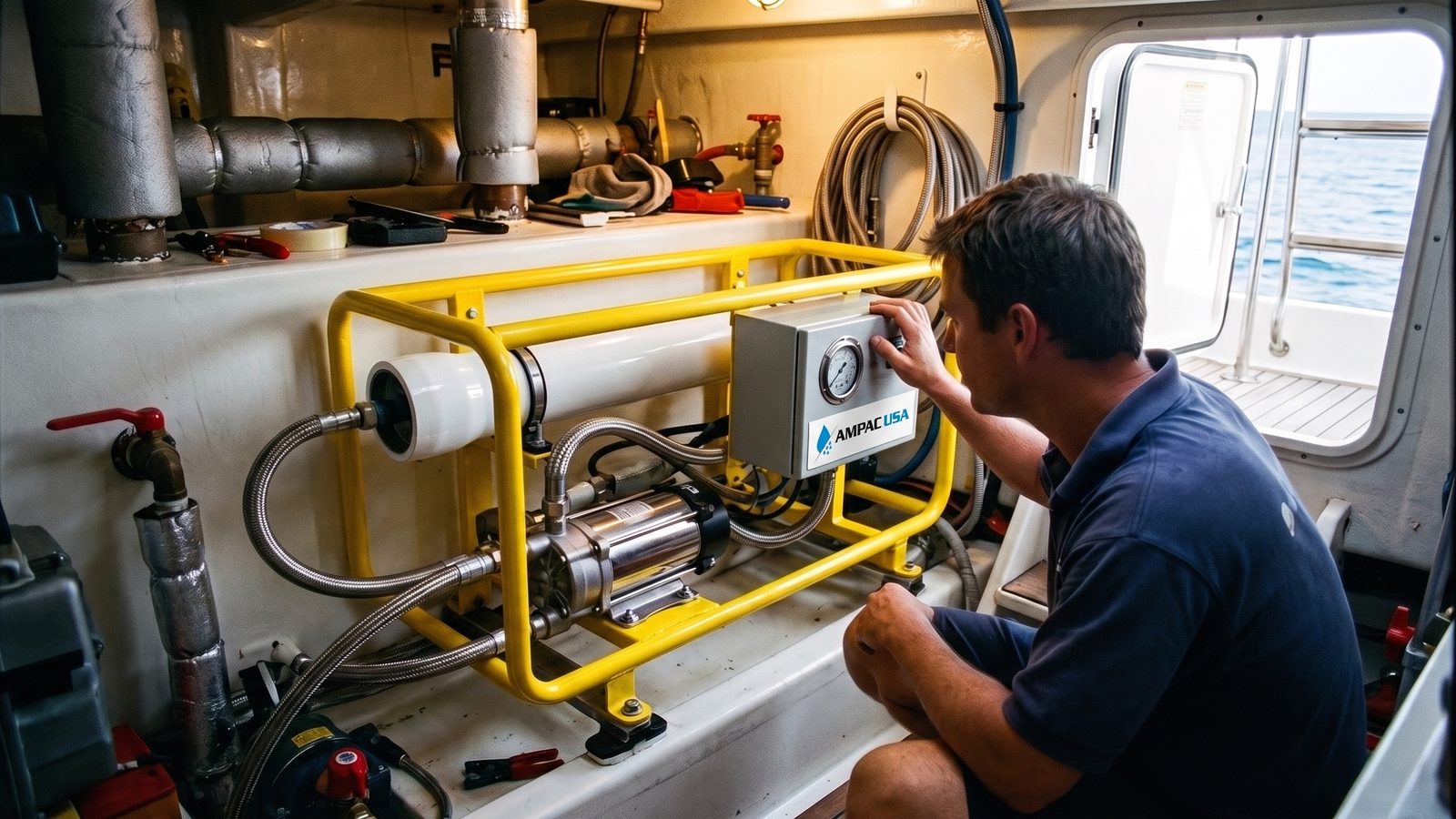
No matter your daily water needs, when you’re looking for the best RO system for boats and yachts, AMPAC USA’s marine watermakers are the clear choice. We’ve learned that off-the-shelf options often don’t cut it. Our systems are built with real care- from strong stainless steel frames to super-efficient membranes- making sure they’re reliable, last a long time, and are truly tough. They give you the most for your money, especially when you think about the rough marine environment. Plus, we can custom build these systems exactly for your needs and your boat’s available space, even for smaller boats with tight spots.
Want to know how we can design, build, and deliver a marine watermaker just for your vessel? Just give us a call at 909-548-4900. Our engineers are ready to figure out your exact water needs and create a system that not only works for you now but can also grow with you later.
Conclusion
Sizing an RO system for a boat comes down to being honest about how you actually live aboard — 6.5 gallons a day covers the basics, but a crew running full liveaboard comfort can burn through 40 gallons per person without thinking twice. Whatever the number, the membrane technology doing the work is the same: thin membranes blocking up to 99% of dissolved solids, backed by proper pre-treatment so scaling and fouling don’t cut that performance short. We’ve been building these systems for over 30 years, so we can help you land on the right size instead of guessing. Read our full breakdown of what makes our marine watermakers reliable, or contact info@ampac1.com or (909) 548-4900 to size a system for your boat or yacht.
Understanding RO for Boats and Yachts (and Beyond)
Good water quality directly affects health, how well things run, and how long your equipment lasts. So, what’s the best RO system for boats and yachts, or really any use? Choosing the right RO system is one of the most important decisions for facility managers, offshore operators, and homeowners alike. At AMPAC USA, we build water treatment systems that handle all kinds of contaminants- from dissolved solids and heavy metals to biological threats and even new compounds. We know our stuff because we’ve been doing this for decades.
Reverse osmosis technology is, simply put, the core of most advanced water treatment. RO membranes are incredibly effective, blocking up to 99% of dissolved contaminants. We’re talking lead, arsenic, nitrates, fluoride, and chlorine byproducts. The semipermeable membrane acts like a super-fine filter, letting only pure water molecules get through. What do you get? Super pure water, right where you need it.
System sizing isn’t a one-size-fits-all thing. It depends on how much water you need daily, how many Total Dissolved Solids (TDS) are in your source water, the water temperature, and how much water you want to recover. Industrial systems can range from 500 GPD (gallons per day) to systems that make millions of GPD. Home units, on the other hand, usually make 50-200 GPD. Here’s a crucial point most people miss: proper pre-treatment is absolutely necessary. This means solid sediment filtration, activated carbon, and antiscalant dosing. Get this right, and you’ll seriously make your membranes last longer and keep your system running at its best. Checking things regularly- like TDS rejection, pressure difference (in PSI), and flow rate- makes sure your system works as it should, helping you avoid expensive downtime.
Frequently Asked Questions
How much water should I plan for per person on a boat or yacht?
Water consumption on a boat or yacht varies significantly based on lifestyle and trip duration. For extreme situations like races, 1.3 gallons per person per day might suffice, while comfortable usage requires about 6.5 gallons. For holidays, plan for around 20 gallons daily, and for a shore-like lifestyle, up to 40 gallons per person per day is recommended.
How do I choose the right marine watermaker for my specific boat or yacht?
The ideal marine watermaker depends on your boat type (motorboat, sailboat, etc.) and your daily water consumption needs. AMPAC USA engineers customize systems to match your specific requirements, considering factors like available space and desired output. We design systems to meet both current and future water demands.
What are the key advantages of choosing an AMPAC USA marine watermaker?
AMPAC USA marine watermakers are engineered for maximum contaminant removal, long-term reliability, and exceptional value. They are super duty, built with meticulous attention to detail, and designed to be long-lasting. Our systems can also be customized to fit even boats and yachts with limited storage space.
What is a marine watermaker and why is it essential for boats and yachts?
A marine watermaker is essentially a reverse osmosis (RO) system specifically designed to convert saltwater into fresh, potable water for use on boats and yachts. It ensures a continuous supply of safe, clean water for drinking, showering, cooking, and other onboard needs, eliminating reliance on shore-based water sources.
What are the primary uses for purified water on a boat or yacht?
On a boat or yacht, purified water from a marine watermaker serves multiple essential purposes. These include drinking, personal hygiene like showers and baths, laundry, cooking, general cleaning, and maintaining a reliable backup water supply for extended voyages or emergencies.
Need a Water Treatment Solution?AMPAC USA engineers custom water purification systems for commercial, industrial, and emergency applications — from 500 GPD to multi-million GPD. Trusted by municipalities, military, and industry worldwide.