
How to Choose the Right Seawater Desalination System: Complete Buyer’s Guide 2026
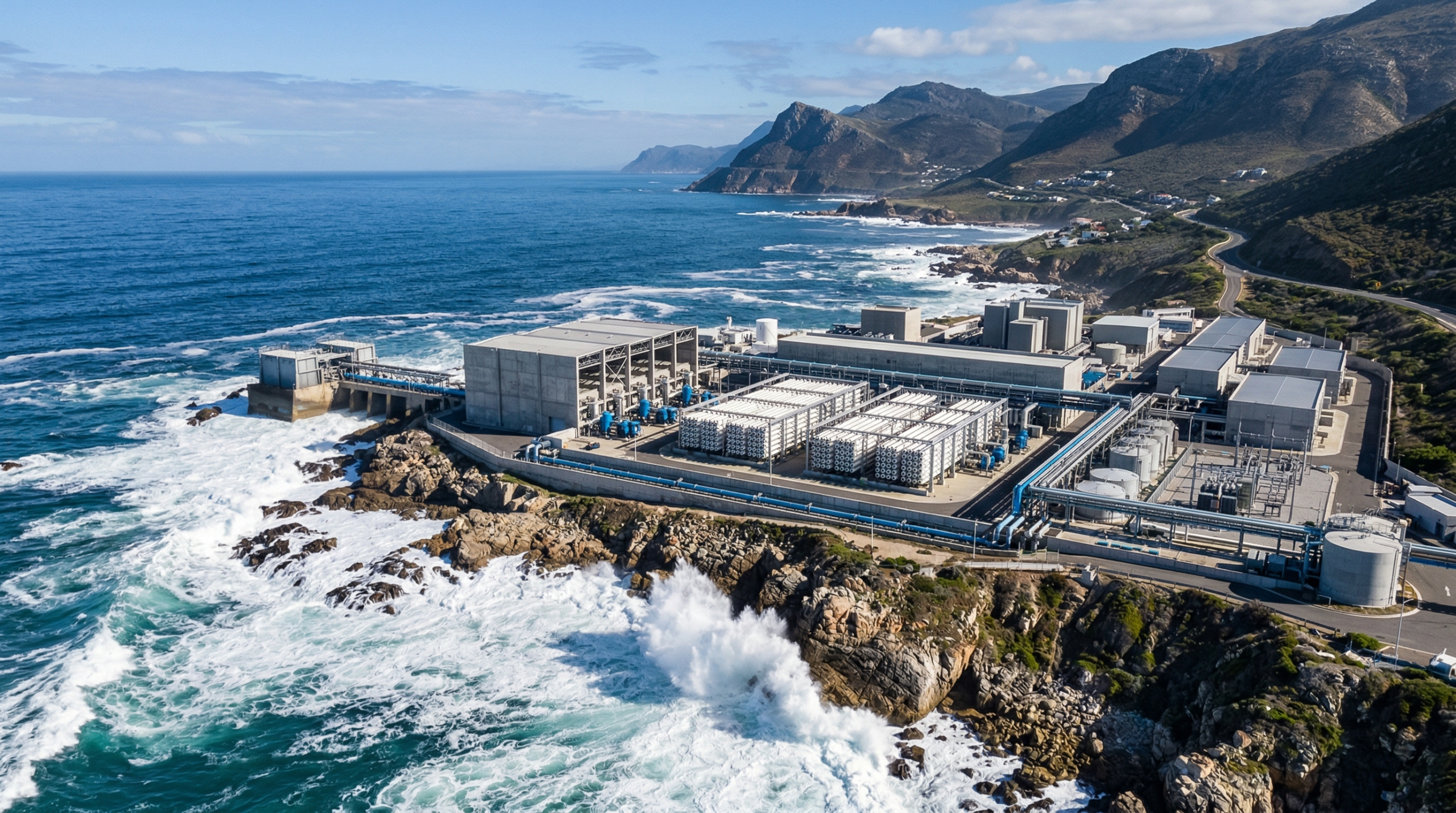
Quick Answer: A seawater desalination system turns ocean water (usually 35,000 ppm TDS) into clean drinking water. It does this using reverse osmosis (SWRO) technology. When you’re picking a system, focus on its capacity (GPD), energy recovery devices, membrane quality, and how it pretreats the water. Residential units cost around $5,000-$15,000. Commercial SWRO systems can run from $50,000 to over $2 million, depending on how much water they make. AMPAC USA builds systems from small 150 GPD watermakers up to huge 600,000+ GPD industrial desalination plants.
Seawater desalination is a really important water treatment technology for our century. The International Desalination Association (IDA) says that by 2025, global desalination capacity topped 130 million cubic meters per day. Reverse osmosis makes up about 69% of all that capacity worldwide. Whether you need a compact watermaker for your boat, a mid-size system for a coastal resort, or a huge municipal desalination plant, picking the right one means looking closely at its specs, how much energy it uses, and its total cost over time.
This full buyer’s guide tells you everything you need to know about seawater reverse osmosis (SWRO) systems in 2026. We’ll cover system types, how to size them, energy recovery tech, membrane choices, pretreatment needs, and a cost-per-gallon breakdown by system size.
How Seawater Desalination Systems Work
Seawater desalination systems use special membranes, like tiny filters, to separate dissolved salts and other stuff from ocean water. This process needs high pressure, usually 800-1,000 psi for seawater, to push the water past the salt. Here’s how a standard seawater RO system works:
- \n
- Intake: Raw seawater comes in from the ocean, either through an open intake or a beach well. \n
- Pretreatment: Filters like multimedia and cartridge filters, plus chemical doses, remove dirt, organic matter, and tiny living things. \n
- High-Pressure Pumping: A strong pump pushes the pretreated water to 800-1,000 psi. \n
- Reverse Osmosis: Water goes through SWRO membranes. These membranes block 99.5-99.8% of the dissolved salts. \n
- Energy Recovery: The salty water that gets rejected still has a lot of energy. Energy recovery devices (ERDs) capture and reuse this. \n
- Post-Treatment: The clean water gets minerals put back in, its pH adjusted, and disinfected so it’s safe to drink. \n
- Storage and Distribution: We store the treated water and then send it out to people who need it. \n
Types of Seawater Desalination Systems
It’s important to understand the different kinds of SWRO systems. That helps you pick the right setup for what you need. We mainly have single-pass and double-pass systems, and each one works best for specific water quality requirements.
Single-Pass SWRO Systems
Single-pass systems run seawater through one set of RO membranes. These are the most common for making general drinking water. They’re a good choice if you’re okay with product water having 200-500 ppm TDS. Single-pass systems cost less upfront, use less energy (typically 2.5-4.0 kWh per cubic meter), and are simpler to operate compared to double-pass setups.
Double-Pass SWRO Systems
Double-pass systems take the clean water from the first pass and send it through a second set of RO membranes. These are usually brackish water membranes that run at 150-300 psi. This process makes ultra-pure water, with TDS below 10 ppm. You’ll need double-pass systems for things like making pharmaceuticals, building semiconductors, boiler feed water, and any other use where the WHO guideline of less than 300 ppm TDS isn’t pure enough. Double-pass systems use more energy, about 3.5-5.5 kWh per cubic meter.
Comparison: Single-Pass vs. Double-Pass SWRO
| Feature | Single-Pass SWRO | Double-Pass SWRO |
|---|---|---|
| Product Water TDS | 200-500 ppm | 1-10 ppm |
| Operating Pressure | 800-1,000 psi | 800-1,000 psi (1st) + 150-300 psi (2nd) |
| Energy Consumption | 2.5-4.0 kWh/m- | 3.5-5.5 kWh/m- |
| Salt Rejection | 99.5-99.7% | 99.9%+ |
| Boron Removal | 85-92% | 99%+ |
| Capital Cost | Lower (baseline) | 30-50% higher |
| Best Applications | Potable water, irrigation | Pharmaceutical, industrial, boiler feed |
Capacity Sizing: How to Determine the Right System Size
Picking the right capacity is one of the most important choices when you buy a seawater desalination system. If it’s too small, you’ll run out of water. If it’s too big, you’re wasting money upfront and on running costs. Think about these things when you’re figuring out how big your system should be:
- \n
- Daily water demand: Calculate how much water you use each day, both at peak times and on average, in gallons per day (GPD). \n
- Recovery rate: SWRO systems usually recover 35-45% of the water, meaning 55-65% becomes salty reject brine. \n
- Redundancy: Plan for an extra 10-20% capacity. That way, you’re covered during maintenance or when demand is high. \n
- Growth projections: Size your system to handle the demand you expect in 5-10 years. This avoids expensive upgrades later. \n
- Climate factors: Warmer seawater (above 25-C) helps membranes work faster, but it might also mean more biological fouling. \n
Key Takeaway: For a town of 1,000 people, you’ll want a system with about 50,000-100,000 GPD capacity. This is based on people using 50-100 gallons of water per day (EPA residential water use estimates). Always add a 15-20% safety margin for when demand spikes.
Capacity Categories and Typical Applications
| System Category | Capacity Range (GPD) | Typical Applications |
|---|---|---|
| Portable / Marine Watermaker | 150-3,000 | Sailboats, yachts, emergency relief |
| Small Commercial | 3,000-20,000 | Small resorts, island communities, remote facilities |
| Mid-Range Commercial | 20,000-100,000 | Hotels, military bases, small municipalities |
| Large Commercial | 100,000-500,000 | Resorts, industrial facilities, large communities |
| Industrial / Municipal | 500,000-10,000,000+ | Municipal water supply, power plants, mining operations |
Energy Recovery Devices: Reducing Operating Costs by 60%
Energy is the biggest cost when you’re desalinating seawater. It makes up 40-60% of what it costs to make water. Energy recovery devices (ERDs) capture the hydraulic energy in the high-pressure salty water that gets rejected. They then send that energy back to the incoming feed water. Modern ERDs can recover 95-98% of the brine stream’s hydraulic energy. This cuts overall energy use by up to 60%.
Types of Energy Recovery Devices
- \n
- Pressure Exchangers (PX): These devices directly move pressure from the salty brine to the incoming feed water. They’re 95-98% efficient. You’ll find them in systems making over 50,000 GPD. Top manufacturers include Energy Recovery Inc. (ERI) and FEDCO. \n
- Turbochargers: These use the brine’s energy to boost the feed pressure. They’re 80-90% efficient. They’re common in mid-size systems (10,000-100,000 GPD). \n
- Pelton Turbines: These turn the brine’s hydraulic energy into mechanical energy, helping the high-pressure pump. They’re 85-92% efficient. Good for smaller systems. \n
- Clark Pump: A piston-like device used in small watermakers (150-1,000 GPD). It’s self-regulating and reliable for boats. \n
Key Takeaway: For any SWRO system making more than 10,000 GPD, an energy recovery device is a must-have. Pressure exchangers are the most efficient (95-98%) and usually pay for themselves in 12-18 months just from the energy savings. Without an ERD, seawater desalination uses about 6-8 kWh/m-. With a modern ERD, that drops to 2.5-3.5 kWh/m-.
Pretreatment Requirements for Seawater Desalination
Good pretreatment is super important. It protects your SWRO membranes and makes sure they work well for a long time. Seawater has dirt, organic stuff, bacteria, algae, and dissolved minerals. Without proper pretreatment, these can foul, scale, or damage your membranes. The pretreatment process should bring the Silt Density Index (SDI) of the feed water down to below 3.0 (ideally below 2.5) before it hits the RO membranes.
\n\n\n\nStandard Pretreatment Components
\n\n\n\n- \n
- Intake Screening: Bar screens and traveling screens remove large debris (seaweed, marine organisms). Mesh size: 3-10 mm. \n
- Coagulation/Flocculation: Ferric chloride or aluminum sulfate dosing aggregates fine suspended particles for easier removal. \n
- Multimedia Filtration (MMF): Gravity or pressure filters with anthracite, sand, and garnet layers remove suspended solids down to 10-20 microns. \n
- Ultrafiltration (UF): Membrane-based pretreatment providing consistent 0.01-0.1 micron filtration. Increasingly preferred over conventional MMF for challenging water sources. \n
- Cartridge Filtration: 5-micron cartridge filters serve as the final safety barrier before the high-pressure pump. \n
- Chemical Dosing: Antiscalant injection prevents calcium and silica scaling; sodium metabisulfite neutralizes residual chlorine that damages polyamide membranes. \n
Conventional vs. UF Pretreatment Comparison
\n\n\n\n| Parameter | Conventional (MMF) | Ultrafiltration (UF) |
|---|---|---|
| Filtrate SDI | 2.5-4.0 | 1.0-2.5 |
| Turbidity Removal | 90-95% | 99%+ |
| Footprint | Larger | 40-60% smaller |
| Chemical Usage | Higher coagulant demand | Lower coagulant demand |
| Capital Cost | Lower for small systems | Higher initial, lower lifecycle |
| Membrane Protection | Good | Excellent |
| Best For | Clean seawater, beach wells | Challenging source water, algal blooms |
TDS Handling: Processing 35,000 ppm Seawater
\n\n\n\nStandard ocean seawater has a total dissolved solids (TDS) concentration of approximately 35,000 ppm (mg/L), though this varies by location. The Arabian Gulf can reach 45,000+ ppm, while the Baltic Sea may be as low as 7,000 ppm. The TDS concentration directly impacts system design, operating pressure, and energy consumption.
\n\n\n\n| Source Water | Typical TDS (ppm) | Required Pressure (psi) | Recovery Rate |
|---|---|---|---|
| Baltic Sea | 7,000-10,000 | 400-600 | 50-60% |
| Mediterranean Sea | 38,000-40,000 | 900-1,050 | 35-42% |
| Atlantic Ocean | 33,000-36,000 | 800-950 | 38-45% |
| Pacific Ocean | 33,000-35,000 | 800-950 | 38-45% |
| Red Sea | 40,000-42,000 | 950-1,100 | 33-40% |
| Arabian Gulf | 42,000-48,000 | 1,000-1,200 | 30-38% |
Higher TDS concentrations require higher operating pressures and result in lower recovery rates. Systems designed for Arabian Gulf water, for example, require more robust high-pressure pumps, stronger pressure vessels, and larger pretreatment capacity compared to systems operating on Atlantic Ocean water.
\n\n\n\nMembrane Selection for Seawater Desalination
\n\n\n\nThe reverse osmosis membrane is the heart of any desalination system. Modern SWRO membranes are thin-film composite (TFC) polyamide membranes designed to withstand the high pressures and aggressive chemistry of seawater applications. Key selection criteria include salt rejection rate, permeate flow rate, boron rejection, and fouling resistance.
\n\n\n\nLeading SWRO Membrane Specifications
\n\n\n\n| Membrane Type | Salt Rejection | Flow Rate (GPD) | Boron Rejection | Best Application |
|---|---|---|---|---|
| Standard SWRO (e.g., Dow SW30HR-380) | 99.7% | 6,000 | 91% | General seawater desalination |
| High Rejection SWRO | 99.8% | 5,500 | 93% | High TDS, boron-sensitive applications |
| Low Energy SWRO | 99.7% | 7,500 | 90% | Energy-sensitive installations |
| High Flow SWRO | 99.7% | 9,000 | 89% | Maximum production per vessel |
| Anti-fouling SWRO | 99.7% | 6,500 | 91% | Challenging feed water with organics |
Membrane manufacturers such as DuPont (Dow FilmTec), Toray, Hydranautics (Nitto), and LG Chem produce SWRO membranes in standard 8-inch diameter by 40-inch length elements, as well as 4-inch elements for smaller systems. AMPAC USA systems are engineered with premium membranes selected specifically for each application’s feed water characteristics.
\n\n\n\nCost-Per-Gallon Analysis by System Size
\n\n\n\nUnderstanding the true cost of desalinated water requires analyzing both capital expenditure (CAPEX) and operational expenditure (OPEX). The cost per gallon decreases significantly with system size due to economies of scale in energy recovery, membrane area utilization, and labor efficiency.
\n\n\n\n| System Capacity (GPD) | Estimated Capital Cost | Energy Cost ($/1,000 gal) | Total Production Cost ($/1,000 gal) | Cost Per Gallon |
|---|---|---|---|---|
| 500 (Marine Watermaker) | $5,000-$12,000 | $12.00-$18.00 | $18.00-$28.00 | $0.018-$0.028 |
| 3,000 | $15,000-$35,000 | $8.00-$14.00 | $14.00-$22.00 | $0.014-$0.022 |
| 10,000 | $45,000-$85,000 | $6.00-$10.00 | $10.00-$16.00 | $0.010-$0.016 |
| 50,000 | $150,000-$350,000 | $4.00-$7.00 | $7.00-$12.00 | $0.007-$0.012 |
| 100,000 | $300,000-$700,000 | $3.50-$6.00 | $6.00-$10.00 | $0.006-$0.010 |
| 500,000 | $1,200,000-$2,500,000 | $2.50-$4.50 | $4.50-$7.50 | $0.0045-$0.0075 |
| 1,000,000+ | $2,000,000-$5,000,000+ | $2.00-$3.50 | $3.50-$6.00 | $0.0035-$0.006 |
Note: Costs based on 2026 market data. Energy costs assume electricity at $0.08-$0.15/kWh. Total production cost includes energy, chemicals, membrane replacement, labor, and maintenance. Actual costs vary by location, feed water quality, and local regulations.
\n\n\n\nKey Takeaway: The cost per gallon of desalinated seawater ranges from $0.004 to $0.028 depending on system size. Systems above 50,000 GPD with energy recovery devices achieve the most economical production costs of $0.005-$0.012 per gallon. The breakeven point where desalination becomes more economical than water trucking is typically around 5,000-10,000 GPD capacity.
\n\n\n\nKey Factors When Purchasing a Seawater Desalination System
\n\n\n\n- \n
- Source Water Analysis: Always conduct a comprehensive water analysis including TDS, temperature, turbidity, SDI, boron, silica, and biological oxygen demand (BOD) before specifying a system. \n
- Energy Availability: Determine available power supply (grid, generator, solar). Systems above 10,000 GPD typically require 3-phase power. Consider solar-hybrid configurations for remote locations. \n
- Environmental Regulations: Brine discharge must comply with local environmental regulations. The EPA and state agencies regulate concentrate disposal, which may require diffuser outfalls, deep well injection, or zero-liquid discharge (ZLD) systems. \n
- Membrane Warranty: Premium SWRO membranes carry 3-5 year prorated warranties. Ensure the system manufacturer provides clear warranty terms and membrane performance guarantees. \n
- Automation Level: Modern systems feature PLC-based controls with SCADA integration, remote monitoring via cellular/satellite, automatic CIP (clean-in-place), and shutdown protection for high pressure, low flow, and high TDS conditions. \n
- Manufacturer Support: Select a manufacturer with proven field experience, available spare parts, commissioning support, and operator training programs. AMPAC USA provides comprehensive commissioning, training, and 24/7 technical support for all desalination systems. \n
- Certifications: Look for NSF/ANSI 61 certification for drinking water components and ensure systems meet local health department requirements. \n
AMPAC USA Seawater Desalination Systems
\n\n\n\nAMPAC USA manufactures a complete range of seawater desalination systems and watermakers designed for marine, commercial, industrial, and municipal applications. Systems range from compact 150 GPD marine watermakers to large-scale 600,000+ GPD industrial desalination plants. All AMPAC systems feature premium SWRO membranes, corrosion-resistant 316L stainless steel and duplex stainless steel construction, energy recovery devices (on applicable models), PLC-based automated controls, and comprehensive pretreatment packages.
\n\n\n\nAMPAC also offers commercial reverse osmosis systems for brackish water applications and industrial RO systems for high-purity water production. Contact AMPAC USA for a custom system quote based on your source water analysis and production requirements.
\n\n\n\n\n📚 References & Further Reading
\n\nFrequently Asked Questions About Seawater Desalination Systems
\n\n\n\nHow much does a seawater desalination system cost?
\n\n\n\nSeawater desalination system costs range from $5,000 for small marine watermakers (150-500 GPD) to over $2 million for large commercial systems (500,000+ GPD). The cost per gallon of production capacity decreases with system size. A mid-range 50,000 GPD system typically costs $150,000-$350,000 installed, producing water at $0.007-$0.012 per gallon.
\n\n\n\nHow much energy does seawater desalination require?
\n\n\n\nModern SWRO systems with energy recovery devices consume 2.5-3.5 kWh per cubic meter (9.5-13.2 kWh per 1,000 gallons) of product water. Without energy recovery, consumption increases to 6-8 kWh per cubic meter. A 100,000 GPD system with an energy recovery device typically requires 150-200 kW of continuous power.
\n\n\n\nWhat is the recovery rate of seawater desalination?
\n\n\n\nSeawater RO systems typically operate at 35-45% recovery rate, meaning 35-45% of the feed water becomes product water and 55-65% is discharged as concentrated brine. Recovery rate depends on feed water TDS, temperature, and membrane configuration. Higher recovery rates increase the risk of membrane scaling and fouling.
\n\n\n\nHow long do SWRO membranes last?
\n\n\n\nSWRO membranes typically last 5-7 years in well-operated systems with proper pretreatment and regular cleaning. Marine watermaker membranes may last 3-5 years due to intermittent use and preservation challenges. Membrane lifespan depends on feed water quality, operating pressure, cleaning frequency, and system design. Budget for membrane replacement every 5 years in your operating cost projections.
\n\n\n\nIs desalinated seawater safe to drink?
\n\n\n\nYes, properly desalinated and post-treated seawater is safe to drink and meets WHO drinking water guidelines. SWRO removes 99.5-99.8% of dissolved salts, bacteria, viruses, and contaminants. Post-treatment includes remineralization (adding calcium and magnesium for taste and health), pH adjustment, and disinfection. The WHO recommends a TDS level below 600 ppm for good quality drinking water, and most SWRO systems produce water well below this threshold.
\n\n\n\nWhat maintenance does a seawater desalination system require?
\n\n\n\nRegular maintenance includes daily monitoring of system parameters (pressure, flow, TDS, pH), weekly chemical dosing system checks, monthly cartridge filter replacement, quarterly membrane cleaning (CIP) with alkaline and acid solutions, annual membrane performance evaluation, and periodic replacement of high-pressure pump seals and O-rings. Well-maintained systems achieve 95%+ uptime reliability.
\n\n\n\n\n\n\n\n
Ready to invest in seawater desalination? AMPAC USA has been manufacturing reverse osmosis and desalination systems for over 20 years, serving customers in 70+ countries worldwide. Browse our complete line of seawater desalination systems and watermakers, or contact our engineering team for a custom system design based on your specific requirements.
\n\n\n\nSources: International Desalination Association (IDA), World Health Organization (WHO) Drinking Water Quality Guidelines, U.S. Environmental Protection Agency (EPA), American Water Works Association (AWWA), National Science Foundation (NSF).
\n\n\nConclusion
\nThis post highlighted how emergency and military-grade water purification systems provide safe drinking water rapidly in the most challenging field conditions. For organizations requiring deployable water treatment capability, AMPAC USA engineers portable and trailer-mounted systems built to perform wherever they are needed. Contact our team at info@ampac1.com or (909) 548-4900 to discuss your emergency water treatment requirements.
\n\n\nBrowse AMPAC USA Seawater Systems: Explore our full range of mobile sea water reverse osmosis and seawater desalination systems from portable watermakers to 1,000,000+ GPD land-based plants.
\n