

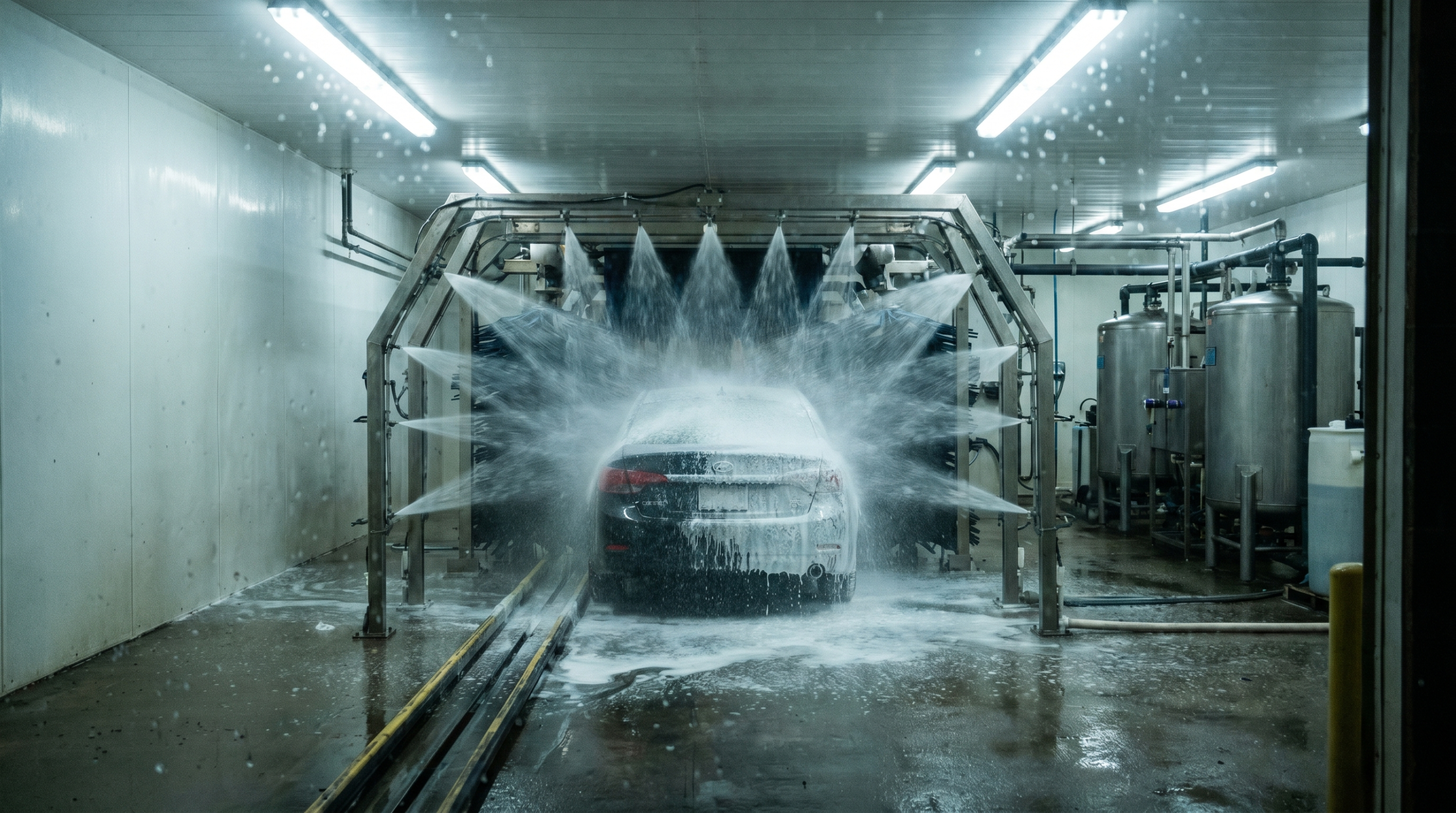

Spot-free rinse is the single biggest differentiator between a car wash that gets repeat customers and one that doesn’t. A vehicle that air-dries with visible water spots sends every customer home frustrated — and to a competitor. Reverse osmosis solves this completely, and it’s why the commercial car wash industry has moved almost universally to RO water for final rinse stages.
Why Car Washes Use Reverse Osmosis Systems
Tap water — even “soft” municipal water — contains dissolved minerals: calcium, magnesium, silica, sodium, and other ions that leave white residue when water evaporates. Total dissolved solids (TDS) in US municipal water averages 150–400 ppm, sometimes higher in western states. When a car dries after a final rinse with TDS water, those dissolved solids stay on the paint surface as visible spots.
Reverse osmosis reduces TDS to 10–30 ppm — well below the 50 ppm threshold where spotting becomes visible to the naked eye. At this TDS level, water evaporates clean. No towel-drying required. No spot-free rinse additive required. The RO membrane does the work.
In addition to spot elimination, RO water is better for your equipment. High-TDS water scale-builds inside spray nozzles, solenoid valves, and heat exchangers, shortening service life. RO-fed equipment runs cleaner longer.
Sizing a Reverse Osmosis System for a Car Wash
RO system sizing for a car wash depends on three variables: car count per day, RO water volume per vehicle (final rinse only), and operating hours. Typical RO water usage for a spot-free final rinse is 2–5 gallons per vehicle. A high-volume tunnel wash running 200 cars per day uses 400–1,000 gallons of RO water daily — with a storage tank buffer to handle peak throughput.
| Car Wash Type | Daily Car Count | Daily RO Water Use | Recommended System |
|---|---|---|---|
| Self-service (4-bay) | 50–100 | 100–300 GPD | 500 GPD system + storage tank |
| In-bay automatic | 100–200 | 300–600 GPD | 800–1,000 GPD system + storage |
| Tunnel wash (mid-volume) | 200–400 | 600–1,500 GPD | 2,000 GPD system + storage |
| High-volume tunnel | 400–800+ | 1,500–4,000 GPD | 4,400–6,000 GPD system + storage |
Storage tank sizing: RO membranes produce water continuously and slowly. A 500-gallon storage tank fed by a 1,000 GPD system fills in roughly 12 hours, giving you 500 gallons of buffer capacity during peak operating hours. For high-volume tunnels, 1,000–2,000 gallon tanks are standard. The repressurization pump pulls from the storage tank and delivers RO water at operating pressure to the spot-free arch.
What a Commercial Car Wash RO System Includes
A complete spot-free rinse RO system for a car wash facility includes:
- Sediment pre-filter (5 micron) — removes particulates that would clog or foul the RO membrane, especially important with municipal water that varies seasonally
- Carbon block pre-filter — removes chlorine and chloramines from municipal supply water, which degrade thin-film composite RO membranes and shorten their service life
- FILMTEC™ thin-film composite RO membrane — rejects 95–99% of dissolved solids at operating pressure; the core of the system
- High-pressure pump — delivers water at 150–250 PSI across the membrane surface; sized to match system output requirements
- Stainless steel storage tank — buffers production rate vs. demand peaks at the spot-free arch
- Booster/repressurization pump — pulls from storage tank and delivers RO water at consistent pressure to the final rinse arch
- TDS meter / conductivity monitor — alerts operators when membrane performance drops below acceptable thresholds (typically >50 ppm TDS output indicates membrane service is due)
Source Water Considerations for Car Wash RO Systems
Municipal water is the simplest source for car wash RO — consistent TDS, chlorinated (which the carbon pre-filter removes), and reliably available. Well water requires additional pre-treatment if iron (above 0.1 ppm), hardness (above 7 GPG), or hydrogen sulfide is present. Iron and hardness both foul RO membranes rapidly without a water softener or iron filtration pre-stage.
High-TDS source water (above 500 ppm) reduces RO membrane output and increases operating cost (more concentrate water discharged per gallon produced). In high-TDS areas like Arizona, Nevada, or parts of Texas, slightly oversizing the RO system compensates for lower recovery efficiency.
RO System ROI for Car Wash Operators
A commercial RO system for a car wash typically pays for itself in 12–24 months through reduced spot-free rinse additive costs, lower equipment maintenance costs, and increased customer retention from a genuinely spot-free result. The ongoing operating cost is primarily filter replacement (sediment and carbon pre-filters every 3–6 months) and membrane replacement (every 2–5 years depending on source water quality and operating hours).
AMPAC USA commercial RO systems for car wash applications are built in the United States with FILMTEC™ membranes, powder-coated aluminum frames, and stainless steel pressure vessels. Systems are factory-tested before shipping and include installation documentation, a commissioning checklist, and lifetime technical support from our water treatment engineers.
Ready to spec a spot-free RO system for your car wash? Contact our engineering team with your daily car count, source water TDS (from your utility’s annual water quality report), and available space — we’ll size and quote the right system within one business day.
Related: Commercial RO System Sizing Guide | RO System Sizing Calculator
Related Articles
- Reverse Osmosis Systems for Hotels: Water Quality, ROI, and Sizing Guide
- Car Wash Water Filtration: Spot-Free RO Systems Sizing and Cost Guide
- American Made Reverse Osmosis Systems: Why US Manufacturing Matters
- Reverse Osmosis Systems for Craft Breweries and Distilleries
Size the right system for your bay count with our commercial reverse osmosis systems built for spot-free rinse water.
Frequently Asked Questions
What TDS level eliminates spotting on cars after a wash?
Below 50 ppm TDS is where visible spotting stops occurring. RO reduces TDS to 10-30 ppm, well below that threshold, so water evaporates clean without towel-drying or spot-free additives.
How much RO water does a car wash use per vehicle?
Typically 2-5 gallons per vehicle for the final spot-free rinse only. A high-volume tunnel wash running 200 cars a day uses 400-1,000 gallons of RO water daily, buffered by a storage tank for peak throughput.
What’s included in a complete car wash RO system?
A 5-micron sediment pre-filter, carbon block pre-filter for chlorine removal, FILMTEC thin-film composite membrane, high-pressure pump, stainless steel storage tank, booster pump, and a TDS meter to alert operators when membrane performance drops.
What is the ROI timeline for a car wash RO system?
Typically 12-24 months, through reduced spot-free rinse additive costs, lower equipment maintenance, and increased customer retention from a genuinely spot-free result.
