

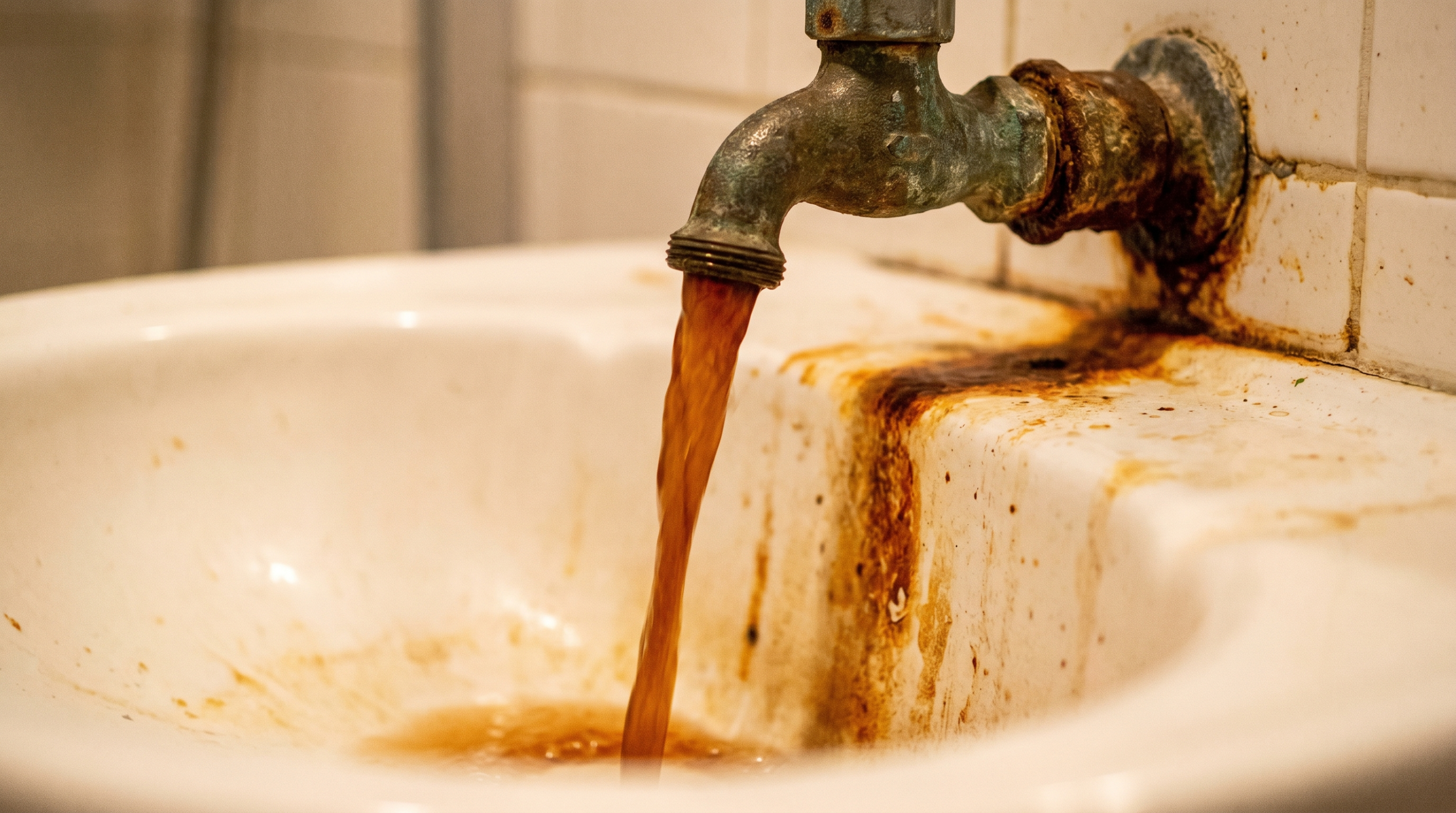

Iron is one of the most common and most disruptive water quality problems for private well owners and facilities drawing from groundwater. It stains fixtures and laundry, produces metallic taste in drinking water, clogs pipes and appliances, and fouls water treatment equipment — including RO membranes — if not addressed upstream. Reverse osmosis removes dissolved iron effectively, but iron’s behavior in water is more complex than most contaminants, and treatment depends on which form of iron you have.
Forms of Iron in Drinking Water
Iron appears in water in several distinct forms that require different treatment approaches:
| Iron Form | Appearance | Also Called | Common Source |
|---|---|---|---|
| Ferrous iron (Fe²⁺) | Clear water — turns red/orange on exposure to air (oxidizes to ferric) | “Clear water iron,” dissolved iron | Deep anaerobic groundwater; most private wells |
| Ferric iron (Fe³⁺) | Red, orange, or brown particles visible in water | “Red water iron,” particulate iron | Oxidized groundwater; shallow wells; old iron pipes |
| Colloidal iron | Red or yellow tint; water may appear hazy; particles too small to settle | Organically complexed iron | Surface water influence; organic-rich groundwater |
| Bacterial iron | Slimy reddish-brown deposits; musty or sewage odor; slime in toilet tank | Iron bacteria (Gallionella, Leptothrix) | Wells with warm water or organic matter; low-oxygen conditions |
Health Effects of Iron in Drinking Water
Iron in drinking water is not regulated as a health-based contaminant by the EPA — the agency’s Secondary Maximum Contaminant Level (SMCL) of 0.3 mg/L is a non-enforceable aesthetic guideline based on taste, color, and staining, not health risk. At normal levels found in US groundwater (0.1–10 mg/L), iron is not acutely toxic.
That said, elevated iron does cause real operational and health-adjacent problems:
- Metallic taste: Detectable at concentrations above 0.3 mg/L; becomes strongly unpleasant above 1–2 mg/L
- Red/orange staining: Toilets, sinks, tubs, laundry — permanent staining begins at 0.3 mg/L. Above 1 mg/L, staining is rapid and severe
- Appliance damage: Iron deposits in water heaters, dishwashers, and washing machines shorten equipment life and require chemical descaling
- Iron bacteria: Not directly harmful to healthy adults, but iron bacteria biofilms in plumbing create conditions favorable to Legionella growth and produce hydrogen sulfide odors
- Pipe plugging: Long-term iron deposits in distribution piping reduce flow and eventually require pipe replacement
Does Reverse Osmosis Remove Iron?
Yes — with important caveats depending on iron form and concentration:
| Iron Form | RO Rejection Rate | Notes |
|---|---|---|
| Ferrous (dissolved, Fe²⁺) | 95–98% | RO rejects dissolved ferrous iron effectively. However, iron above 0.05–0.1 mg/L in RO feed water oxidizes and precipitates on the membrane surface, causing rapid fouling. Pre-oxidation + filtration required above these thresholds. |
| Ferric (particulate, Fe³⁺) | 99% (mechanical filtration) | Ferric iron particles are removed by the 5-micron pre-filter before reaching the membrane. A pre-filter alone handles ferric iron — this is not a membrane-level removal. |
| Colloidal iron | 90–99% | Colloidal iron passes through standard 5-micron pre-filters. Requires coagulation, ultrafiltration, or green sand filtration upstream. Organically complexed iron is the most difficult form to remove and can foul membranes. |
| Bacterial iron | N/A — requires disinfection | RO membranes do not kill iron bacteria. Shock chlorination of the well + UV disinfection required before RO treatment. |
The critical rule for iron and RO membranes: Total iron in RO feed water should be below 0.05 mg/L (0.05 ppm). Iron oxidizes in the high-recovery environment inside an RO pressure vessel and precipitates directly on the membrane surface — a form of fouling called iron fouling that is extremely difficult to clean and rapidly destroys membrane performance. If your well water has iron above 0.1 mg/L, iron pre-treatment before the RO system is not optional.
Iron Pre-Treatment for RO Systems
The correct pre-treatment depends on iron concentration and form:
- Iron 0.1–1.0 mg/L, ferrous (clear water iron): Oxidizing filter (green sand filter with potassium permanganate or chlorine injection + contact tank) converts ferrous to ferric, which is then filtered out before the RO membrane. Alternatively, birm or catalytic carbon filter if dissolved oxygen is sufficient.
- Iron above 1.0 mg/L: Aeration + retention tank to oxidize iron, followed by sand or multimedia filter, followed by RO. For very high iron (above 5 mg/L), a dedicated iron removal system before RO is essential.
- Colloidal iron: Coagulation-filtration or ultrafiltration before RO. Standard sediment filters pass colloidal iron.
- Iron with hardness (common in well water): Water softener after iron filter but before RO — iron fouls cation exchange resin at elevated concentrations, so iron must be removed first. Softener then protects the RO membrane from hardness scaling.
- Iron with hydrogen sulfide (H₂S): H₂S (rotten egg odor) frequently co-occurs with iron in anaerobic groundwater. Aeration removes H₂S; oxidizing filtration handles both iron and manganese in the same stage.
Iron Treatment Options Compared
| Technology | Iron Removal | Best For | Limitations |
|---|---|---|---|
| Oxidizing filter (green sand, birm) | 90–99% ferrous + ferric | Point-of-entry; whole house or facility; 0.3–10 mg/L iron | Requires periodic regeneration (KMnO₄) or backwash; manganese catalyst depletes over time |
| Aeration + sand filtration | 90–99% ferrous + ferric | High iron (above 5 mg/L); large flow rates | Space requirements; requires blower or spray aeration; not suitable for H₂S (H₂S re-dissolves) |
| Water softener | Up to 2–3 mg/L ferrous | Low iron + high hardness; secondary benefit | Iron fouls resin above 2–3 mg/L; requires frequent regeneration; not a primary iron treatment |
| Reverse osmosis (with iron pre-treatment) | 95–98% residual dissolved iron | Point-of-use polishing after upstream iron treatment; combined contaminant removal (iron, TDS, arsenic, hardness) | Requires iron below 0.05–0.1 mg/L in feed water; not suitable as sole iron treatment at high concentrations |
| Chlorination + filtration | 99%+ ferrous + ferric | Municipal-scale; high iron + bacteria co-treatment | Requires chlorine residual management; not practical for residential scale without chemical handling |
Testing Your Water for Iron
Iron testing should report:
- Total iron — the regulatory reference number
- Ferrous (dissolved) vs. ferric (particulate) — determines pre-treatment type (must collect sample in an airtight container immediately from the tap to preserve ferrous)
- Manganese — frequently co-occurs with iron; often treated by the same oxidizing filter; EPA SMCL is 0.05 mg/L
- pH — iron removal efficiency via aeration or oxidizing filtration is strongly pH-dependent; optimal above 7.0
- Hydrogen sulfide — if you smell rotten egg odor, request H₂S testing
AMPAC USA RO Systems for Iron-Containing Water
AMPAC USA commercial and residential RO systems are frequently specified as the final polishing stage in well water treatment trains that include upstream iron removal. Our engineering team can review your water test results and specify the complete pre-treatment sequence — iron filter, softener, sediment pre-filter, carbon block, and RO — as a coordinated system rather than independent components.
For facilities and residences with complex well water (iron + arsenic + hardness, or iron + nitrates + TDS), RO is often the most economical single-stage polisher once iron has been removed upstream.
Well water testing showing elevated iron? Share your full water test — including iron speciation, pH, hardness, and TDS — and we’ll specify the right pre-treatment and RO configuration. Contact AMPAC USA for a free technical consultation.
Related: Nitrate Removal by Reverse Osmosis | Arsenic Removal by Reverse Osmosis | Whole House RO Systems
Related Articles
- Nitrate Removal by Reverse Osmosis: Well Water Treatment Guide | AMPAC USA
- Chromium-6 in Drinking Water: Reverse Osmosis Removal Guide | AMPAC USA
- Lead in Drinking Water: How Reverse Osmosis Removes Lead | AMPAC USA
- Fluoride Removal by Reverse Osmosis: Does RO Filter Fluoride? | AMPAC USA
Frequently Asked Questions
Does reverse osmosis remove iron from well water?
Yes, RO rejects dissolved ferrous iron at 95-98 percent, but iron above 0.05-0.1 mg/L in the feed water oxidizes and precipitates on the membrane surface, causing rapid fouling. Pre-oxidation and filtration are required above these thresholds before RO is used as a polishing step.
What’s the difference between ferrous and ferric iron in water?
Ferrous iron (Fe2+) is dissolved and appears as clear water that turns red or orange on exposure to air. Ferric iron (Fe3+) is particulate and appears as visible red, orange, or brown particles. Each requires a different treatment approach.
How much iron can RO membranes tolerate before fouling?
Total iron in RO feed water should be below 0.05 mg/L. Iron oxidizes inside the high-recovery RO pressure vessel and precipitates directly on the membrane surface, a fouling type that is extremely difficult to clean and rapidly destroys performance.
What pre-treatment does high-iron well water need before RO?
For iron between 0.1 and 1.0 mg/L, an oxidizing filter (green sand with potassium permanganate or chlorine injection) converts ferrous to ferric iron for filtering out. Above 1.0 mg/L, aeration plus a retention tank followed by sand filtration is typically needed before the RO stage.
