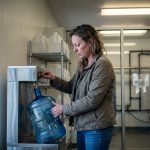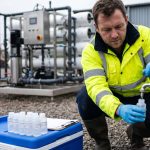



New Jersey requires private well water to be tested for arsenic and other contaminants before a home is sold or leased. That part works. Since the Private Well Testing Act took effect in 2002, upward of 80,000 wells have been tested, and in the parts of the state where arsenic-bearing bedrock sits close to the surface, roughly one in five comes back over the legal limit. What the law does not do is make anyone fix it. Follow-up surveys of homeowners who tested positive found that 28% took no action at all to reduce their exposure, even after being handed a lab result that said their water wasn’t safe to drink.
That gap, tested and told versus actually treated, is the real story of the PWTA. It’s a well-designed disclosure law sitting on top of a weak enforcement mechanism, and it’s worth understanding both halves if you live on a well anywhere in the state, or honestly anywhere in the country where testing laws exist but treatment doesn’t.
What Does New Jersey’s Private Well Testing Act Actually Require?
The PWTA requires an untreated water sample to be tested for a list of primary and secondary contaminants, arsenic included, whenever a property with a private well is sold or newly leased. For sales, the buyer or seller arranges the test and both parties see the results before closing. For rentals, the landlord pays for it, has to retest every five years, and must hand tenants a copy of new results within 30 days of getting them.
That’s the entire mandate. There is no statewide requirement to test a well on a fixed schedule if you’re not selling or renting, no requirement to install treatment if arsenic comes back high, and no follow-up mechanism once the sale closes. The law was built to fix an information problem, buyers and tenants deserve to know what’s in the water before they move in, and it does that well. It was never built as a treatment mandate, and that distinction matters more than it sounds like it should.
How Common Is Arsenic in New Jersey Well Water, Really?
In the areas of the state where testing has been targeted at higher-risk geology, arsenic above New Jersey’s 5 micrograms-per-liter standard, one-tenth the old federal number, has shown up in roughly one in five untreated wells, and in some targeted sampling efforts, well over half. A study of 279 untreated well samples in one high-risk area found 62.4% exceeded the state limit.
New Jersey’s 5 µg/L standard is intentionally stricter than the EPA’s 10 µg/L federal MCL, and it’s been in place since 2006. That’s worth flagging because plenty of the households living with elevated arsenic don’t know the standard changed. Surveys of well owners in affected areas found many were aware their region had a known arsenic problem in general, but had no idea the state’s legal threshold had been cut by 90% two decades ago. A number that used to be “fine” isn’t anymore, and nobody sent a follow-up notice to homes tested under the old rule.
Roughly 1.1 million New Jersey residents, about 11 to 13% of the state, get their drinking water from one of an estimated 400,000 private wells. None of those wells are regulated the way a public utility’s water supply is. The PWTA is the only checkpoint most of them will ever hit.
Do People Actually Treat Their Water After Testing Positive?
Not consistently, and the data on this is more specific than a general impression. In a follow-up survey of New Jersey households whose PWTA-required test came back above the state arsenic MCL, treatment system use was reported by 63% of respondents, but only 15% reported both installing treatment and following through on the maintenance and monitoring that keeps it working. Meanwhile 28% reported taking no protective action of any kind, meaning they kept drinking untreated well water with a documented arsenic exceedance.
That 15% number is the one that should worry anyone thinking about this as a public health system rather than a paperwork requirement. A reverse osmosis or whole-house arsenic treatment system that isn’t maintained isn’t protecting anyone. Filter media has a service life. Pre-treatment components need periodic replacement. A system installed the month after a bad test and never touched again is, within a couple of years, functionally the same as no system at all, except the household now believes it’s safe.
There’s a second wrinkle here too. Research on installed whole-house arsenic treatment systems in New Jersey homes found that microparticles of the arsenic-removal media itself had escaped into the treated water in 71% of the systems tested. Installing a system is necessary but it isn’t sufficient. The system has to be the right one for the household’s specific water chemistry, and it has to be checked, not just installed and forgotten.
Why Do So Many Homeowners Skip Treatment After a Positive Result?
Cost is the obvious answer, and it’s a real one, whole-house arsenic treatment isn’t cheap, and PWTA testing happens at exactly the moment, mid-real-estate-transaction, when a household has the least appetite for another five-figure line item. But cost alone doesn’t explain the awareness gap underneath it.
A meaningful share of well owners who tested positive genuinely didn’t understand what the number on their lab report meant. They knew “arsenic” was bad in the abstract. They didn’t necessarily know their result was above a legal standard, what health risk that represented over years of exposure, or that the standard itself had gotten six times stricter since 2006. The PWTA delivers a number. It doesn’t reliably deliver the context that turns a number into a decision to act.
There’s also a structural timing problem. The test happens at closing, often the single busiest, most expensive month of a household’s year. A positive arsenic result competes for attention with movers, mortgage paperwork, and a hundred other line items. Without a mandated follow-up, a nudge at month six, a reminder at year one, there’s nothing pulling that decision back into focus once the transaction is done.
What Actually Works for Removing Arsenic from Well Water?
Reverse osmosis is the most consistently effective residential technology for arsenic removal, capable of reducing both the more common arsenate and the harder-to-remove arsenite forms when the system is sized and installed correctly for the specific well’s water chemistry. That “correctly” is doing real work in that sentence. Arsenic occurs in two different oxidation states, and pretreatment or oxidation may be needed depending on which form dominates in a given well, which is exactly the kind of detail a generic under-sink filter from a hardware store won’t handle.
For households on AMPAC USA’s residential reverse osmosis systems, the point is straightforward: RO membrane technology is built to reject dissolved contaminants like arsenic at the molecular level, not just filter out sediment. It’s the same underlying principle municipal and industrial reverse osmosis systems use at scale, sized down for a home’s kitchen tap or, for whole-house coverage, a point-of-entry configuration.
The maintenance piece matters as much as the install. A system needs periodic filter and membrane changes on a schedule, not “whenever it seems like it might need it.” Given that only 15% of households in the New Jersey follow-up survey reported proper maintenance and monitoring alongside treatment, that’s arguably the bigger lever to pull than getting more people to install a system in the first place. A well-maintained system that’s actually running is worth more to public health than ten systems gathering dust under a sink two years after a positive test.
What Should NJ Well Owners Do If They Just Got a Positive PWTA Test?
Confirm what form of arsenic contamination applies, ask the testing lab or a water treatment professional to interpret the specific number against the current 5 µg/L state standard, not the old 50 µg/L federal one some longtime well owners still remember. Then treat the result as a decision point, not paperwork to file away. If a household is going to install treatment, matching the system to the well’s actual chemistry (arsenic species, pH, co-occurring contaminants like iron or manganese that can affect removal) makes the difference between a system that works and one that technically exists.
And critically: put maintenance on a calendar. Not “check it sometime.” A specific date, tied to the manufacturer’s recommended service interval, the same way anyone would schedule a car’s oil change. The PWTA gets a household to the starting line. Nothing in the law walks them through the next five years.
Frequently Asked Questions
Does the New Jersey Private Well Testing Act require me to treat my water if arsenic is found?
No. The PWTA requires testing and disclosure at the point of sale or lease, not treatment. Whether a household installs a treatment system after a positive result is entirely up to them, which is a major reason the law catches contamination without necessarily fixing it.
How often does New Jersey well water actually test positive for arsenic?
It varies sharply by region, since arsenic in NJ groundwater comes largely from local bedrock geology. In areas targeted for higher risk, roughly one in five untreated wells has exceeded the state’s 5 µg/L standard, and some targeted studies found exceedance rates above 60%.
Is New Jersey’s arsenic standard the same as the federal EPA standard?
No, New Jersey’s standard is 5 micrograms per liter, adopted in 2006, compared to the EPA’s federal limit of 10 micrograms per liter. Some well owners tested under the older 50 µg/L standard may not realize the legal bar has since dropped by 90%.
Are homeowners who install arsenic treatment systems maintaining them properly?
Not reliably. In a New Jersey follow-up study of households with confirmed arsenic exceedances, only 15% reported both using treatment and following proper maintenance and monitoring practices, while 63% reported using treatment at all. Separately, research on installed systems found arsenic-removal media particles had escaped into treated water in 71% of tested homes, underscoring that installation alone doesn’t guarantee ongoing protection.
What’s the most effective way to remove arsenic from private well water?
Reverse osmosis is the most consistently effective residential approach, since RO membranes reject dissolved arsenic at the molecular level rather than simply filtering sediment. Because arsenic exists in different chemical forms depending on a well’s water chemistry, a system should be matched to the specific well, not chosen off a generic shelf model, and paired with a fixed maintenance schedule.
Sources: NJDEP Private Wells Program; NJDEP Private Wells – Arsenic; Flanagan et al., “Health protective behavior following required arsenic testing under the New Jersey Private Well Testing Act,” ScienceDirect / PMC6219474; “Arsenic in Private Well Water Part I: Impact of the New Jersey Private Well Testing Act on Household Testing and Mitigation Behaviors,” PMC5204457; “Targeted Private Well Outreach Following a Change in Drinking Water Standard,” PubMed 36070573; “Twenty years of private well testing in New Jersey,” IWA Publishing, Water Policy.
Related AMPAC USA resources: Residential Reverse Osmosis Systems | Reverse Osmosis Technology
AMPAC USA engineers custom water purification systems for commercial, industrial, and emergency applications — from 500 GPD to multi-million GPD. Trusted by municipalities, military, and industry worldwide.