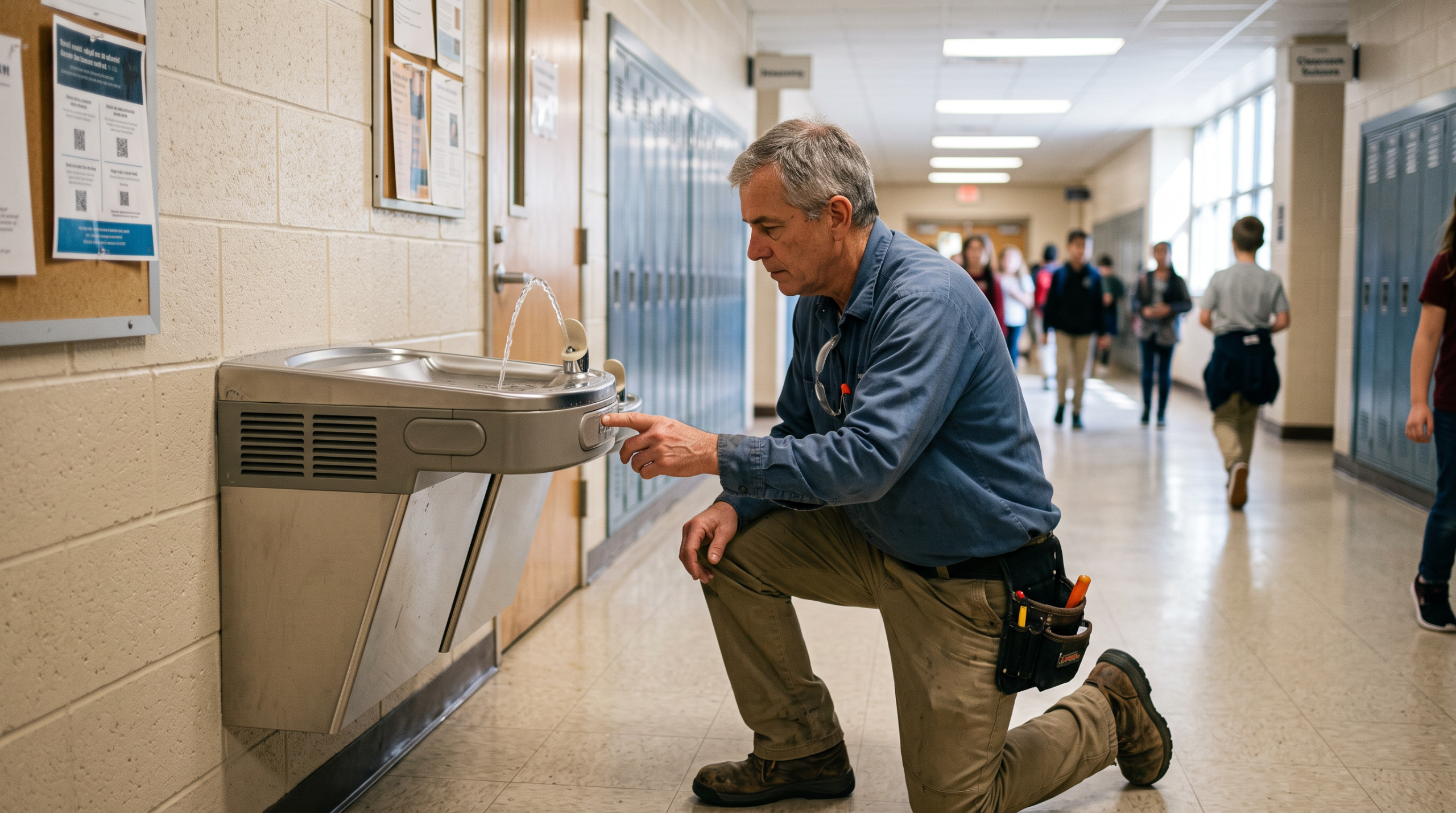

In short: lead in school drinking water is not a solved problem. When the U.S. Government Accountability Office surveyed school districts nationwide, an estimated 43% had tested their water for lead, and among those that tested, 37% found elevated levels. Most of the fixtures and pipes responsible are decades old, and there is no federal law requiring every school in the country to test. EPA’s own position is blunt: there is no known safe level of lead exposure for children. Filtration at the point of use, not just testing, is what actually gets lead out of the water a kid drinks.
That gap between “we found lead” and “we fixed it” is where a lot of schools still sit. Testing tells you there’s a problem. It doesn’t remove a single microgram from the water.
Why Does Lead Even Get Into School Drinking Water?
Lead gets into school water almost never from the source supply itself. It leaches in on the way to the tap, from lead service lines, lead solder joining older copper pipe, and brass fixtures and water fountains that were legal to install with lead components until 1986, and weren’t required to be truly “lead-free” (under 0.25% lead content) until 2014.
School buildings sit right in the crosshairs of that timeline. A huge share of U.S. public school buildings were constructed before 1970, long before either standard existed, and a lot of them still carry original or early-replacement plumbing. Water that sits stagnant overnight, over a weekend, or across a summer break picks up more lead from that old plumbing the longer it sits, which is part of why levels in the same fountain can test fine one week and elevated the next depending on when the sample is drawn.
How Widespread Is the Problem, Actually?
Wide enough that it shows up every time someone actually looks. The GAO’s national survey found 37% of school districts that tested for lead found elevated levels, and that was drawn from districts serving roughly 35 million students. That’s not a handful of unlucky buildings, it’s a pattern.
It also keeps surfacing state by state. New York’s public schools are required to test every potable outlet and act on anything above 5 parts per billion, and elevated results still turn up in that state’s public results dashboard year after year. Washington, Maryland, and Idaho have all had individual schools flag elevated lead in 2025 testing rounds, in some cases well above the 15 ppb action level EPA and many states use as a trigger for remediation. Minnesota built a public map in 2025 specifically so parents could look up their own kid’s school.
None of this means lead is spiking. It means the plumbing has been there the whole time, and testing is finally catching up to it in more places.
Why Does Aging School Infrastructure Make This Worse?
Because lead risk and building age move together, and American school buildings are old. GAO’s broader infrastructure survey found 54% of public school districts need to update or replace multiple building systems, and that pattern extends straight into the water lines feeding drinking fountains and kitchen taps. A fixture installed in 1975 wasn’t held to any lead-free standard at all. A fixture installed in 1990 might still contain up to 8% lead by weight, since the pre-2014 “lead-free” definition allowed far more lead than today’s rule does.
Renovation and deferred maintenance cut both ways here. Disturbing old pipe during a partial remodel can knock loose scale and increase lead release temporarily. But leaving 50-year-old fixtures untouched because a full renovation isn’t budgeted just keeps the source in place. Neither option removes lead from water that’s already sitting in the line, which is the actual reason filtration at the tap matters regardless of what state the building’s infrastructure is in.
Is There a National Requirement to Test School Water for Lead?
No, and that’s a big part of why results vary so much by state. There is no federal law mandating that every U.S. school test its drinking water for lead. EPA’s own accounting puts it at roughly 8 states requiring school lead testing outright, with about 13 more supporting voluntary district testing through funding or in-kind help. Everywhere else, testing happens if a district chooses to do it, or not at all.
EPA runs a voluntary program called 3Ts, Training, Testing, and Taking Action, that gives districts a testing and remediation framework since there’s no mandate forcing them to use one. Since 2019, that program has helped get water tested at nearly 13,000 schools and over 20,000 child care facilities, with about 2,500 schools completing remediation work. EPA announced $26 million in new 3Ts funding in June 2025 and selected projects for over $35 million more in January 2026. That’s real money moving, but it’s still opt-in. A district that never applies for funding or never tests simply doesn’t generate a data point, which means the true national number is almost certainly higher than what shows up in any published survey.
What Actually Removes Lead From Drinking Water?
Filtration certified specifically for lead removal, applied at or near the point of use. Not all filters do this. A basic carbon filter marketed for taste and odor may do very little for dissolved lead unless it’s specifically certified under NSF/ANSI 53 for lead reduction. Reverse osmosis membranes are one of the most reliable technologies for this, because the membrane physically rejects dissolved metals including lead along with a wide range of other contaminants, rather than relying on adsorption alone.
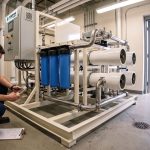
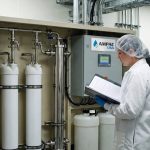
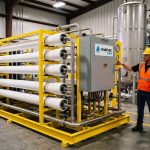
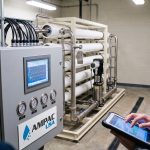
For a whole campus, that means thinking past a single filtered fountain and toward the building or district level. This is where a system like AMPAC’s commercial reverse osmosis system comes in. It’s built to treat higher volumes consistently across multiple outlets, kitchens, fountains, classroom filling stations, rather than depending on point-of-use pitchers or individual faucet attachments that need constant cartridge tracking across dozens of locations. For districts weighing options, our reverse osmosis page breaks down how the technology works and where it fits relative to simpler carbon filtration.
Flushing outlets before use (running water for a set period after it’s sat stagnant) is a legitimate short-term mitigation step, and it’s part of what EPA’s 3Ts guidance recommends. But flushing doesn’t fix the source, it manages around it, and it has to be repeated correctly every single morning to matter. Filtration removes the risk regardless of whether that morning routine happens.
What Should Parents and School Administrators Actually Do With This?
Ask for the district’s most recent test results by building, not just a district-wide summary, since lead risk is fixture-specific and can vary fountain to fountain in the same school. If a district hasn’t tested, ask why, and ask whether they’ve applied for 3Ts funding through their state. If elevated results exist, ask what remediation step was taken: a flushing schedule is not the same thing as a filter, and a filter is not the same thing as a confirmed re-test showing levels came down.
For any building with older plumbing (which, statistically, is most of them), certified point-of-use or point-of-entry filtration is the only step that reliably closes the gap between finding lead and actually removing it from the water kids drink every day.
Frequently Asked Questions
Is there a safe level of lead in school drinking water?
No. EPA and CDC both state there is no known safe level of lead exposure for children. Action levels like 15 ppb (EPA) or 5 ppb (used by states like New York) are regulatory triggers for remediation, not a threshold below which lead is considered harmless.
How common is elevated lead in school water testing?
In GAO’s national survey of school districts, 37% of districts that tested for lead found elevated levels, out of districts serving an estimated 35 million students combined.
Does my state require schools to test for lead in drinking water?
It depends. EPA estimates roughly 8 states mandate school lead testing, with about 13 more offering funding or support for voluntary testing. The remaining states have no requirement, so check with your specific school district or state health department.
Does boiling water remove lead?
No. Boiling water actually concentrates lead as the water evaporates, it does not remove it. Filtration certified for lead reduction, such as NSF/ANSI 53-certified filters or reverse osmosis, is required to physically remove lead from water.
What’s the difference between flushing a fountain and filtering it?
Flushing runs out water that sat stagnant in old pipes overnight, temporarily lowering lead levels for that use, but it has to be done correctly every day and doesn’t address the source. Filtration removes lead from the water regardless of how long it sat, providing a consistent barrier at the point of use.
Sources: U.S. Government Accountability Office (GAO-18-382, gao.gov); U.S. EPA 3Ts for Reducing Lead in Drinking Water in Schools and Child Care Facilities (epa.gov); U.S. EPA newsroom, June 2025 and January 2026 funding announcements (epa.gov); CDC Childhood Lead Poisoning Prevention, Blood Lead Reference Value (cdc.gov); New York State Department of Health, Lead Testing of School Drinking Water; Minnesota Department of Health, 2025 school lead testing map.
AMPAC USA engineers custom water purification systems for commercial, industrial, and emergency applications — from 500 GPD to multi-million GPD. Trusted by municipalities, military, and industry worldwide.