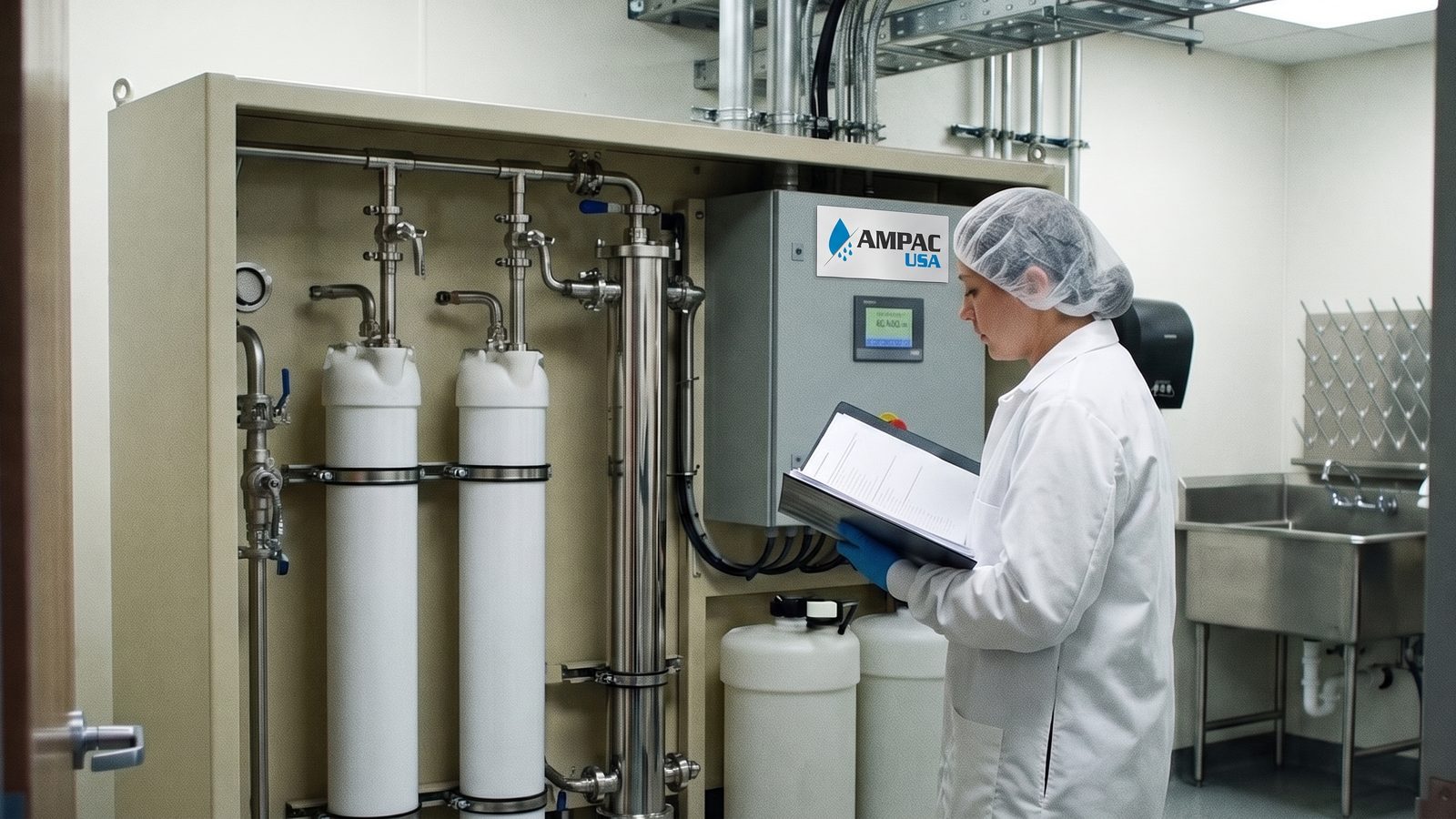

A cell-and-gene therapy suite can’t run on the same water spec as a QC glassware sink, but facility engineers are increasingly asked to plan both under one roof. Demand for the water in between — Type I and Type II lab-grade ultrapure water — is climbing faster than most capital plans account for, and the mismatch shows up during commissioning, not during the RFP.
This guide walks through why demand is accelerating, what Type I, Type II, and Type III water actually mean under ASTM D1193, and how to size a system against real lab applications instead of a generic “high purity” line item.
TL;DR: The ultrapure water market is projected to grow from $11.52B in 2025 to $12.88B in 2026, an 11.8% CAGR (Research and Markets, 2026), with cell-and-gene therapy and HPAPI facility build-outs among the fastest-growing demand drivers. Facility engineers should match ASTM D1193 water type — not just flow rate — to each lab application before sizing a system.
How Fast Is Ultrapure Water Demand Actually Growing?
The global ultrapure water market is projected to grow from $11.52 billion in 2025 to $12.88 billion in 2026, an 11.8% compound annual growth rate, and to reach $20.11 billion by 2030 (Research and Markets, 2026). Pharmaceutical and life-science demand sits alongside semiconductor fabrication as a primary driver of that curve, not a secondary one.
The pharmaceutical water segment specifically was valued at $38.70 billion in 2023 and is projected to reach $107.15 billion by 2034, a 9.25% CAGR, with the U.S. market alone growing from $7.11 billion in 2024 to a projected $17.04 billion by 2034 (Towards Healthcare, 2026). That report names biosimilars, monoclonal antibodies, and cell and gene therapies explicitly as the products pulling water demand upward fastest.
Why Are Cell and Gene Therapy Build-Outs Driving the Surge?
Cell and gene therapy manufacturing is the fastest-growing subsegment of biopharma water demand because every new facility needs a validated ultrapure water source before it can run a single batch. The cell and gene therapy manufacturing market is projected to grow from $6.86 billion in 2026 to $26.59 billion by 2035, a 16.25% CAGR (BioSpace/Towards Healthcare, 2026).
Unlike small-molecule drug manufacturing, CGT processes are cell-based and endotoxin-sensitive at nearly every step — media prep, cell washing, viral vector production, and final formulation all draw on lab-grade or pharmaceutical-grade water. Facility teams building out CGT suites are specifying ultrapure water capacity earlier in the design phase than earlier drug-manufacturing generations did, because a single out-of-spec water event can compromise an entire patient-specific batch.
What Role Does HPAPI Manufacturing Play in the Demand Curve?
Highly potent API (HPAPI) manufacturing is a second, separate driver: the global HPAPI market is projected to grow from $33.45 billion in 2026 to $69.13 billion by 2035, an 8.4% CAGR, driven largely by antibody-drug conjugates and targeted oncology compounds (BioSpace, 2026).
HPAPI facilities are containment-first by design — isolators, downflow booths, dedicated air handling — and every one of those systems still needs a validated water source for cleaning, formulation, and analytical QC. As CDMOs expand HPAPI capacity in the U.S. and Europe, each new suite adds another point-of-use demand for Type I or USP-grade water, on top of the water already required for the facility’s core manufacturing train.
Type I, Type II, and Type III Lab Water: What the ASTM D1193 Grades Actually Mean
ASTM D1193, Standard Specification for Reagent Water, defines four water grades by resistivity, conductivity, and organic and ionic contamination limits — not by the technology used to produce them (ASTM International). Type I is the purest grade and the one most GMP lab applications require; Type II and Type III support lower-sensitivity uses and typically feed the polishing stage that produces Type I.
| Grade | Resistivity (min) | Conductivity (max) | TOC (max) | Typical Production Method |
|---|---|---|---|---|
| Type I | 18.0 MΩ·cm at 25°C | 0.056 µS/cm | 50 ppb | RO → mixed-bed ion exchange → 0.2-micron filtration |
| Type II | 1.0 MΩ·cm at 25°C | 1.0 µS/cm | 50 ppb | Distillation, or RO + deionization |
| Type III | 4.0 MΩ·cm at 25°C | 0.25 µS/cm | 200 ppb | RO, distillation, or EDI, then 0.45-micron filtration |
Note the counterintuitive part: Type III has a lower resistivity minimum than Type I but a wider conductivity ceiling, because the standard sets independent limits for each parameter rather than deriving one from the other. In practice, most labs treat Type III and Type II as feed water for a Type I polisher rather than as end-use grades on their own.
How Is Lab Water Different from USP Pharmaceutical Water?
ASTM lab water grades and USP pharmaceutical water grades answer different questions: ASTM D1193 governs water used in analytical testing and instrumentation, while USP Purified Water and Water for Injection govern water that becomes part of, or contacts, a drug product. Our USP Purified Water and WFI guide covers the compendial side in depth, including why WFI still requires distillation under U.S. cGMP rules.
A GMP facility commonly needs both: Type I ASTM water at the analytical bench for HPLC, ICP-MS, and cell culture QC, and USP Purified Water or WFI in the manufacturing suite itself. Sizing one system to try to serve both purposes is a common and expensive planning mistake — the validation requirements, distribution loop design, and monitoring plans are not interchangeable.
What Capacity and Purity Level Does Your Application Actually Need?
Matching water grade to application is the single most consequential sizing decision a facility engineer makes, because over-specifying Type I capacity everywhere inflates both capital cost and ongoing polishing-resin load. The table below maps common lab applications to the ASTM grade they actually require.
| Application | Water Grade Needed | Sizing Consideration |
|---|---|---|
| HPLC / LC-MS mobile phase prep | Type I | Point-of-use, low daily volume; produce fresh, do not store |
| ICP-MS trace metal analysis | Type I | Ultra-low ionic background is the limiting spec, not flow rate |
| Mammalian cell culture media | Type I, endotoxin-monitored | Point-of-use draw; batch timing matters more than storage |
| General reagent and buffer prep | Type II | Centralized loop can serve multiple benches |
| Glassware rinsing, autoclave feed | Type III | Higher volume; typically feeds a Type I/II polisher downstream |
| Multi-bench GMP lab suite | Centralized Type I with Type III pretreatment | 80–500+ LPD depending on bench count and shift pattern |
Type I water is also the least forgiving to store: it begins absorbing atmospheric CO₂ and picking up leachables from storage vessels almost as soon as it’s produced, which is why point-of-use generation — rather than a large storage tank — is standard practice for Type I systems.
How Do You Size a Lab Water System for a GMP Build-Out?
Sizing starts with bench count and daily draw per bench, not with the building’s overall water budget. AMPAC’s APRO-DI15 lab water system illustrates the typical treatment train for a centralized Type I source: ion-exchange softening and activated carbon pretreatment, single-pass reverse osmosis, primary and polisher mixed-bed deionization, and a 254 nm UV stage with a 0.2-micron final filter, producing water to 18.2 MΩ·cm Type I resistivity at the point of use.
For facilities that need higher throughput across multiple lab suites, our reagent-grade laboratory water systems scale up to centralized units such as the WFI-HP80 (80 LPH / 500 GPD) and WFI-HP160 (160 LPH), both producing 18.2 megohm-standard water distributed to multiple points of use. The right choice depends on whether your labs are clustered on one loop or spread across a building — a single centralized system with a well-designed distribution loop is usually more cost-effective than several small point-of-use units once you’re serving more than two or three benches.
For background on how reverse osmosis and electrodeionization combine to reach ultrapure conductivity levels across industries beyond the lab bench, see our ultrapure water and EDI systems guide.
Facility Engineer’s Checklist Before Specifying a Lab Water System
- Confirm which applications need Type I versus Type II or Type III — don’t default every point to Type I
- Separate ASTM lab water requirements from USP Purified Water/WFI requirements if the facility needs both
- Calculate daily draw per bench and peak simultaneous demand, not just total building flow
- Decide centralized loop versus point-of-use generation based on bench layout and distance from the source
- Specify online resistivity and TOC monitoring at the point of use, not just at the generation skid
- Confirm feed water chemistry (municipal vs. well) before finalizing pretreatment stage design
- Build in resin/membrane replacement and UV lamp service intervals when budgeting operating cost, not just capital cost
For a closer look at how RO systems are configured specifically for pharmaceutical and lab water treatment trains, see our pharmaceutical and laboratory water purification RO guide.
Frequently Asked Questions
What is the difference between Type I, Type II, and Type III lab water?
Type I is the purest ASTM D1193 grade, with resistivity of at least 18 megohm-cm and TOC below 50 ppb, used for HPLC, ICP-MS, and cell culture. Type II (1 megohm-cm minimum) supports general reagent and buffer prep. Type III (4 megohm-cm minimum, wider conductivity limit) is typically used for glassware rinsing and as feed water for a Type I polisher.
Is Type I lab water the same as USP Water for Injection (WFI)?
No. Type I is an ASTM D1193 analytical-water grade defined by resistivity and organic/ionic limits, while WFI is a USP pharmaceutical grade defined by conductivity plus an endotoxin limit and, in the U.S., must be produced by distillation. A GMP facility often needs both, produced by separate, independently validated systems.
How much capacity does a typical GMP lab need for ultrapure water?
It depends on bench count and draw pattern rather than building size. A single analytical bench may need only a few liters per day of point-of-use Type I water, while a multi-bench GMP lab suite typically requires a centralized system in the 80 to 500+ LPD range, sized against peak simultaneous demand rather than average daily volume.
Why is ultrapure water demand growing so quickly right now?
The ultrapure water market is projected to grow at an 11.8% CAGR through 2026 (Research and Markets), with pharmaceutical demand growing even faster in specific subsegments — cell and gene therapy manufacturing at a projected 16.25% CAGR and HPAPI manufacturing at 8.4% CAGR through 2035 — because each new advanced-therapy or high-potency facility requires its own validated water source before production can start.
Can Type I water be stored, or does it need to be produced on demand?
Type I water degrades almost immediately on contact with the atmosphere as it absorbs CO₂ and picks up trace leachables from storage surfaces. Best practice is producing it at the point of use rather than storing it in a tank, which is why Type I systems are typically sized for on-demand generation rather than bulk storage.
Planning a Lab Water System for a GMP Build-Out?
AMPAC USA designs and manufactures ultrapure lab water systems, including the APRO-DI15 and the WFI-HP series, producing Type I and Type II water for biopharma, cell-and-gene therapy, and analytical labs. Systems are engineered and factory-tested in the U.S., with documentation packages suited to facility validation planning.