

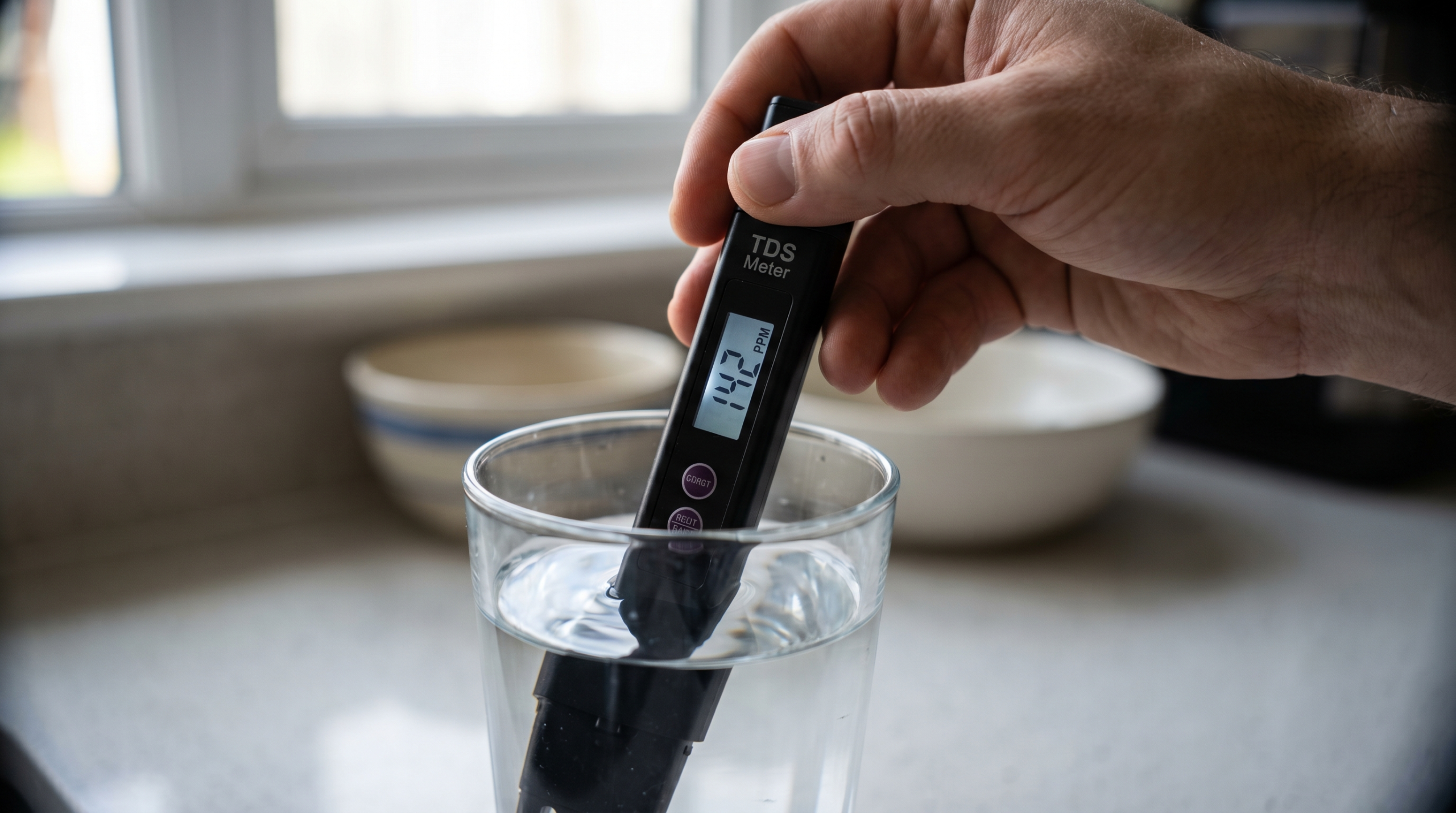

RO water quality comes down to three numbers most people have never looked at: TDS, pH, and conductivity. Understanding what they mean — and what acceptable ranges look like — tells you whether your reverse osmosis system is working, when to replace membranes, and whether your water is suited to its intended use.
TDS: The Primary RO Performance Indicator
Total Dissolved Solids (TDS) measures the concentration of all dissolved inorganic and organic substances in water, expressed in parts per million (ppm) or milligrams per liter (mg/L). These include calcium, magnesium, sodium, chloride, sulfate, nitrate, bicarbonate, and hundreds of trace compounds.
TDS Ranges and What They Mean
| TDS (ppm) | Classification | Typical Source |
|---|---|---|
| 0-50 | Very low | RO permeate, distilled water |
| 50-150 | Low | Mountain spring water, good RO output |
| 150-500 | Medium | Average municipal tap water |
| 500-1000 | High | Hard water areas, some well water |
| 1000-3000 | Very high | Brackish water, agricultural runoff |
| 3000+ | Extreme | Seawater (avg 35,000 ppm) |
What TDS Tells You About Your RO Membrane
A healthy RO membrane rejects 96-99% of incoming TDS. To calculate your system’s rejection rate:
Rejection % = ((Feed TDS – Permeate TDS) / Feed TDS) x 100
Example: Feed at 400 ppm, permeate at 12 ppm = 97% rejection. Good.
Same feed, permeate at 80 ppm = 80% rejection. Membrane fouling or damage — investigate immediately.
A drop in rejection rate is usually the first sign of membrane failure, before any visible symptoms. Check TDS monthly with an inexpensive pen meter ($15-30). When rejection drops below 90%, it’s time to replace membranes.
pH: What RO Does to Water Acidity
Pure water has a pH of 7.0 (neutral). Reverse osmosis tends to produce slightly acidic water — typically pH 5.5 to 6.8 — because the membrane removes alkalinity (bicarbonates) along with other minerals. The carbonic acid naturally dissolved in water then dominates, pulling pH down.
pH Ranges for Common RO Applications
| pH Range | Suitable For | Notes |
|---|---|---|
| 5.5-6.5 | Standard RO permeate | Slightly acidic; fine for most uses |
| 6.5-7.5 | Drinking water (ideal) | Add remineralization stage |
| 6.0-6.8 | Hydroponics, plant watering | Most plants prefer slightly acidic |
| 7.0-7.4 | Aquariums (freshwater) | Species-dependent |
| 6.5-8.5 | EPA drinking water standard | Secondary standard (non-enforceable) |
For drinking water, a remineralization stage (calcite filter or mineral cartridge) raises pH to 7.0-7.5 and adds back beneficial calcium and magnesium. AMPAC residential and commercial systems include optional remineralization as a fourth-stage add-on.
Conductivity: The Engineer’s TDS
Electrical conductivity (EC) measures how well water conducts electricity, expressed in microsiemens per centimeter (uS/cm) or millisiemens per centimeter (mS/cm). Dissolved ions carry charge — so higher TDS = higher conductivity. The relationship is approximately:
TDS (ppm) = EC (uS/cm) x 0.5 to 0.7 (depending on ion composition)
Industrial water treatment systems often monitor conductivity in real time because conductivity sensors are continuous — unlike grab-sample TDS meters. AMPAC commercial RO systems can integrate inline conductivity sensors with 4-20mA outputs for SCADA or BMS integration.
Conductivity Targets by Application
| Application | Target EC | Target TDS equiv. |
|---|---|---|
| Drinking water (general) | <500 uS/cm | <300 ppm |
| Food & beverage processing | <100 uS/cm | <60 ppm |
| Pharmaceutical (USP) | <1.3 uS/cm | <1 ppm |
| Car wash spot-free rinse | <20 uS/cm | <12 ppm |
| Boiler feedwater | <100 uS/cm | <60 ppm |
| Hydroponics (nutrient solution) | 1,200-3,500 uS/cm | 600-2,000 ppm |
When to Test and What to Do
Monthly TDS checks with a pen meter are sufficient for most residential systems. Commercial systems warrant weekly checks and a log — gradual TDS creep is easier to catch in trend data than in single readings.
When to act:
- TDS rejection below 90%: Replace membranes. Also check pre-filters — a clogged sediment filter increases pressure drop and stresses the membrane.
- pH below 5.5: Add remineralization or a calcite post-filter. Acidic water can corrode copper plumbing over time.
- TDS rising but rejection rate stable: Feed water quality has changed. Get a full water test to identify new contaminants.
- Sudden TDS spike: Check for membrane rupture, o-ring failure, or bypass valve position.
Get Your System Sized Right
The right RO system for your application depends on feed water TDS, required output TDS, flow rate, and temperature. Use our RO sizing calculator to get a system recommendation based on your parameters. For complex applications or high-TDS source water, our engineers provide free system design consultations.
Every system ships factory-tested. FILMTEC membranes. 2-year parts warranty. Made in Woods Cross, UT.
Frequently Asked Questions
What rejection rate should a healthy RO membrane achieve?
96-99 percent of incoming TDS. Rejection is calculated as (Feed TDS minus Permeate TDS) divided by Feed TDS, times 100. Feed at 400 ppm and permeate at 12 ppm gives 97 percent rejection; if permeate rises to 80 ppm, that’s only 80 percent rejection, signaling membrane fouling or damage.
Why is RO permeate slightly acidic?
RO membranes remove alkalinity (bicarbonates) along with other minerals, so the carbonic acid already dissolved in water dominates and pulls pH down to a typical range of 5.5 to 6.8. This is normal and can be corrected with a remineralization stage if needed.
How does conductivity relate to TDS?
Conductivity is essentially TDS measured electronically: TDS in ppm approximately equals conductivity in uS/cm times 0.5 to 0.7, depending on ion composition. Conductivity sensors allow continuous real-time monitoring, unlike grab-sample TDS meters.
When should I replace my RO membrane based on TDS readings?
When rejection rate drops below 90 percent. Also check pre-filters first, since a clogged sediment filter increases pressure drop and stresses the membrane, sometimes mimicking membrane failure.
