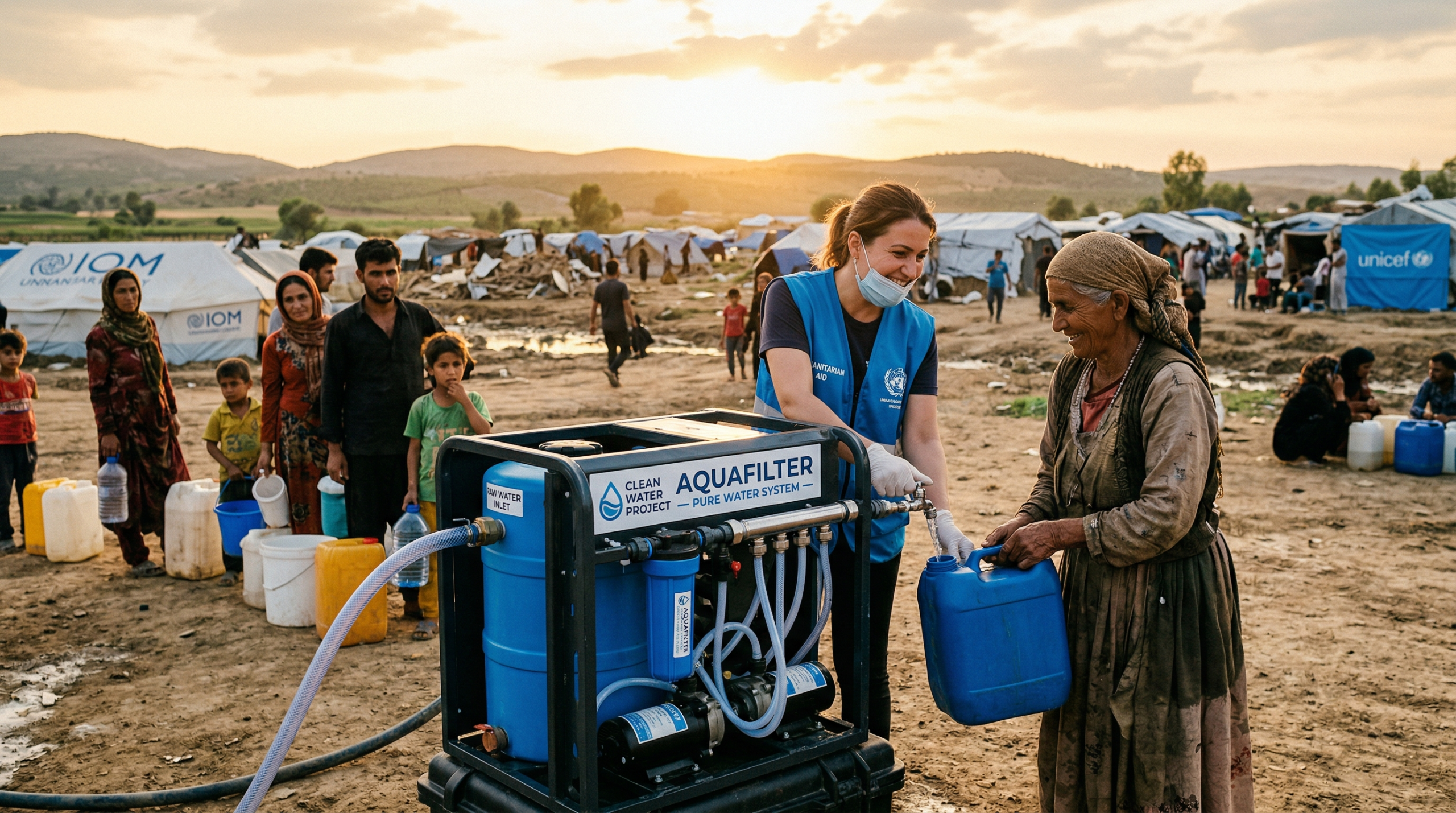

When natural disasters, armed conflicts, or infrastructure failures disrupt water supplies, access to clean drinking water becomes an immediate life-or-death priority. The World Health Organization estimates that contaminated water causes 505,000 diarrheal deaths annually, with the risk multiplying dramatically during emergencies when treatment infrastructure is damaged or overwhelmed. Portable and rapidly deployable water purification systems save lives by producing safe drinking water within hours of arrival at a disaster site.
WHO Emergency Water Quality Standards
Emergency drinking water must meet minimum quality standards established by the WHO and the Sphere Humanitarian Standards:
| Parameter | WHO Emergency Standard | RO System Output |
|---|---|---|
| Turbidity | <1 NTU (ideally <0.2 NTU) | <0.1 NTU |
| E. coli | <1 CFU per 100 mL | 0 CFU (99.99% removal) |
| Free Chlorine Residual | 0.2-0.5 mg/L at point of delivery | Post-chlorination required |
| TDS | <1,000 mg/L (ideally <500) | 10-50 mg/L (95-99% removal) |
| Minimum Supply | 15 L/person/day (Sphere minimum) | System-dependent (150-100,000+ GPD) |
| pH | 6.5-8.5 | 5.5-7.0 (remineralization recommended) |
Emergency Water Purification Technologies Compared
| Technology | Treats Seawater? | Removes Chemicals? | Output (GPD) | Power Required | Portability |
|---|---|---|---|---|---|
| Portable RO | Yes | Yes (95-99%) | 150-100,000+ | Electric/diesel/solar | Backpack to trailer |
| Chlorination | No | No | Unlimited | None | Tablets/liquid – highly portable |
| Ceramic/Gravity Filters | No | Minimal | 5-50 | None (gravity) | Very portable |
| UV Purifiers | No | No | 100-10,000 | Low electric | Compact units available |
| UF Hollow Fiber | No | Minimal | 500-50,000 | Low/hand pump | Portable units available |
| Solar Disinfection (SODIS) | No | No | 2-10 per bottle | Sunlight only | No equipment needed |
Sizing Emergency Water Systems by Population
The Sphere Standards mandate a minimum of 15 liters (approximately 4 gallons) per person per day for drinking, cooking, and basic hygiene. Use this table to size emergency water purification equipment:
| Population Served | Min. Water Needed (GPD) | Recommended System Size | Estimated Cost |
|---|---|---|---|
| 1-10 people (family/team) | 40 | 150 GPD portable RO | $3,000-$6,000 |
| 50 people (small camp) | 200 | 500 GPD portable RO | $5,000-$10,000 |
| 250 people (village/shelter) | 1,000 | 1,500 GPD mobile RO | $8,000-$15,000 |
| 1,000 people (refugee camp) | 4,000 | 5,000-6,000 GPD mobile RO | $15,000-$30,000 |
| 5,000 people (large camp) | 20,000 | 25,000 GPD containerized RO | $50,000-$100,000 |
| 25,000 people (municipal) | 100,000 | Multiple containerized systems | $200,000+ |
Military-Specification Water Purification Systems
Military-grade water purification systems are designed to operate in the harshest conditions – extreme temperatures (-25 to +50 degrees Celsius), high altitude, sandstorms, and rough transport. These systems meet MIL-STD-810 environmental testing standards for shock, vibration, temperature cycling, humidity, and altitude.
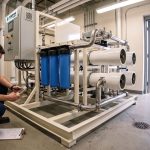
AMPAC USA military-spec water purification systems feature ruggedized construction, rapid deployment capability (operational within 30-60 minutes), multi-source capability (freshwater, brackish, and seawater), and self-contained power options including diesel generators and solar panels.
Power Options for Emergency Water Purification
| Power Source | Best For | Pros | Cons |
|---|---|---|---|
| Diesel Generator | Immediate deployment, any capacity | Reliable, high power, runs day/night | Fuel logistics, noise, emissions |
| Solar Panels + Battery | Sustained off-grid operation | No fuel needed, silent, zero emissions | Weather dependent, higher upfront cost |
| Grid Power | Where infrastructure is intact | Lowest cost, reliable if available | Often unavailable in disaster zones |
| Hand/Foot Pump | Personal/small group use | No power needed, ultra-portable | Very low output, physically demanding |
| Vehicle-Mounted | Mobile operations | Arrives with transport, immediate use | Limited to vehicle location |
Emergency Deployment Checklist
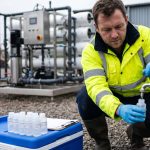
- Assess water source: Test the available water (river, lake, well, sea) for TDS, turbidity, pH, and biological contamination to select proper pretreatment
- Calculate demand: Population x 15 liters/day minimum (4 gallons/person/day). Add 20% safety margin
- Select and transport system: Match system capacity to demand. Ensure logistics for system weight and dimensions
- Secure power source: Generator with adequate fuel supply (plan for 7-14 day minimum operation) or solar array with battery bank
- Set up intake: Position intake hose in deepest, cleanest available water. Install screening to prevent debris from entering system
- Commission system: Run system for 15-30 minutes, flushing initial permeate to drain until TDS stabilizes
- Test output: Verify permeate meets WHO standards (TDS, turbidity, microbiological) before distribution
- Add post-chlorination: Dose permeate with 0.2-0.5 mg/L free chlorine to maintain residual during storage and distribution
- Establish distribution: Set up storage tanks, distribution points, and queue management for orderly water collection
- Monitor continuously: Check TDS, flow rate, and pressure readings every 4 hours. Adjust pretreatment as source water quality changes
Frequently Asked Questions
Why is portable reverse osmosis considered the gold standard for emergency water purification?
Portable reverse osmosis (RO) is the gold standard because it can treat any water source – freshwater, brackish, or seawater – and effectively remove chemicals, producing 150 to 100,000+ GPD of potable water. This capability ensures safe drinking water even from heavily contaminated sources, meeting stringent WHO emergency standards.
What are the minimum water requirements for disaster relief according to WHO standards?
According to the WHO Sphere Standards for humanitarian response, the minimum water requirement is 15 liters per person per day. AMPAC USA’s emergency water purification systems are designed to meet or exceed this critical supply, ensuring adequate potable water for affected populations.
What contaminants do emergency RO systems remove to meet WHO water quality standards?
Emergency RO systems effectively remove critical contaminants to meet WHO standards, including reducing turbidity to less than 0.1 NTU and achieving 0 CFU for E. coli (99.99% removal). They also reduce Total Dissolved Solids (TDS) by 95-99% (to 10-50 mg/L) and can remove chemical contaminants, ensuring comprehensive water safety.
Can emergency water purification systems treat seawater or brackish water for drinking?
Yes, portable reverse osmosis (RO) systems are uniquely capable of treating seawater, brackish water, and freshwater sources. Unlike other emergency purification methods such as chlorination or UV, AMPAC USA’s RO technology is specifically designed to desalt and purify highly saline or contaminated water, making it versatile for any disaster scenario.
How quickly can AMPAC USA’s emergency water purification systems provide safe drinking water?
AMPAC USA’s rapidly deployable emergency water purification systems can produce safe drinking water within hours of arrival at a disaster site. Our portable reverse osmosis units are engineered for quick setup and operation, providing immediate access to potable water from 150 to over 100,000 GPD, crucial for saving lives during crises.
Be Prepared: Emergency Water Purification from AMPAC USA
AMPAC USA has provided emergency water purification systems to disaster relief organizations, military units, NGOs, and government agencies worldwide for over 30 years. Our systems are engineered for rapid deployment, multi-source capability, and sustained field operation.
Contact AMPAC USA for emergency preparedness planning and system recommendations. Call (909) 762-8020 or request information online.
Related Articles
- How AMPAC USA Supports Emergency and Disaster Relief with Portable Water Units
- Comprehensive Guide to ultraviolet sterilization: A Deep Dive into Water Purification
- Water Purification Technologies: Ultrafiltration, Nanofiltration and Reverse Osmosis
- Common Mistakes to Avoid in Water Purification: Precautions to Take
Conclusion
Getting clean water to displaced populations fast isn’t just about having a purification unit on hand — it’s about matching the right technology and capacity to the actual population being served, using the WHO sizing benchmarks covered above. Portable RO remains the workhorse for disaster response because it handles whatever feedwater shows up on site, from floodwater to compromised municipal supply, without needing a known source in advance. AMPAC USA’s emergency systems are built around the deployment checklist and power options discussed in this guide, so response teams aren’t improvising in the field. Contact our team at info@ampac1.com or (909) 548-4900 to discuss emergency water purification for your organization’s response plan.