

PFAS contamination has become one of the most pressing drinking water safety issues of the decade. Known as “forever chemicals” because they do not break down naturally in the environment, PFAS compounds have been detected in the drinking water supplies of more than 110 million Americans according to the Environmental Working Group. The EPA finalized its first-ever enforceable PFAS drinking water standards in April 2024, and reverse osmosis has emerged as the gold standard for residential and commercial PFAS removal.
What Are PFAS? Understanding Forever Chemicals
PFAS (per- and polyfluoroalkyl substances) are a class of more than 12,000 synthetic chemicals that contain strong carbon-fluorine bonds – one of the strongest chemical bonds in nature. These bonds make PFAS extremely resistant to heat, water, oil, and degradation. Manufacturers have used PFAS since the 1940s in non-stick cookware (Teflon), waterproof clothing (Gore-Tex), food packaging, firefighting foam (AFFF), and hundreds of other industrial and consumer products.
The carbon-fluorine bond that makes PFAS useful is the same property that makes them dangerous. Once released into the environment, PFAS persist for thousands of years. They accumulate in soil, groundwater, surface water, and – critically – in human blood and organs. The U.S. Centers for Disease Control reports that PFAS compounds are detectable in the blood of 97% of Americans tested.
Health Risks of PFAS Exposure
Research published by the Agency for Toxic Substances and Disease Registry (ATSDR) and the World Health Organization has linked PFAS exposure to:
- Cancer: Kidney cancer and testicular cancer (PFOA classified as “possibly carcinogenic” by IARC)
- Thyroid disease: Disruption of thyroid hormone production and function
- Immune system suppression: Reduced vaccine effectiveness and increased infection susceptibility
- Reproductive harm: Decreased fertility, pregnancy-induced hypertension, low birth weight
- Liver damage: Elevated cholesterol, liver enzyme changes
- Developmental effects: Impacts on fetal and child growth and learning
EPA PFAS Regulations: What You Need to Know (2024-2026)
In April 2024, the EPA established the first-ever legally enforceable National Primary Drinking Water Regulation (NPDWR) for six PFAS compounds. Public water systems must comply by 2029, but many consumers and businesses are not waiting – they are installing point-of-use treatment now.
| PFAS Compound | EPA MCL (ppt) | Common Sources | RO Removal Rate |
|---|---|---|---|
| PFOA (Perfluorooctanoic acid) | 4 | Non-stick coatings, food packaging | 96-99% |
| PFOS (Perfluorooctane sulfonate) | 4 | Firefighting foam (AFFF), stain-resistant fabrics | 97-99% |
| PFNA (Perfluorononanoic acid) | 10 | Industrial chemical processing | 94-98% |
| PFHxS (Perfluorohexane sulfonate) | 10 | Firefighting foam, metal plating | 93-97% |
| PFBS (Perfluorobutane sulfonate) | 2,000 (HFPO-DA mixture) | Replacement chemistry for PFOS | 90-95% |
| GenX (HFPO-DA) | 10 | Replacement for PFOA in manufacturing | 91-96% |
How Reverse Osmosis Removes PFAS from Water
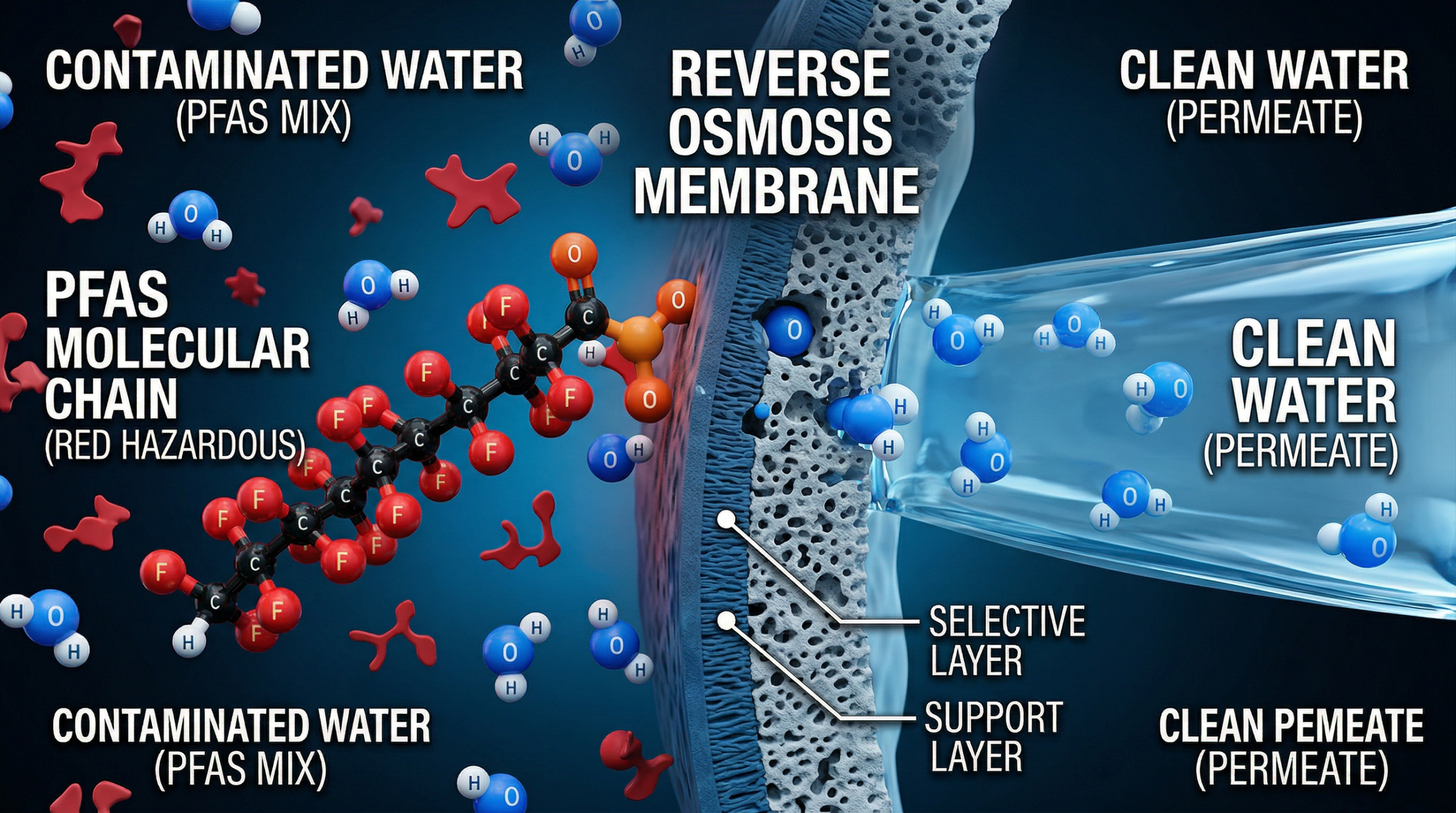
Reverse osmosis removes PFAS through a combination of size exclusion and charge repulsion. PFAS molecules range from 0.5 to 1.5 nanometers in size, while the effective pore size of a thin-film composite (TFC) polyamide RO membrane is approximately 0.1 nanometers (0.0001 microns). This means PFAS molecules are 5-15 times larger than the membrane pores – they physically cannot pass through.
Additionally, PFAS compounds carry a negative charge in water, and TFC membranes also carry a slight negative surface charge. This charge repulsion provides a secondary barrier that enhances rejection rates, particularly for shorter-chain PFAS compounds like PFBS and GenX that approach the membrane’s size exclusion limit.
PFAS Removal Methods Compared: RO vs. GAC vs. Ion Exchange
While reverse osmosis is the most effective single technology for PFAS removal, other treatment methods are also used. The EPA’s PFAS Treatment Guide identifies three primary technologies:
| Treatment Method | Long-chain PFAS | Short-chain PFAS | Cost | Maintenance | Other Contaminants |
|---|---|---|---|---|---|
| Reverse Osmosis | 96-99% | 90-96% | $$ | Filter changes every 6-12mo, membrane every 2-5yr | Removes 95-99% of all dissolved contaminants |
| Granular Activated Carbon (GAC) | 90-95% | 50-70% | $ | Carbon bed replacement every 6-18mo | Chlorine, VOCs, some pesticides |
| Anion Exchange Resin | 95-99% | 85-95% | $$$ | Resin replacement/regeneration | Nitrates, sulfates, perchlorate |
| Nanofiltration | 90-97% | 70-85% | $$ | Similar to RO | Partial TDS removal (50-80%) |
| Standard Carbon Filter | 40-60% | 10-30% | $ | Filter changes every 2-6mo | Chlorine, taste, odor |
The critical distinction is short-chain PFAS removal. As manufacturers phase out long-chain PFAS (like PFOA and PFOS), they are replacing them with shorter-chain alternatives (like GenX and PFBS). These smaller molecules are harder to remove – GAC and standard carbon filters struggle with them, while RO maintains 90%+ removal rates across the full PFAS spectrum.
Which RO Membranes Remove PFAS Most Effectively?
Not all RO membranes perform equally for PFAS removal. The two main membrane types used in RO systems are:
Thin-Film Composite (TFC) Polyamide: These are the standard in modern RO systems and provide the highest PFAS rejection rates (90-99%). The polyamide active layer has tighter pore structure and negative surface charge, both of which enhance PFAS rejection. TFC membranes are used in virtually all commercial and industrial RO systems.
Cellulose Triacetate (CTA): An older membrane chemistry with slightly larger effective pore size. CTA membranes remove 80-90% of PFAS – still significant, but less effective than TFC for the most stringent applications. CTA membranes have the advantage of chlorine tolerance but are being replaced by TFC in most new installations.
Testing Your Water for PFAS
Before investing in water treatment, test your water to determine if PFAS contamination is present and at what levels. Here is how to approach testing:
- Check your water utility’s Consumer Confidence Report (CCR): Public water systems are required to test for PFAS under the new EPA rule. Your annual water quality report should include PFAS data starting in 2025-2026.
- Use a certified laboratory: For private wells and independent testing, send samples to an EPA Method 533 or 537.1 certified lab. Labs like Eurofins, SGS, and ALS Environmental offer PFAS testing panels for $200-$400.
- Check the EWG PFAS contamination map: The Environmental Working Group maintains an interactive map showing known PFAS contamination sites across the United States.
- Consider proximity to known sources: If you live near military bases, airports, industrial facilities, or landfills, PFAS contamination risk is significantly higher due to historical use of AFFF firefighting foam and industrial discharge.
Choosing an RO System for PFAS Removal
When selecting a reverse osmosis system specifically for PFAS removal, look for these features:
- NSF/ANSI 58 certification: Confirms the system meets standards for TDS reduction and contaminant removal
- NSF P473 certification: Specifically tests for PFOA and PFOS removal (look for this if available)
- TFC polyamide membrane: The most effective membrane type for PFAS rejection
- Carbon pre-filter stage: Provides additional PFAS adsorption before the RO membrane
- TDS monitoring: Built-in TDS meter to verify system performance over time
- Adequate capacity: Size the system for your daily water consumption needs
AMPAC USA residential RO systems use high-rejection TFC membranes with multi-stage carbon prefiltration, providing comprehensive PFAS removal that meets and exceeds the new EPA standards. For higher-volume applications, AMPAC commercial RO systems deliver the same PFAS protection at scale.
📚 References & Further Reading
- U.S. EPA: PFAS in Drinking Water
- NSF/ANSI 58: Certified Systems for PFAS Removal
- EWG: PFAS Contamination in the U.S.
- AMPAC USA – PFAS Removal with Reverse Osmosis
Frequently Asked Questions: PFAS and Reverse Osmosis
How effective is reverse osmosis at removing PFAS from drinking water?
Reverse osmosis (RO) systems are highly effective, removing 90-99% of PFAS compounds, including PFOA and PFOS. A properly configured RO system, like those designed by AMPAC USA, consistently meets the EPA’s enforceable maximum contaminant levels (MCLs) of 4 parts per trillion (ppt) for these ‘forever chemicals’.
What are the new EPA regulations for PFAS in drinking water?
In April 2024, the EPA finalized its first-ever enforceable drinking water standards for PFAS. These regulations set Maximum Contaminant Levels (MCLs) of 4 parts per trillion (ppt) for PFOA and PFOS, the two most studied ‘forever chemicals.’ These standards aim to protect public health from widespread PFAS contamination.
Why are PFAS referred to as ‘forever chemicals’?
PFAS are called ‘forever chemicals’ due to their unique molecular structure, specifically the strong carbon-fluorine bonds. These bonds are among the strongest in nature, making PFAS extremely resistant to heat, water, oil, and natural degradation. Consequently, they persist in the environment for thousands of years once released.
What are the primary health risks associated with PFAS exposure?
Research from the Agency for Toxic Substances and Disease Registry (ATSDR) and the World Health Organization links PFAS exposure to several serious health issues. These include increased risks of kidney and testicular cancer, thyroid disease, immune system suppression, reproductive harm, liver damage, and developmental effects.
Does reverse osmosis remove all types of PFAS chemicals?
Reverse osmosis effectively removes a broad spectrum of PFAS compounds, encompassing the class of more than 12,000 synthetic chemicals characterized by strong carbon-fluorine bonds. While the EPA specifically regulates PFOA and PFOS, RO’s membrane filtration mechanism is effective against the entire class of these ‘forever chemicals,’ making it a comprehensive solution for PFAS removal.
Protect Your Water from Forever Chemicals
With EPA PFAS regulations now in effect and compliance deadlines approaching, there has never been a more important time to ensure your drinking water is safe. Reverse osmosis provides the most reliable, comprehensive PFAS removal available – removing 90-99% of all regulated forever chemicals in a single treatment step.
AMPAC USA engineers reverse osmosis systems for every scale, from home drinking water to industrial water treatment. All systems use high-rejection TFC membranes proven to exceed EPA PFAS standards.
Contact AMPAC USA for a free consultation on PFAS-safe water treatment. Call (909) 762-8020 or request a quote online.
Related Articles
- Microplastics in Drinking Water: Can Reverse Osmosis Remove Them? [2026 Research]
- Lead in Drinking Water: How Reverse Osmosis Removes Lead | AMPAC USA
- Arsenic in Drinking Water: How Reverse Osmosis Removes It
- Chromium-6 in Drinking Water: Reverse Osmosis Removal Guide | AMPAC USA
Conclusion
PFAS regulations are only getting stricter, and the EPA limits discussed above mean utilities and facilities that haven’t tested their water yet are running out of runway to figure out a plan. Reverse osmosis remains one of the few treatment methods that reliably rejects PFAS across different chain lengths, though membrane selection matters more here than with most contaminants — not every RO membrane performs the same against these compounds. Testing your water first, as covered in this guide, tells you what you’re actually dealing with before you spec a system. Contact our team at info@ampac1.com or (909) 548-4900 to discuss PFAS removal with reverse osmosis for your water supply.