Summary: Industrial reverse osmosis (RO) systems have evolved from simple salt-rejection membranes into sophisticated water management platforms integrating real-time monitoring, energy recovery, and zero liquid discharge (ZLD) capabilities. This guide covers the engineering fundamentals, key application sectors, 2025 technology trends driving the industry, and the total lifecycle considerations that differentiate industrial-grade systems from commercial-grade equipment.
What Defines an Industrial Reverse Osmosis System?
An industrial reverse osmosis system is distinguished from commercial RO not merely by scale but by design philosophy. Industrial systems are engineered for continuous 24/7 operation, built to ASME pressure vessel standards, designed with redundant process trains to eliminate single points of failure, and controlled by SCADA (Supervisory Control and Data Acquisition) systems that provide real-time process visibility.
Production capacity typically begins at 10,000 gallons per day (GPD) and scales to multi-million GPD in large municipal or industrial desalination applications. The water quality requirements span an equally wide range — from basic dissolved solids reduction for cooling tower make-up water to USP Purified Water and Water for Injection (WFI) for pharmaceutical manufacturing.
Core Design Principles of Industrial RO Systems
Membrane Configuration and Pressure Vessels
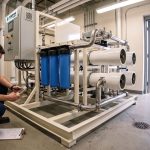
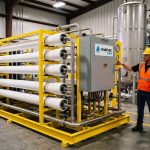
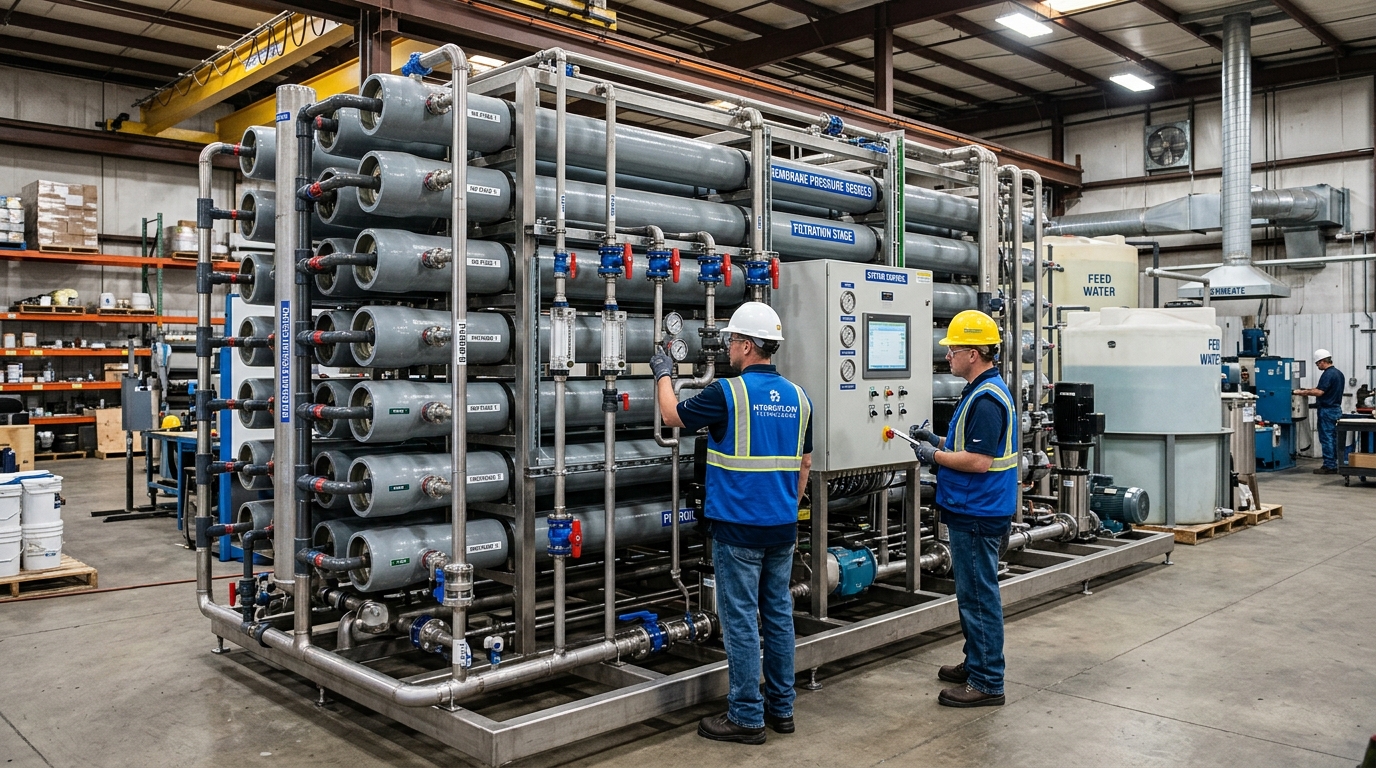
Industrial RO systems use spiral-wound thin-film composite (TFC) membranes housed in pressure vessels rated for 150–600 psi (depending on source water TDS). Standard commercial membrane elements are 4-inch or 8-inch diameter and 40 inches long. Industrial systems typically use 8-inch elements at 6–8 elements per vessel, arranged in arrays (pressure vessels in parallel) and stages (arrays in series).
The array configuration is expressed as a ratio — for example, a 2:1 array has two first-stage vessels feeding one second-stage vessel. The concentrate from the first stage becomes the feed to the second stage, maximizing recovery while maintaining adequate cross-flow velocity to prevent concentration polarization at the membrane surface. The AWWA and the Water Environment Federation both publish membrane element array design guidelines for industrial applications.
Energy Recovery Devices
In seawater and high-pressure brackish applications, concentrate exits the system at nearly the same pressure as the feed — representing significant recoverable energy. Energy recovery devices (ERDs) capture this pressure and transfer it to the incoming feed stream, reducing net energy consumption by 40–60% compared to systems without ERDs.
Isobaric ERDs (such as pressure exchangers) are the most efficient, achieving 95%+ energy transfer efficiency. Centrifugal ERDs (turbine-based) are simpler but less efficient at approximately 80–85%. For a 1 MGD industrial RO system operating at 800 psi, the difference in annual electricity cost between a system with and without an ERD can exceed $150,000.
Pre-Treatment Engineering
Industrial pre-treatment trains are engineered with the same rigor as the RO system itself. Typical components include:
- Multimedia filtration (dual media or tri-media) to reduce SDI below 3
- Ultrafiltration (UF) membranes as an alternative to multimedia for tighter SDI control, particularly for surface water sources with variable turbidity
- Sodium bisulfite (SBS) dosing for dechlorination when activated carbon is not practical at scale
- Antiscalant chemical dosing with selection matched to the specific scaling ions (calcium carbonate, calcium sulfate, barium sulfate, silica)
- pH adjustment via sulfuric acid dosing for carbonate scale control or sodium hydroxide for permeate quality optimization
- Cartridge filters (5-micron) as final protection ahead of the high-pressure pump
Key Industrial Application Sectors
Power Generation
Power plants — particularly thermal power stations with steam-cycle turbines — require ultra-pure boiler feed water (BFW) with conductivity below 0.1 µS/cm. Mineral deposits in steam generators cause tube failures that can shut down entire generating units. Industrial RO is the first stage of a BFW treatment train, followed by mixed-bed deionization (or electrodeionization) to achieve ultra-pure quality. A single 500 MW coal or gas plant may require 2–5 MGD of boiler feed water. See our guide on ultra-pure water for industrial applications.
Semiconductor and Electronics Manufacturing
Semiconductor fabrication requires ultrapure water (UPW) with resistivity of 18.2 MΩ·cm — the theoretical maximum for pure water. A single semiconductor fab uses 2–4 million gallons per day of UPW. Industrial RO systems serve as the primary dissolved solids removal stage, producing water that then passes through electrodeionization (EDI), UV oxidation, and final polishing before use in wafer rinsing and chemical bath preparation.
Pharmaceutical and Biotechnology
The United States Pharmacopeia (USP) defines Purified Water and Water for Injection specifications that virtually all pharmaceutical manufacturing processes require. Industrial RO systems are the foundation of pharmaceutical water treatment, removing pyrogens, endotoxins, bacteria, viruses, and dissolved organics ahead of downstream polishing. cGMP compliance requires full documentation of system design, validation, and ongoing performance monitoring.
Municipal Water Treatment
Municipal RO is increasingly used for both potable water production from brackish groundwater and for advanced water reuse (treating municipal wastewater effluent to potable or near-potable standards). The EPA’s water quality criteria and state-level drinking water regulations are driving adoption of large-scale RO in water-stressed municipalities across the Southwest, Middle East, and parts of Asia.
Food and Beverage Processing
Food and beverage manufacturers use industrial RO for ingredient water standardization, concentration of liquids (juice, dairy), and equipment cleaning water production. Consistent TDS in ingredient water directly affects product taste, shelf life, and batch-to-batch consistency. The FDA and NSF/ANSI Standard 61 govern materials in contact with food-grade water treatment systems.
2025 Technology Trends in Industrial RO
1. Zero Liquid Discharge (ZLD) Integration
Zero liquid discharge systems recover virtually all water from the RO concentrate stream, leaving only a dry solid waste for disposal. The driving forces are increasingly stringent wastewater discharge regulations and water scarcity economics. ZLD typically combines brine concentrators (thermal evaporators) with crystallizers, often preceded by a high-recovery RO stage operating at 90–95% recovery. Capital costs are significant ($3–8 million for a 500,000 GPD ZLD system), but operating cost savings from reduced water intake and zero discharge permit compliance make ZLD economically justified in many industrial applications.
2. Real-Time Digital Monitoring and Predictive Maintenance
Modern industrial RO systems integrate IoT sensors measuring conductivity, pH, flow, pressure differential, and temperature at every process stage. Cloud-connected SCADA systems analyze this data in real time, enabling predictive maintenance alerts before performance degrades. Machine learning models trained on historical membrane fouling data can now predict when to schedule cleaning cycles 2–4 weeks in advance, reducing downtime and extending membrane life.
3. Low-Energy Membrane Development
Next-generation membranes incorporating aquaporin proteins (biological water channels) and graphene oxide layers are achieving higher water flux at lower operating pressures in laboratory and pilot-scale trials. Commercial availability is expected by 2026–2028. These membranes could reduce energy consumption in large industrial systems by 20–35% compared to current TFC technology.
4. Circular Water Economy Mandates
The EU’s revised Urban Wastewater Treatment Directive (2024) and California’s Direct Potable Reuse regulations are compelling industrial facilities to treat and reuse process water rather than discharge it. Industrial RO systems are central to these circular water economy strategies, with advanced water reuse facilities achieving 85–95% water recovery across entire industrial campuses.
AMPAC USA Industrial RO Systems
AMPAC USA designs and manufactures industrial reverse osmosis systems from 10,000 GPD to multi-million GPD capacities. Our systems serve power generation, pharmaceutical manufacturing, municipal water treatment, and industrial process water applications. Every AMPAC industrial system is engineered to your specific source water chemistry and production requirements, with pre-treatment design, SCADA controls, and performance monitoring included.
Explore related resources: industrial RO system components guide, high purity water systems, and why industrial RO treatment is vital.
Frequently Asked Questions
What is the typical lifespan of an industrial RO membrane?
Industrial RO membranes typically last 5–7 years with proper pre-treatment and maintenance. High-pressure seawater membranes may last 5 years due to the mechanical stress of operating at 800–1,200 psi. Brackish water membranes in well-maintained systems with stable feed water quality can last 7–10 years. Performance monitoring through normalized permeate conductivity tracking is the most reliable indicator of membrane health.
How is industrial RO system performance measured?
Performance is tracked through normalized permeate flow (NPF), normalized salt passage (NSP), and normalized pressure differential (NPD) — all adjusted to a standard reference temperature and pressure. Monthly logging and comparison to the system’s initial baseline values reveals fouling trends before they become membrane damage. A 15% decline in NPF or a 15% increase in NSP typically triggers a cleaning or replacement evaluation.
What is the role of electrodeionization (EDI) after industrial RO?
Electrodeionization is a downstream polishing technology that removes the residual dissolved ions that RO membranes cannot fully reject at scale. EDI combines ion exchange resins with a low-voltage electrical field to continuously regenerate the resin without chemicals. The combination of RO + EDI is the standard water treatment train for semiconductor UPW, pharmaceutical purified water, and power plant boiler feed water where conductivity below 0.1 µS/cm is required. See our detailed overview of ultra-pure water production for more on post-RO polishing steps.
Can industrial RO systems handle seawater?
Yes — seawater reverse osmosis (SWRO) is a mature technology deployed in large-scale desalination plants globally. SWRO requires higher operating pressures (800–1,200 psi) and specialized high-rejection membranes compared to brackish water systems. Energy recovery devices are standard in SWRO applications to offset the significantly higher energy requirements. AMPAC USA’s seawater desalination systems are engineered for coastal and offshore applications.
What causes industrial RO membranes to fail prematurely?
The three leading causes of premature industrial RO membrane failure are: (1) chlorine or chloramine exposure — even brief chlorine contact irreversibly oxidizes TFC membrane polymer; (2) calcium carbonate or sulfate scaling due to inadequate antiscalant dosing or softener bypass; and (3) biological fouling from inadequate pre-treatment allowing bacteria to establish biofilm on the membrane surface. All three are preventable through proper pre-treatment design and routine monitoring.
Citations and References
- American Water Works Association. Reverse Osmosis and Nanofiltration (M46). AWWA. awwa.org
- U.S. Environmental Protection Agency. Water Quality Criteria and Standards. EPA. epa.gov
- United States Pharmacopeia. USP General Chapter <1231> Water for Pharmaceutical Purposes. USP. usp.org
- NSF International. NSF/ANSI/CAN 61: Drinking Water System Components — Health Effects. NSF. nsf.org
- Water Environment Federation. Membrane Bioreactors: Design, Operation, and Applications. WEF. wef.org
- International Desalination Association. IDA Desalination Yearbook 2024–2025. IDA. idadesal.org