

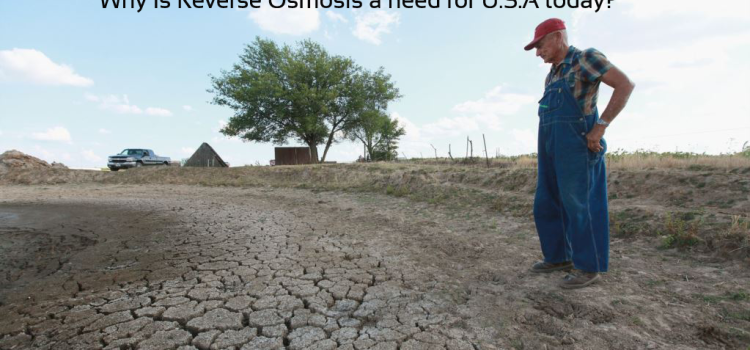

Not long ago, a news hit the country, California was facing a drought-like situation in various parts of its state. The state’s green pastures were now covered with hay and dried up grass having the potential to set ablaze. The water bodies all across the state had dried up to an all-time low revealing the water-cut edges of the hills they covered. However, this year due to wet winter and a whole lot of water conservation projects carried out by the government in California, the state has returned to its lost glory. As good news as it is, it does pose a question for all of America. Are we in abundance of water for the coming generations or not.
California was just an example of what would happen to other states if we don’t move towards other alternatives of water for our needs. One such alternative is Reverse Osmosis for conversion of salty seawater into potable water. Here is how Reverse Osmosis is the need of the hour for the USA:
- Desalination can provide for household, commercial and industrial needs of the country. Instead of depleting freshwater resources in the country we can look for other alternatives to satisfy our water requirements. One such way is Reverse Osmosis.
- Israel was drought hit once upon a time and did not have enough water to provide for its citizens. Today by using the simple method of Reverse Osmosis, they desalinate seawater and provide for all their agricultural needs too. So much so that the country has more than needed stock of food and water.
- For the various requirements of our daily chores, freshwater supplies are not always needed which means reverse osmosis systems can play a huge role in obtaining a specific water profile for other activities.
- Reverse Osmosis can solve our problems of water scarcity where there is drought like situations and agriculture is a major profession. This can lead to the growth of the economy as well.
- Reverse Osmosis poses as a helpful tool in achieving our environmental, business and performance goals keeping in mind the current state and need of the country as a whole.
The need for finding more options for water is undeniable in the current state of things. With melting water glaciers and water levels decreasing every day, we have to look at options that help conserve water. Reverse Osmosis can be a step forward in helping the USA achieve its water goals and hopefully one day the alarming rate of decreasing water levels won’t bother us again.
Frequently Asked Questions
What specific contaminants does reverse osmosis effectively remove from US tap water?
Reverse osmosis is highly effective at removing a wide range of contaminants increasingly found in US tap water, including lead, PFAS (per- and polyfluoroalkyl substances), nitrates, and chromium-6. AMPAC USA’s commercial and industrial systems are engineered to specifically address these and other water quality challenges, ensuring purified water for various applications.
How can reverse osmosis address water scarcity issues in the United States?
Reverse osmosis offers a critical solution to water scarcity in the US by enabling desalination, converting abundant salty seawater into potable water. This reduces reliance on dwindling freshwater resources, as demonstrated by countries like Israel which now meet agricultural and domestic needs through RO desalination. AMPAC USA designs systems capable of large-scale desalination for municipal, commercial, and industrial use.
What are the commercial and industrial applications of reverse osmosis in the USA?
Commercial and industrial sectors in the USA utilize reverse osmosis to achieve specific water profiles essential for their operations, from food and beverage processing to military bases and luxury resorts. RO systems provide high-purity water for manufacturing, agriculture, and various daily chores where freshwater supplies are not always suitable. AMPAC USA specializes in engineering robust RO systems for these diverse and demanding applications.
Does aging water infrastructure in the US increase the need for reverse osmosis?
Yes, aging water infrastructure in the US significantly contributes to water quality issues, making advanced treatment like reverse osmosis increasingly necessary. Deteriorating pipes can introduce contaminants, while outdated treatment plants may struggle with emerging pollutants. RO systems provide a reliable barrier, ensuring safe and purified water despite these infrastructural challenges.
Can reverse osmosis contribute to economic growth in drought-prone US regions?
Absolutely. In drought-stricken US regions where agriculture is vital, reverse osmosis can provide a consistent and reliable water source for irrigation through desalination or water recycling. This ensures agricultural productivity, supports local economies, and fosters growth even when traditional freshwater sources are scarce. AMPAC USA’s systems are designed to support such large-scale water provision.
Related Articles
- Reverse Osmosis System Maintenance Guide: Service Intervals and Procedures
- How Reverse Osmosis Works: The Complete Technical Guide | AMPAC USA
- Water Softener vs Reverse Osmosis: Which Do You Need? | AMPAC USA
- What Is Reverse Osmosis? The Complete 2026 Guide to RO Water Purification
Conclusion
California’s drought scare wasn’t an outlier, it was a preview, and water scarcity keeps resurfacing across the country even in years when conservation efforts buy some breathing room. Reverse osmosis matters here because it can pull usable water from sources municipal systems would otherwise write off, from brackish groundwater to the ocean itself. That flexibility is why AMPAC USA builds both land-based RO and desalination systems rather than just one or the other. Contact our team at info@ampac1.com or (909) 548-4900 if water security is on your radar for the years ahead.
AMPAC USA engineers custom water purification systems for commercial, industrial, and emergency applications — from 500 GPD to multi-million GPD. Trusted by municipalities, military, and industry worldwide.
