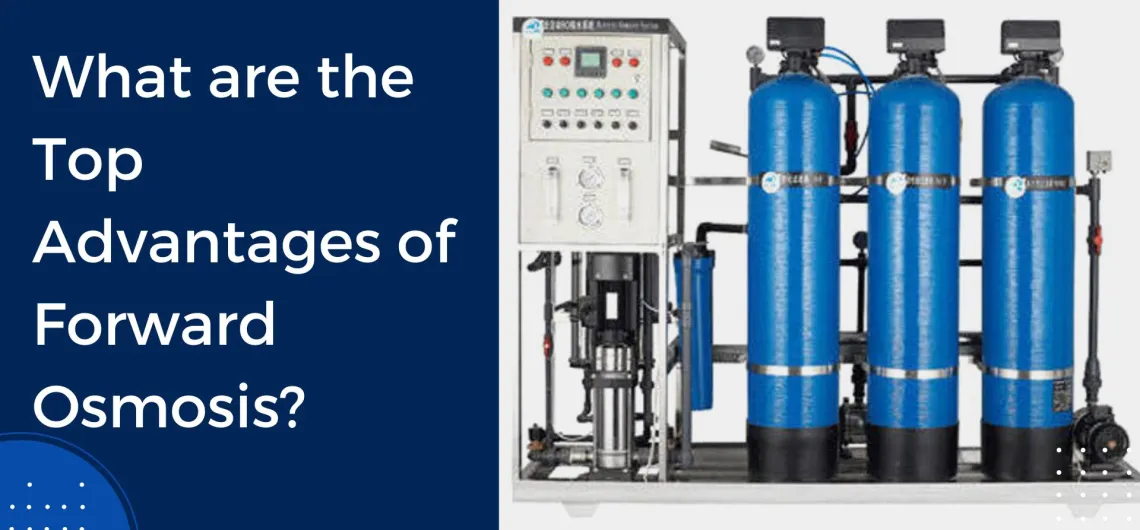

Forward Osmosis Advantages Benefits is a big deal in today’s water treatment world. Here at AMPAC USA, we give you solutions that make sure you get safe, clean water for your home, business, or industrial needs. Our systems are built to pull out maximum contaminants and last a long, long time.
Forward osmosis is a smart technology. We use it for dewatering and concentrating liquids. It’s also great for purifying water and getting rid of stuff you don’t want. Many folks see it as better than reverse osmosis because it doesn’t mess with or harm the products. Instead, it keeps the good stuff, like bioactivity and taste, exactly as they should be. Let’s look at how it works and what makes it so good.
How Forward Osmosis Works
During the Forward Osmosis process, a special “draw solution” gets diluted. Then, we regenerate it to use again in the system. This draw solution is carefully made with high osmotic pressure, using simple sugars and salts. Since it’s clean and free of particles, we can regenerate it with low energy membrane processes.
Over the last five years, Forward Osmosis has really taken off. We’ve seen huge improvements in the membranes, the equipment, and even the way we design the process.
Thanks to these steps forward, forward osmosis systems are now more affordable. You’ll find them in more industries, homes, and businesses than ever before.
What Makes Forward Osmosis So Good?
Here’s a quick rundown of why forward osmosis is so popular today.
-
Color, Taste, and Nutrients Stay Put
With forward osmosis, there’s no osmotic pressure on the concentrate. That means no browning, no weird tastes, and no loss of nutrients. It’s why FO beats reverse osmosis and thermal evaporation methods.
-
Low Cost and Energy Use
Dewatering with FO needs very little energy. We only need power to circulate two liquids, the draw solution and the feed solution. Even that takes just ten psi or less. It uses less energy than other methods like thermal concentration. Plus, forward osmosis operating costs are low because FO naturally handles foulants well.
FO membranes don’t clog or foul as easily. This means you need less pre-treatment. Why less clogging? FO works without hydrostatic pressure, which cuts down on problems. Also, FO is simple to set up and quite affordable for smaller setups. Even the equipment takes up less space than evaporators.
-
More High-Quality Water
Forward osmosis also gives you a stream of super pure water as a bonus. You can reuse this water in so many ways: for boiler feed makeup, washdowns, irrigation, cooling tower feed makeup, or even to dilute other waste streams that are over discharge limits. Want to know more about Forward Osmosis and buy a system from AMPAC USA? Browse the AMPAC USA product range.
Trust AMPAC USA for Forward Osmosis Products
AMPAC USA is a top manufacturer and distributor of high-quality, American-made water treatment systems, including Forward Osmosis systems. We started in 1994, building water purification equipment. Over the years, we’ve grown into a large-scale manufacturer, making all kinds of major purification equipment and handling complete water infrastructure installations.
AMPAC USA is especially known for its fantastic technical services. We get how tough marine conditions can be. That’s why we use military and marine-grade parts in our off-shore and on-shore reverse osmosis watermakers. We build equipment that’s easy to use, heavy-duty, strong, and dependable. Without cutting corners, AMPAC USA custom-engineers, designs, fabricates, and manufactures systems to handle the absolute toughest water treatment conditions anywhere on Earth.
To learn more, read about AMPAC USA or call us at 909-548-4900.
Frequently Asked Questions
How does forward osmosis preserve product quality better than reverse osmosis or thermal methods?
Forward osmosis is superior because it doesn’t alter or damage the products, preserving their bioactivity, color, sensory profile, and nutrient content. Unlike reverse osmosis or thermal evaporation, FO avoids browning or changes to the liquid’s inherent characteristics.
What is the energy consumption of a forward osmosis system?
Forward osmosis systems are highly energy-efficient, requiring minimal energy primarily for circulating the draw and feed solutions. This process typically consumes ten psi or less, making it significantly more energy-efficient than thermal concentration methods.
How does forward osmosis minimize membrane fouling?
Forward osmosis membranes possess an intrinsically high tolerance for foulants, making them less prone to plugging and fouling compared to other membrane technologies. This inherent resistance contributes to lower operating costs and reduced maintenance requirements for AMPAC USA’s systems.
What is the function of the draw solution in the forward osmosis process?
In forward osmosis, the draw solution is a high osmotic pressure mixture of simple sugars and salts that pulls water across the membrane. It is then diluted and regenerated for reuse within the system, a low-energy process due to its clean, particulate-free nature.
Why has forward osmosis technology become more widely adopted recently?
Forward osmosis has gained significant acceptance in the last five years due to advancements in membrane technology, equipment design, and process optimization. These improvements have made FO systems, like those engineered by AMPAC USA, more affordable and applicable across a broader range of industrial, commercial, and residential water purification needs.
AMPAC USA engineers custom water purification systems for commercial, industrial, and emergency applications — from 500 GPD to multi-million GPD. Trusted by municipalities, military, and industry worldwide.