
For a business owner, chances are the business needs a reverse osmosis filtration system for the water required. It is needed on a much larger level when it comes to manufacturing products especially the ones that require water as an ingredient. In the 1950s when Reverse Osmosis was first introduced, no one would’ve thought that Industrial Reverse Osmosis systems would become an important ingredient in the 21st century. This article explores the details to which an industrial RO abides. From its need to cost and performance, the article is a know-how guide to Industrial Reverse Osmosis Systems.
Description:
In the age of globalization, businesses moving forward need ways to run a cost-efficient, law-abiding venture, that creates brand and revenue. In the factories, therefore, choosing the right systems could mean the difference between loss of time and excellent results. For manufacturing firms especially like beverage, pharmaceutical, food and dairy industries, getting water filtration systems is important. Even more important is following water regulations which get even the biggest industries in trouble. Knowing hence, what and how it works is important for one to know before investing in such heavy machinery. This article answers some very basic questions related to the purchase of Industrial Reverse Osmosis.
What is an Industrial RO?
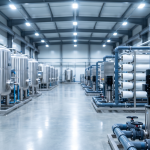
Industrial grade Reverse Osmosis Systems are equipment that works on the process of reverse osmosis for purification of water. These systems work like any other commercial or residential grade RO systems except these provide a larger capacity of purified water that is, above 5000 GPD. Also, the RO process inside can be customized based on the need of a particular factory or manufacturing firm. This is done because the water supply available in each region is different and so Industrial ROs have at times differing RO systems.
Is it necessary to have an Industrial RO?
If there is a business involved, chances are an Industrial RO is needed. In every business, filtration of water is essential as the water coming in contains a number of contaminants one can never be sure of. Be it a regular online service provider or a manufacturer, everyone needs water filtration systems. When it comes to manufacturing firms though, every factory with a requirement of water above 10,000 GPD needs an Industrial grade RO. It is necessary as RO reduces chances of impure water getting into the product and helps the company reach the standard of water quality required for the region.
How does one know if they need an Industrial RO?
If the client or user is a business and wants to use the RO for manufacturing purpose, their water usage determines whether they need an Industrial RO or not. Usually, small scale industries work smoothly with a simple commercial grade system. However, for medium and large scale industries the amounts to water to be filtered is more than 10,000 GPD. If the water requirement each day exceeds this number, chances are they need an Industrial RO for smooth and hassle-free operations. Instead, if commercial grade systems are installed, it can cost a lot in operations and maintenance.
Is there any significant difference between commercial and Industrial RO?
There is a major difference. Commercial grade RO ranges from 100 GPD to 10,000 GPD and are extensively used for medium level requirements in shops, restaurants, cafes and large-scale supermarkets. Meanwhile, Industrial level systems range from 6,000 GPD to 100,000 GPD. Additionally, the process of reverse osmosis differs a little for each of these. Also, the water supply plays an important role as the quality determines how the system is going to work. Usually, for industrial systems, the process is more high-end than commercial grade. With a difference in craft and capacities, their costs differ too.
What about equipment that is not currently manufactured anywhere?
In the case of industries such as the Military, Oil & gas industries, requirements vary based on the location, water quality, and output. In such situations, customized options for RO are available. RO suppliers send an executive to gauge the need and look at the parameters. For such projects, experts usually check for the following:
- Water quality, constituents, elements.
- Water supply source
- Required water quality
- Required water capacity
- Wastewater treatment standard regulations
- Location of the equipment to be installed and more
The experts then work out a plan where they design equipment that considers all the above parameters and give an ideal solution to the water treatment problem.
How expensive is an Industrial RO?
This scale RO is available at very feasible rates compared to the firm. Higher capacity systems cost more than the initial models. However, if your requirements come in the higher ranges, the cost increases proportionately. Ideally a 12,000 GPD RO costs near about $10,000 but differs from seller to seller. It should be seen as an asset because, in a bid to spend less, one ends up settling for machinery that costs more in maintenance and downtimes. The best way is to understand one’s need of the product and getting it at the best price from a verified seller.
What in case of challenges with downtime and maintenance?
Companies provide assistance on call and on-site as well. Choosing the right company is important as very few of them have a 24×7 customer service. Take a look at sellers that send experts for understanding requirements, installing the machine at the time of delivery, on-site assistance in case of downtimes and maintenance repair. Choose a brand that offers assistance post selling the products, because no one understands a product better than the makers themselves. Also, qualified personnel is an important part of this service, before choosing a brand some points to take care of are:
- Experience in the field
- Number of previous clients
- Skilled personnel
- Availability of on-time customer service posts the sale.
There have been instances where businesses have faced losses due to the wrong system choice, smaller industries have shut down even because of wrong investments. Avoiding all that is easy by just being aware of what the business needs and everything is sorted by the seller and their experts.
About the Author:
Ampac USA is a 28-year-old water treatment systems manufacturer that provides water treatment solutions for residential, industrial and commercial purposes.
Frequently Asked Questions
How does reverse osmosis remove contaminants from water?
Reverse osmosis forces water through a semi-permeable membrane with pores as small as 0.0001 microns, physically blocking dissolved salts, heavy metals, bacteria, and viruses. AMPAC USA RO systems achieve up to 99% rejection of total dissolved solids (TDS), producing high-purity water suitable for drinking, industrial processes, and commercial applications.
What is the typical lifespan of an RO membrane?
High-quality RO membranes last 2–5 years depending on feed water quality and maintenance frequency. AMPAC USA systems use thin-film composite (TFC) membranes rated for extended service life. Regular pre-filter replacement and periodic membrane cleaning significantly extend operational longevity.
How much water does an RO system waste?
Standard RO systems recover 50–75% of feed water as permeate (purified output), with the remainder discharged as concentrate. AMPAC USA's high-recovery commercial systems achieve up to 85% recovery using energy recovery devices and optimized flow design, reducing operational costs substantially.
What pressure is required for a reverse osmosis system?
Brackish water RO systems typically operate at 150–600 PSI, while seawater systems require 800–1,200 PSI. AMPAC USA designs each system to match source water salinity and desired flow rate, incorporating energy-efficient high-pressure pumps with variable frequency drives (VFDs) to minimize power consumption.
Can reverse osmosis remove viruses and bacteria?
Yes. RO membranes provide absolute removal of bacteria (>99.9999%) and viruses (>99.99%), making them one of the most effective water purification technologies. AMPAC USA systems exceed NSF/ANSI 58 standards and include pre-treatment stages to protect membrane integrity.
Related Articles
- Whole House Reverse Osmosis System for Commercial & Industrial Water Treatment
- Cannabis Water Treatment: Why Commercial Grows Use Reverse Osmosis
- Commercial Reverse Osmosis System Buyer's Guide: 100 to 10,000 GPD
- Does Reverse Osmosis Remove PFAS? What Commercial Operators Need to Know
Conclusion
This post explored how reverse osmosis technology delivers high-purity water across a wide range of residential, commercial, and industrial applications. For businesses and organizations requiring reliable RO purification, AMPAC USA engineers custom systems tailored to your specific water quality requirements and flow demands. Contact our team at info@ampac1.com or (909) 548-4900 to discuss your water treatment needs.
AMPAC USA engineers custom water purification systems for commercial, industrial, and emergency applications — from 500 GPD to multi-million GPD. Trusted by municipalities, military, and industry worldwide.