
Seawater desalination has really changed over the last ten years, both in technology and cost. Today, modern seawater reverse osmosis (SWRO) systems, especially those with energy recovery, can make fresh water for just $0.40-$0.80 per cubic meter in big plants. That’s competitive with traditional water treatment methods in places where water is scarce. This guide will walk you through how SWRO works, what makes energy and capital costs different between systems, how to think about getting rid of brine, and what’s next for desalination technology as we head into 2026 and beyond.
- Globally, we now have over 100 million m-/day of desalination capacity, as of 2023.
- SWRO, or seawater reverse osmosis, makes up more than 60% of all desalination capacity worldwide.
- Since the 1990s, energy recovery devices have cut SWRO energy use by up to 60%.
- The Middle East and North Africa run the most desalination capacity globally.
- AMPAC USA SWRO systems handle capacities from 1,800 to over 100,000 GPD for commercial and industrial needs.
Why Seawater Desalination Is Becoming the World’s Water Supply Strategy
About 97% of the world’s water is salty, mostly ocean water with 33,000-37,000 ppm of total dissolved solids (TDS). The other 3% is freshwater, but two-thirds of that is stuck in glaciers and ice caps. The freshwater we actually use, like surface water and shallow groundwater, is under huge stress. Think population growth, farming needs, industrial use, and climate-driven droughts all hitting it at once.
The World Health Organization figured that by 2025, half the world’s people would live in water-stressed areas. The International Desalination Association reports that global desalination capacity topped 100 million cubic meters per day in 2023, a big jump from 65 million in 2015. SWRO now accounts for roughly 70% of all global desalination capacity.
How Seawater Reverse Osmosis Works
Seawater reverse osmosis uses hydraulic pressure to push seawater through a special semi-permeable membrane, going against its natural osmotic flow. Seawater has an osmotic pressure of about 390 psi (27 bar). To get water through the membrane, the pressure you apply has to be higher than that, usually 800-1,200 psi (55-83 bar) in commercial SWRO systems.
The membrane blocks dissolved ions like sodium, chloride, magnesium, sulfate, and many others, but lets water molecules pass through. Modern SWRO membranes can reject 99.5-99.8% of salt, making permeate with 150-400 ppm TDS from seawater that started at 35,000 ppm. The water that doesn’t go through exits as a concentrated brine, around 50,000-70,000 ppm TDS, and at pretty much the same pressure as the incoming water.
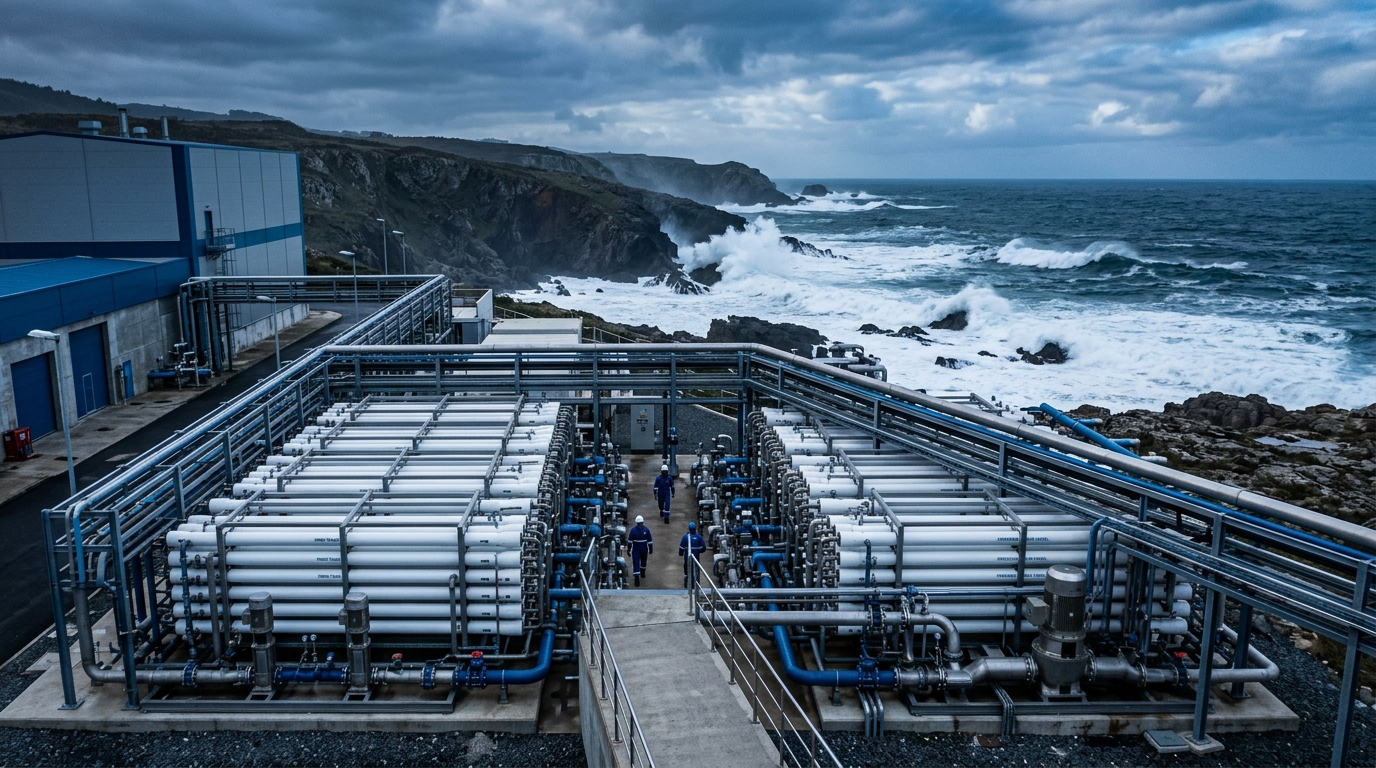
A Typical SWRO Process Train
- Intake screening: Bar screens and fine screens pull out marine life, trash, and big particles from raw seawater.
- Pre-treatment: Dissolved air flotation (DAF) or multimedia filtration cuts down on algae, suspended solids, and cloudiness. Sometimes, coagulation-flocculation is added for surface seawater intakes.
- Cartridge filtration (5-micron): This is the final particle protection before the high-pressure pump.
- Antiscalant dosing: Stops sulfate and carbonate from scaling up the membranes.
- High-pressure pump + energy recovery device: This pressurizes the feed to 800-1,200 psi, and the ERD gets pressure back from the brine stream.
- SWRO membrane array: Multi-stage pressure vessel arrays hit 40-50% recovery, meaning 40-50 gallons of clean water for every 100 gallons of feed.
- Post-treatment: Things like remineralization (using lime or calcite contactors), pH adjustment, disinfection, and fluoride dosing happen here before the water goes out for distribution.
Energy Consumption: The Key Cost Driver
Energy makes up 30-50% of the cost to run a seawater desalination plant. Without energy recovery, an SWRO system uses 7-12 kWh for every cubic meter of water it produces. But with modern pressure exchanger ERDs, which are over 95% efficient, energy use drops to 2.5-4.0 kWh/m-. That’s a 60-70% reduction, and it completely changed how affordable SWRO became over the last 15 years.
| System Type | Energy Consumption (kWh/m-) | Relative Cost Index |
|---|---|---|
| Early SWRO (no ERD, pre-2000) | 7-12 | 3.0x |
| Modern SWRO (centrifugal ERD) | 4-6 | 1.8x |
| Modern SWRO (isobaric ERD) | 2.5-4.0 | 1.0x (baseline) |
| Brackish water RO (no ERD) | 0.5-1.5 | 0.4x |
If electricity costs $0.08/kWh, the energy part of making 1 cubic meter of desalinated water with a modern SWRO system and ERD is about $0.24-$0.32. That’s less than half the cost of seawater RO back in the 1990s. This is why cities like Dubai, Singapore, Tel Aviv, and Los Angeles now count on SWRO as a main water source, not just a last resort.
SWRO vs. Multi-Stage Flash and Multi-Effect Distillation
Before membrane technology got good, thermal desalination processes were king: multi-stage flash (MSF) distillation and multi-effect distillation (MED). These boil seawater and then condense the steam, which takes a ton of heat energy, about 8-25 kWh/m- thermal equivalent. You still see them running in Gulf states where cheap natural gas and waste heat from nearby power plants make them financially sound.
But for new plants around the world, SWRO is now the clear winner. It uses 60-80% less energy than thermal processes, needs less physical space, and it’s modular, so you can add capacity without rebuilding the whole thing. The International Desalination Association says that over 90% of new desalination capacity signed between 2020-2024 used membrane technology.
Brine Disposal: The Environmental Challenge

For every cubic meter of fresh water an SWRO system makes at 45% recovery, it discharges about 1.2 cubic meters of concentrated brine. This brine is roughly twice as salty as the incoming seawater. When this brine goes into coastal waters, it creates local salinity changes and oxygen depletion that can harm marine life in the discharge area.
Smart ways to handle brine include:
- Diffuser systems: These use multi-port diffusers to quickly mix the brine plume with ambient seawater. It’s the most common method for plants on the coast.
- Co-discharge with power plant cooling water: Mixing brine with large amounts of slightly warm cooling water reduces how much the salinity impacts the discharge point.
- Subsurface injection wells: You see these in some inland brackish water applications, but rarely for large volumes of seawater because of the scale needed.
- Zero liquid discharge (ZLD): This makes sense for inland applications, but it’s just not practical for big coastal SWRO plants. Why? Because evaporating ocean-scale brine volumes takes too much energy and money.
The EPA’s Marine Protection, Research, and Sanctuaries Act controls ocean discharge in US waters, and the WHO’s desalination guidelines cover both brine management and the remineralization needed for permeate that’s too pure to go straight into distribution.
Applications for SWRO Systems
Municipal Water Supply
Big municipal SWRO plants, from 1 MGD to over 100 MGD, serve coastal cities where freshwater is scarce or droughts have made traditional supplies insufficient. The Claude Buss Desalination Plant in Carlsbad, CA, at 50 MGD, was the largest in the US when it opened and now provides about 10% of San Diego County’s water. Singapore gets 30% of its national water from SWRO. Israel produces over 80% of its municipal water through desalination.
Island and Remote Community Water Supply
Island communities without freshwater aquifers, from Pacific atolls to the Caribbean and Mediterranean, rely completely on SWRO or rainwater harvesting. Container-mounted SWRO systems, making 10,000-500,000 GPD, can ship to remote spots and be up and running in days. AMPAC USA designs containerized seawater desalination systems specifically for these kinds of places.
Offshore Oil and Gas Platforms
Offshore platforms can’t bring in fresh water, so all potable, cooling, and process water must be made on-site from seawater. Compact SWRO units, built for marine environments with corrosion-resistant materials, vibration-resistant skid mounting, and ATEX-rated electrical parts for hazardous areas, serve this market worldwide.
Cruise Ships and Naval Vessels
Modern cruise ships carry SWRO systems that make 100,000-500,000 GPD to supply 3,000-6,000 passengers and crew. Naval vessels depend on compact, high-pressure SWRO for drinking water at sea. The U.S. Navy and allied naval forces trust AMPAC USA systems for their shipboard freshwater needs.
Emerging Technologies in Seawater Desalination
Solar-Powered SWRO
The cost to build solar photovoltaic electricity has dropped 90% since 2010. Now, solar-powered SWRO plants are running in Saudi Arabia, Chile, and Australia, producing water at costs that compete with grid-powered systems in sunny regions. Battery storage or grid backup handles when the sun isn’t shining. Solar-powered desalination is one of the fastest-growing parts of the industry.
Forward Osmosis
Forward osmosis (FO) uses a concentrated draw solution to pull water through a membrane without needing external pressure. In theory, this should use much less energy than RO. Commercial FO systems are now used for pre-treatment and concentration, but big-scale FO for desalination is still in late development. Getting the draw solution to regenerate effectively is still a challenge.
Mineral Recovery from Brine
Seawater brine holds lithium, magnesium, potassium, bromine, and uranium in amounts that could be commercially valuable. Extracting specific ions from desalination brine is moving from research to commercial use, with lithium recovery from SWRO brine being tested in Chile, Israel, and the UAE. Could brine actually become a resource? It might just help offset desalination operating costs.
Evaluating a seawater desalination systems
When specifying a SWRO system, the critical design inputs are:
- Seawater TDS and temperature: Both affect osmotic pressure and required operating pressure; feed water temperature below 15-C significantly reduces membrane permeability
- Biological fouling potential: Coastal waters near estuaries, algae bloom zones, or harbors require more robust pre-treatment
- Required permeate quality: Potable water standards require post-treatment remineralization; process water may require additional polishing
- Recovery rate target: Higher recovery reduces brine volume but increases scaling risk and concentrate salinity
- Energy source and cost: Solar, grid, diesel genset, or co-generation all affect operating cost differently
- Intake design: Open ocean intakes vs. beach wells (which provide natural pre-filtration) significantly affect pre-treatment requirements and biological fouling risk
AMPAC USA Seawater Desalination Systems
AMPAC USA designs and manufactures seawater reverse osmosis systems from 1,000 GPD containerized units to multi-million GPD industrial plants. Our SWRO systems are engineered for coastal municipal water supply, offshore and marine applications, island communities, and industrial process water from seawater sources.
Every AMPAC SWRO system is designed to your site-specific seawater analysis and production requirements. We provide complete pre-treatment, high-pressure pump selection, energy recovery device integration, SCADA controls, post-treatment remineralization, and commissioning support. For related reading, see our guides on composition of seawater and industrial RO system selection.
Frequently Asked Questions
How much does it cost to produce fresh water from seawater desalination?
Modern large-scale seawater reverse osmosis (SWRO) plants can produce fresh water for $0.40 – $0.80 per cubic meter. This cost is competitive with conventional water treatment in many water-stressed regions, primarily due to advancements in energy recovery technologies. AMPAC USA systems are designed for optimal efficiency to keep operational costs low.
How does Seawater Reverse Osmosis (SWRO) technology work?
SWRO systems use high hydraulic pressure to force seawater through a semi-permeable membrane, overcoming its natural osmotic pressure of approximately 390 psi. Applied feed pressures typically range from 800-1,200 psi, allowing water molecules to pass while rejecting dissolved ions like sodium and chloride. This process effectively separates pure water from saline solution.
Why is seawater desalination crucial for future water supply?
Seawater desalination is vital because 97% of the world’s water is saline, and accessible freshwater sources are increasingly strained by population growth, agriculture, industry, and climate change. By 2025, half the world’s population was living in water-stressed areas, making desalination a critical strategy to secure potable water supplies. Global capacity exceeded 100 million cubic meters per day in 2023, with SWRO accounting for 70%.
What technological advancements have improved SWRO efficiency?
Significant advancements, particularly in energy recovery devices, have dramatically improved SWRO efficiency. These devices have cut energy consumption by up to 60% since the 1990s, making desalination more economically viable. AMPAC USA incorporates these technologies to ensure high performance and lower operational costs for our commercial and industrial systems.
What is the current global capacity for seawater desalination?
Global installed desalination capacity surpassed 100 million cubic meters per day in 2023, a substantial increase from 65 million in 2015. Seawater Reverse Osmosis (SWRO) systems account for approximately 70% of this worldwide capacity, highlighting its dominance as the preferred desalination method. This growth underscores the increasing reliance on desalination for fresh water.
Citations and References
- World Health Organization. Desalination for Safe Water Supply: Guidance for the Health and Environmental Aspects Applicable to Desalination. WHO. who.int
- International Desalination Association. IDA Desalination Yearbook 2024-2025. IDA. idadesal.org
- U.S. EPA. Marine Protection, Research, and Sanctuaries Act. EPA. epa.gov
- Water Research Foundation. Seawater Desalination Costs. WRF. waterrf.org
- American Membrane Technology Association. AMTA Membrane Technology Fact Sheets. AMTA. amtaorg.com
- NSF International. NSF/ANSI Standard 58: Reverse Osmosis Drinking Water Treatment Systems. NSF. nsf.org
Conclusion
Desalination is no longer a last-resort water source for a handful of Gulf states — as this guide covers, the combination of falling energy costs and better membrane technology is pushing seawater RO into mainstream use for coastal utilities and industrial sites everywhere. The economics still come down to the same variables discussed above: intake type, energy recovery, and membrane selection all move the needle on cost per gallon. AMPAC USA has been building systems across that full range for years, from portable watermakers to large land-based plants. Contact our team at info@ampac1.com or (909) 548-4900 to discuss a seawater desalination system for your project.
See our full line of seawater desalination watermakers, from 300 GPD portable units to 500,000+ GPD plants.
AMPAC USA engineers custom water purification systems for commercial, industrial, and emergency applications — from 500 GPD to multi-million GPD. Trusted by municipalities, military, and industry worldwide.