
Last updated: July 15, 2026
Reverse osmosis (RO) is a water purification process that forces water through a semi-permeable membrane under pressure, removing dissolved salts, minerals, and contaminants while letting purified water pass through. It’s the same core technology used in home drinking-water systems, hospital water loops, and large-scale seawater desalination plants.
That one-paragraph definition is the whole concept in miniature. Everything below explains the mechanics, the sizing math, and where RO actually gets deployed – from a single kitchen faucet to a 24/7 industrial boiler-feed loop.
TL;DR: Reverse osmosis pushes water through a semi-permeable membrane to strip out dissolved solids, bacteria, and other contaminants. Systems scale from small under-sink units (residential) to large skid-mounted plants (industrial), with sizing measured in gallons per day (GPD). RO is standardized in the U.S. under NSF/ANSI 58, the reference standard for point-of-use reverse osmosis treatment systems (NSF International, 2026).
See AMPAC USA’s full reverse osmosis systems lineup.
How Does Reverse Osmosis Work?
Reverse osmosis works by applying pressure to push water through a membrane with pores small enough to block dissolved salts and most contaminants, while letting water molecules through. This reverses natural osmosis, which normally moves water toward the more concentrated side, not away from it – hence the name.
Reverse osmosis reverses the natural direction of osmotic flow by applying mechanical pressure greater than a solution’s natural osmotic pressure, forcing water molecules through a semi-permeable membrane while dissolved salts and larger molecules are rejected – the operating principle codified in NSF/ANSI 58, the U.S. standard for point-of-use RO systems (NSF International, 2026).
The Semi-Permeable Membrane
The membrane is the core of any RO system. It’s typically a thin-film composite (TFC) material rolled into a spiral-wound cartridge, with pore sizes small enough to reject dissolved salts, heavy metals, and many organic compounds. Water molecules pass through; most everything else doesn’t.
Osmotic Pressure and Why Pressure Matters
In natural osmosis, water moves from a low-concentration side to a high-concentration side across a membrane, diluting the concentrated solution. Reverse osmosis works against that tendency. A pump applies feed-water pressure that exceeds the natural osmotic pressure, forcing water molecules to cross the membrane in the opposite direction – from the concentrated (feed) side to the dilute (permeate) side.
TDS Rejection
Total dissolved solids (TDS) rejection describes how effectively a membrane blocks dissolved minerals and salts from passing through. Buyers often assume “RO removes everything,” but rejection rates vary by membrane type, feed-water chemistry, and system design – which is why pre-treatment (sediment and carbon filtration) and membrane selection matter as much as the RO stage itself.
What Size RO System Do You Need? (GPD Capacity by Use Case)
RO system sizing is measured in gallons per day (GPD), and the right size depends entirely on peak water demand, not just headcount. A single-family home may need as little as 50-100 GPD, while an industrial boiler-feed application can require 500,000+ GPD – a difference of four orders of magnitude within the same core technology.
Across restaurants, hospitals, and manufacturing plants, undersized RO systems are the most common and most expensive mistake – capacity needs to account for peak-hour demand, not average daily usage, or the system runs the membranes harder than necessary and shortens their service life.
Residential, Commercial, and Industrial RO Compared
| Segment | Typical GPD Range | Typical Use Case | Approximate Price Band* |
|---|---|---|---|
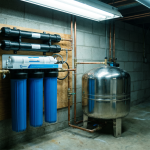
| Residential | 50-100 GPD | Under-sink drinking water, small households | $200 – $800 |
| Light Commercial | 500-2,500 GPD | Cafes, small offices, dental/medical clinics | $2,000 – $15,000 |
| Commercial | 2,500-20,000 GPD | Restaurants, hotels, hospitals, large offices | $15,000 – $75,000 |
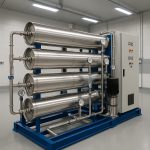
| Industrial | 20,000-500,000+ GPD | Manufacturing, boiler feed, pharmaceutical, municipal | $75,000 – $1,000,000+ |
| Containerized / Mobile | Custom builds, 10,000-1,000,000+ GPD | Remote sites, disaster relief, marine/desalination, temporary capacity | Custom quote |
*Price bands are general industry ranges for planning purposes; actual cost depends on feed-water quality, pre-treatment needs, and system configuration. Contact a specifier for a project-specific quote.
Explore: residential RO systems · commercial RO systems · industrial RO systems · containerized and mobile RO systems
Where Is Reverse Osmosis Used?
Reverse osmosis is used anywhere water quality, consistency, or purity directly affects an operation – restaurants, hospitals, manufacturing plants, office buildings, municipal water systems, and marine or seawater desalination applications. Each setting has different feed water, uptime requirements, and regulatory pressure, which shapes system design more than raw GPD alone.
Restaurants and Food Service
Restaurants use RO to protect ice machines, espresso equipment, and steam ovens from scale buildup caused by hard, mineral-heavy water. Consistent water quality also affects taste consistency in beverages and food prep, which is why many food-service operators treat RO as equipment protection first and taste improvement second.
Hospitals and Healthcare Facilities
Hospitals rely on RO for dialysis water, sterile processing, and lab equipment, where water purity is a regulatory and patient-safety requirement rather than a convenience. These systems typically run continuously and need redundancy built in, since downtime directly affects clinical operations.
Factories and Manufacturing
Manufacturing plants use industrial RO for boiler feed water, process water, and rinse water in production lines. Scale and mineral buildup in boilers reduces efficiency and shortens equipment life, so RO pretreatment is often a maintenance-cost decision as much as a water-quality one.
Offices and Commercial Buildings
Office buildings use light-commercial RO for break-room water stations, coffee service, and building-wide filtered water taps. Demand here is steadier and lower-volume than food service or healthcare, which is why light-commercial systems in the 500-2,500 GPD range typically fit.
Municipal and Marine/Desalination
At the largest scale, municipalities and coastal facilities use industrial and containerized RO systems for seawater desalination and municipal drinking-water treatment. Seawater desalination requires higher operating pressures than brackish or freshwater RO because seawater has substantially higher osmotic pressure to overcome.
What Certifications Matter for RO Equipment?
Certifications matter because they verify that an RO system was designed, tested, and manufactured against independent, third-party standards rather than a manufacturer’s own claims. AMPAC USA holds NSF/ANSI 58 compliance for point-of-use RO systems, ISO 9001:2015 certification for its quality management system, and WQA (Water Quality Association) recognition – three separate signals covering performance, manufacturing process, and industry standing.
NSF/ANSI 58 is the American National Standard covering point-of-use reverse osmosis drinking water treatment systems, addressing structural integrity, material safety, and contaminant reduction claims (NSF International, 2026). ISO 9001 is the international standard for quality management systems, applied across manufacturing processes rather than to a single product line (ISO, 2026).
- NSF/ANSI 58 – the reference standard for point-of-use RO treatment systems, covering structural integrity and contaminant-reduction performance claims.
- ISO 9001:2015 – an international quality-management-system standard applied to the manufacturing process, not a specific product claim.
- WQA (Water Quality Association) – an industry association whose recognition signals adherence to established water-treatment industry standards and practices.
Frequently Asked Questions
What size RO system do I need for a restaurant?
Most full-service restaurants fall in the light-commercial to commercial range, roughly 500-2,500 GPD, depending on ice machine load, espresso volume, and steam equipment. Feed-water hardness and peak-hour usage both push sizing up, so a site-specific water test is the standard way to confirm the right capacity.
What size RO system do I need for a hospital?
Hospitals typically require commercial to industrial-grade systems, often starting around 2,500 GPD and scaling higher for dialysis units, sterile processing, and lab equipment. Redundancy is usually built in, since these applications can’t tolerate downtime the way a break-room water station can.
What size RO system do I need for a factory?
Industrial applications like boiler feed and process water commonly start at 20,000 GPD and can exceed 500,000 GPD at large manufacturing sites. Sizing depends on production volume, feed-water chemistry, and whether the RO output feeds a boiler, a rinse line, or a cooling process.
How much does a commercial reverse osmosis system cost?
Commercial RO systems generally fall between $15,000 and $75,000 depending on GPD capacity, pre-treatment needs, and installation complexity. Feed-water quality has an outsized effect on price, since poor source water often requires additional pre-filtration stages before the RO membranes themselves.
How long do RO membranes last before replacement?
Membrane lifespan depends heavily on feed-water quality, pre-treatment effectiveness, and usage patterns rather than a fixed timeline. Systems with proper pre-treatment and regular maintenance schedules generally see longer membrane service life than systems running untreated, high-scale feed water.
Can reverse osmosis remove all contaminants from water?
No single treatment method removes every possible contaminant, and RO is no exception – it’s highly effective against dissolved salts, many heavy metals, and a wide range of organic compounds, but some dissolved gases and very small molecules can pass through. That’s why RO is often paired with carbon filtration or UV disinfection for full-spectrum treatment.
Choosing the Right RO System for Your Application
Reverse osmosis scales from a 50-GPD under-sink unit to a 500,000-GPD industrial plant, and the right choice depends on peak demand, feed-water quality, and how much downtime your operation can tolerate. Getting the GPD range right up front avoids the two most common mistakes: undersizing (which shortens membrane life) and oversizing (which wastes capital).
Whether you’re specifying a system for a single restaurant location or a multi-site industrial rollout, matching capacity to actual peak demand – not just headcount or square footage – is the single factor that most affects long-term cost and performance. A water test and a load calculation, done before equipment selection, will save more money than any spec-sheet comparison.