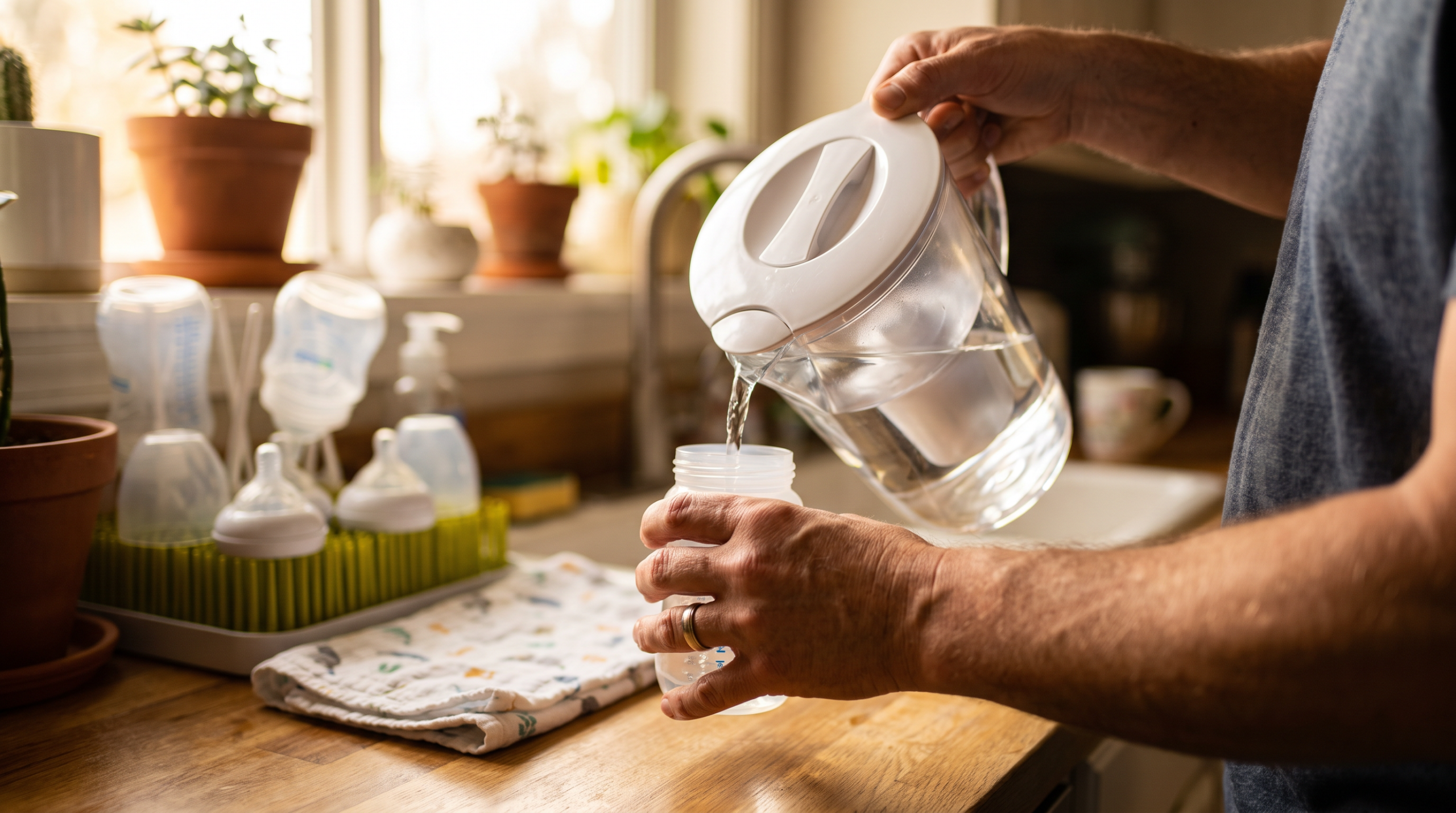

In short: for most households on a regulated municipal water supply, tap water is fine for mixing infant formula. But two risks deserve real attention from parents: Cryptosporidium, a parasite that survives standard chlorine disinfection and is the leading cause of waterborne disease outbreaks in the US, and arsenic, which the EPA caps at 10 parts per billion in drinking water but which has no separate, lower limit set for infant exposure. Well water adds a third risk, nitrate, which can cause a rare but serious blood disorder in bottle-fed babies under six months old. None of this means panic. It means knowing your water source and treating it appropriately before it goes into a bottle.
Formula-fed infants drink more water, relative to their body weight, than almost anyone else in a household. A newborn taking in 25 ounces of reconstituted formula a day is getting a concentrated, repeated dose of whatever is in that water, every single bottle, every single day, for months. That’s a different exposure pattern than an adult drinking a glass of water occasionally, and it’s why pediatric and public health guidance treats formula water as its own category, not just “drinking water.”
Why Can’t Chlorine Kill Cryptosporidium?
Cryptosporidium is a microscopic parasite protected by a hard outer shell that resists the chlorine levels used in standard municipal water treatment. It survives disinfection that would kill most bacteria, which is exactly why it’s become the leading cause of waterborne disease outbreaks in the United States, accounting for roughly half of all reported waterborne outbreaks in recent CDC surveillance years.
The CDC estimates around 823,000 cryptosporidiosis cases occur annually in the US, though fewer than 2% get formally reported, so the real burden is likely far higher than the official case counts suggest. For a healthy adult, a Crypto infection usually means a rough week of watery diarrhea and cramping. For an infant, whose immune system and hydration reserves are both still developing, the same infection can escalate faster and hit harder.
This is why the CDC’s guidance during a boil water advisory is specific: bring tap water to a full rolling boil for one minute before using it in formula, even if the water has already passed through a home filter or pitcher, because standard carbon filtration doesn’t reliably remove Cryptosporidium either. Only boiling, or a filter specifically rated for cyst and oocyst removal, gets the job done.
Is Arsenic in My Tap Water Actually a Problem for My Baby?
Arsenic becomes a meaningful concern for formula-fed infants because they’re drinking multiple bottles a day from the same water source, week after week, at a body weight that’s a fraction of an adult’s, which means the same contaminant level translates into a much higher relative dose.
The EPA sets the legal limit for arsenic in public drinking water at 10 parts per billion, a standard adopted in 2001 to replace the older, far looser 50 ppb limit. That’s the number municipal utilities have to meet. What doesn’t exist is a separate, lower limit built specifically around infant exposure, even though the EPA itself states that arsenic has moderate-to-robust evidence linking it to effects on infant growth and childhood cognitive and neurological development.
Arsenic shows up more heavily in groundwater from certain geological regions, parts of New England, the Southwest, and the Midwest in particular, and it’s almost entirely a groundwater issue, meaning private well owners in those regions carry more of the risk than people on treated municipal supplies. If you’re on a well, or you live in one of those higher-risk regions and aren’t sure what’s coming out of your tap, testing is the only way to know for certain rather than guessing.
What About Nitrate and “Blue Baby Syndrome”?
Nitrate contamination in well water can cause methemoglobinemia, commonly called blue baby syndrome, a condition where an infant’s blood loses its normal ability to carry oxygen, and bottle-fed babies under six months old are the population at highest risk.
The warning signs are specific: a blue-gray tint to the skin, lips, or fingernails, along with unusual irritability or lethargy. Left unrecognized, it can progress to seizures or worse, which is why the EPA’s 10 mg/L nitrate limit exists specifically with infant protection in mind. Nitrate mostly comes from agricultural runoff, fertilizer, livestock operations, and septic systems near a well, so it’s overwhelmingly a rural and private-well issue rather than something municipal customers need to worry about, since city water is tested for it routinely.
Does the American Academy of Pediatrics Say Tap Water Is Safe or Not?
The AAP’s position is conditional, not a blanket yes or no: if your local health department confirms your tap water is safe, room-temperature tap water is fine for mixing formula; if it’s unsafe or you’re unsure, use bottled water or briefly boiled and cooled tap water instead.
The AAP is also specific about how long to boil: no more than one minute. Boiling longer doesn’t add safety, it just evaporates water and concentrates whatever minerals or contaminants remain, working against the goal instead of helping it. And separately from contamination risk, the AAP has been explicit on a related point that trips up a lot of new parents: never dilute formula with extra water to stretch it further. Doing so throws off an infant’s electrolyte balance and can trigger seizures from water intoxication, a completely different mechanism from anything discussed above, but worth stating clearly here because the instinct to “make the can last longer” is common and genuinely dangerous.
So What Water Source Is Actually Safest for Formula?
The safest options, in order of convenience and reliability, are ready-to-use liquid formula (no water needed at all), properly treated tap water from a confirmed-safe municipal source, or tap water that has passed through a filtration system rated to remove both microbial cysts and chemical contaminants like arsenic and lead.
This is where a home reverse osmosis system earns its keep for families preparing formula regularly. RO membranes are fine enough to reject Cryptosporidium oocysts along with dissolved arsenic, nitrate, and lead, the exact contaminant list that matters most for infant water safety, in a single pass, without needing to boil a pot of water for every bottle at 2 a.m. AMPAC’s residential reverse osmosis systems are built around that kind of multi-barrier filtration, and for anyone comparing how RO stacks up against pitcher filters or boiling, our reverse osmosis overview breaks down what the membrane actually removes and why it matters for a household with an infant in it.
Well water households have an extra step regardless of filtration: get the well tested annually for nitrate, arsenic, and coliform bacteria, since none of that is regulated or monitored the way municipal water is, and a filter can only address what it’s designed for, not what’s untested and unknown.
What Should Parents Actually Do This Week?
Find out where your water comes from and whether it’s municipal or well. If it’s municipal, pull your utility’s most recent Consumer Confidence Report, it’s public and usually a quick search away, and check the arsenic and disinfection byproduct numbers specifically. If it’s a well, get it tested for nitrate and arsenic if you haven’t in the past year. If there’s ever a boil water advisory in your area, use ready-to-use formula if you have it on hand, and if you don’t, boil the water for exactly one minute, no more, no less, and let it cool before mixing.
None of this is about fear. It’s about matching the water source to what it actually needs before it goes into a bottle a newborn is going to finish in ten minutes and ask for again in three hours.
Frequently Asked Questions
Can I use a regular pitcher water filter for baby formula instead of boiling?
Standard carbon pitcher filters are not reliably rated to remove Cryptosporidium, so the CDC recommends boiling tap water for one minute during a boil water advisory even if it has already passed through a home filter. A reverse osmosis system, by contrast, is fine enough to remove Cryptosporidium oocysts directly.
Is bottled water automatically safer than tap water for formula?
Not automatically. The FDA holds bottled water to the same 10 ppb arsenic limit the EPA sets for municipal tap water, so bottled water isn’t a guaranteed upgrade, it’s simply an alternative source, and it should still be treated as unsterile unless the label specifically says otherwise.
How long should I boil water for infant formula?
Bring it to a rolling boil for exactly one minute, then let it cool to room or body temperature before mixing. The AAP specifically warns against boiling longer, since that concentrates minerals and contaminants rather than removing them.
Do I need to worry about arsenic if I’m on city water, not a well?
Less than well-water households, since municipal utilities are required to meet the EPA’s 10 ppb limit, but “meets the legal limit” and “zero risk for a bottle-fed infant” aren’t the same statement, given there’s no separate infant-specific threshold. Checking your utility’s Consumer Confidence Report is a five-minute way to see your actual numbers.
What are the warning signs of blue baby syndrome from nitrate?
A blue-gray discoloration of the skin, lips, or nailbeds, combined with unusual lethargy or irritability in an infant under six months old. It’s rare and tied almost exclusively to nitrate-contaminated well water, but it progresses quickly, so it warrants immediate medical attention, not a wait-and-see approach.
Sources: CDC (Cryptosporidium prevention, boil water guidance, infant formula preparation); EPA (arsenic and nitrate drinking water standards, chemical contaminant rules); American Academy of Pediatrics / HealthyChildren.org (formula water preparation guidance); CDC MMWR cryptosporidiosis outbreak surveillance 2009-2017.
AMPAC USA engineers custom water purification systems for commercial, industrial, and emergency applications — from 500 GPD to multi-million GPD. Trusted by municipalities, military, and industry worldwide.