
In short: Organophosphate esters (OPEs), the chemicals that replaced older brominated flame retardants in furniture, electronics, and building materials, have been detected in more than 90% of tap water samples tested in multiple studies, including compounds already listed by California as carcinogens. Conventional drinking water treatment removes very little of them. Reverse osmosis, particularly at industrial scale, is one of the few technologies documented to reliably strip them out of the water supply.
If that’s the first time you’ve heard the term “organophosphate ester,” you’re not alone. These chemicals don’t get the press that PFAS gets, but they’re in more places than most people realize, and the water research on them has been building quietly for years.
What Are Organophosphate Esters, and Why Are They in Water at All?
Organophosphate esters are a class of chemicals used as flame retardants and plasticizers in everything from couch cushions and mattress foam to circuit boards, car interiors, and building insulation. They became common after the early 2000s, when several older brominated flame retardants were phased out over health concerns and manufacturers switched to OPEs as the replacement.
The problem is that OPEs aren’t chemically bound into the products they’re added to. They leach out slowly, into household dust, into air, and eventually into wastewater and surface water, which is how they end up in the water systems that feed treatment plants. A study of Shanghai’s tap water system found three OPE compounds, tributyl phosphate (TBP), tris(2-chloroethyl) phosphate (TCEP), and tris(1-chloro-2-propyl) phosphate (TCIPP), in more than 90% of samples collected across the distribution network, from source water through to the tap (PMC). Similar patterns have shown up in drinking water treatment plant studies in South Korea, where OPFRs were tracked alongside PFAS through the treatment process (PMC).
This isn’t a contamination event tied to one factory or one spill. It’s a structural feature of how these chemicals are used, and it means trace-level OPE presence in tap water is closer to the norm than the exception in tested municipal systems.
What Do We Actually Know About the Health Risk?
The clearest health signal comes from California’s regulatory record. Two OPE compounds specifically, TDCIPP (also called chlorinated tris) and TCEP, are listed under California’s Proposition 65 as chemicals known to cause cancer, based on laboratory animal studies showing carcinogenic effects (California OEHHA). Both were common in polyurethane foam furniture and mattresses before a 2020 California law restricted their use in new products sold in the state (California OEHHA).
Beyond the cancer listing, peer-reviewed research has linked broader OPE exposure to reproductive effects, lower IQ scores in children, and endocrine disruption. A risk assessment published in Water Research used EPA’s own oral reference dose and cancer slope factor methodology to evaluate OPE exposure through drinking water and found that while hazard quotients generally sat in a low-risk range, the calculated risk to children was consistently higher than the risk to adults (PubMed). That’s a pattern that shows up again and again in water contaminant research: children absorb more relative to body weight and are exposed during periods of rapid development, so what registers as “low risk” on an adult scale carries more weight for the youngest people drinking that water.
There’s no federal Maximum Contaminant Level for OPEs in drinking water yet. That absence of a hard EPA limit sometimes gets read as “not a real problem.” It’s more accurate to read it as “the regulatory process hasn’t caught up to compounds that only started showing up broadly in water testing in the last decade or so.” Prop 65 and the underlying toxicology studies are running ahead of the plumbing code.
Why Doesn’t Regular Water Treatment Remove These Chemicals?
Conventional treatment processes, coagulation, sedimentation, sand filtration, and chlorination, were designed for pathogens, sediment, and a specific list of legacy contaminants. Organophosphate esters are small, largely uncharged organic molecules that pass through most of those steps without much resistance.
Research specifically comparing treatment stages found that OPEs persisted through standard drinking water purification, with the review literature describing conventional treatment as generally ineffective at removing them, particularly the chlorinated variants like TCEP, which resist the chemical processes that work on other pollutants (MDPI). A separate review covering OPE occurrence and removal technologies across water treatment systems reached the same conclusion: standard municipal treatment is not built to catch this class of chemical, and the compounds accumulate as they cycle through the water system rather than breaking down (ScienceDirect).
That gap is exactly why OPEs show up consistently at the tap, even in cities with modern treatment infrastructure. The plant is doing its job on the contaminants it was designed for. OPEs were never on that original list.
Does Reverse Osmosis Actually Remove Organophosphate Esters?
Yes, and the data here is more concrete than for most emerging contaminants. A study of a municipal landfill leachate treatment system, a setting with far higher OPFR concentrations than typical drinking water, found that microfiltration paired with reverse osmosis was the critical step in removal, while biological treatment stages contributed comparatively little. Total OPFR concentration dropped from 4,807 nanograms per liter to 103.91 nanograms per liter through the full system, with close to 98% of the dissolved-phase compounds removed once RO was applied (PubMed).
That number matters because it’s measuring the hardest case: a waste stream, not clean source water, going through membrane treatment. RO’s dense, semi-permeable membrane physically excludes molecules by size and charge rather than relying on a chemical reaction that a specific compound might resist. That’s the mechanical advantage over chlorination or standard filtration: it doesn’t need to “recognize” the contaminant to reject it.
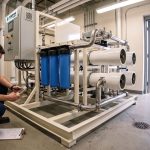
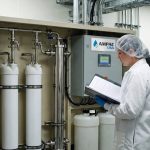
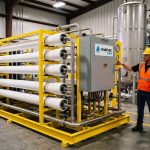
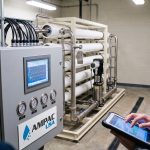
This is the layer AMPAC USA works in directly. For facilities producing water at real volume, whether that’s a manufacturing plant managing process water or a municipal system upgrading its treatment train, our industrial reverse osmosis systems are built around the same membrane principle documented in that removal study: physically excluding dissolved organic contaminants that conventional treatment steps let through. It’s not a chemical workaround for one flame retardant compound. It’s a filtration approach that doesn’t care which emerging contaminant shows up next.
What Can Someone Do About This at the Tap or in the Home?
At the household level, point-of-use reverse osmosis is the most consistent answer the research supports. Because OPEs pass through municipal treatment largely intact, a home’s tap water reflects whatever made it through that plant, and RO membrane filtration installed after the tap is one of the few consumer-accessible technologies with documented removal performance against this contaminant class, for the same physical-exclusion reason described above.
For households weighing options, AMPAC’s residential reverse osmosis systems apply that same membrane filtration at the point of use, rather than relying on the municipal treatment chain to catch a class of chemical it wasn’t originally designed to catch.
Outside of filtration, the practical exposure-reduction steps mirror general advice on OPEs in dust and indoor air: checking furniture and children’s product labels for flame retardant disclosures, since the 2020 California restrictions only apply to new products sold in that state, and ventilating and dusting regularly, since indoor dust is a major non-water exposure pathway for the same chemical class.
Is This Going to Become the Next PFAS-Style Regulatory Story?
It’s too early to say with certainty, but the pattern is familiar. PFAS spent years accumulating peer-reviewed detection and health-effect data in academic literature before EPA moved to a federal drinking water standard. OPEs are earlier on that same curve: broad detection data exists, state-level carcinogen listings exist for specific compounds, and removal-technology research exists. What’s missing is a federal MCL, and that typically arrives years after the science, not alongside it.
For facility operators and utilities, waiting for a federal number before investing in better filtration has historically meant playing catch-up once the deadline lands. The safer read of research like this is: the removal technology already works, and it doesn’t require a coming regulation to justify installing it now.
Frequently Asked Questions
What are organophosphate esters used for?
They’re used as flame retardants and plasticizers in furniture foam, mattresses, electronics, vehicle interiors, and building insulation, largely as replacements for older brominated flame retardants phased out in the early 2000s.
Are organophosphate esters actually dangerous in drinking water?
Two specific compounds, TDCIPP and TCEP, are listed by California’s Prop 65 program as known carcinogens based on animal studies. Broader research has linked OPE exposure to reproductive effects and lower IQ in children, and one drinking water risk assessment found children carry a higher relative risk than adults, even though overall calculated hazard levels were low.
Does boiling water remove flame retardant chemicals?
No. Boiling concentrates dissolved solids rather than removing organic compounds like OPEs, and it has no documented effect on this contaminant class.
Can a standard water filter pitcher remove organophosphate esters?
Most basic carbon pitcher filters aren’t tested or certified against OPEs specifically. The removal data that exists points to reverse osmosis membrane filtration, which physically excludes the molecules by size, as the technology with documented performance against this contaminant class.
Is there a federal limit on organophosphate esters in drinking water?
Not currently. There is no EPA Maximum Contaminant Level specific to OPEs as of this writing, even though state-level carcinogen listings and peer-reviewed detection and risk data already exist.
Sources: PMC (Shanghai tap water study); PMC (Korea drinking water treatment plants); PubMed (Water Research risk assessment); California OEHHA Prop 65 fact sheets; MDPI (OPE removal technologies review); ScienceDirect (OPE occurrence and removal review); PubMed (landfill leachate RO removal study).
AMPAC USA engineers custom water purification systems for commercial, industrial, and emergency applications — from 500 GPD to multi-million GPD. Trusted by municipalities, military, and industry worldwide.