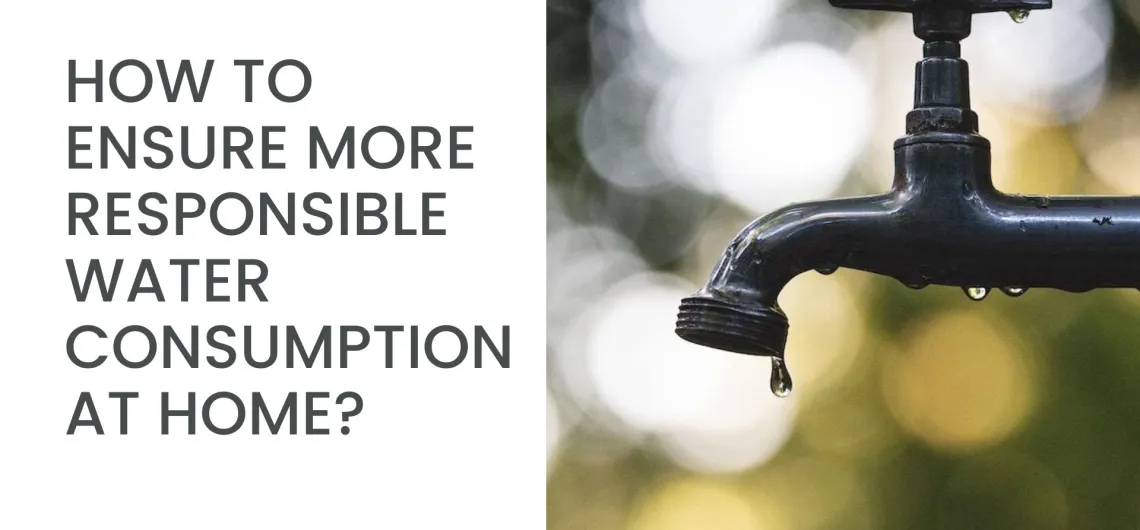

In the words of Leonardo Da Vinci, water is the driving force of all nature. It’s a vital element for all living beings and is a precious commodity. It is a non-renewable natural resource essential for the survival of all living beings. So, when consuming it, n should be more responsible and take only what they need. The process of saving water should start in every home. Here are a few pointers on how to ensure more responsible water consumption at home.
-
Review Your Water Usage
You need to check the installation of indoor and outdoor piping and plumbing at regular set periods to ensure there are no leaks. It will help you to avoid any potential breakouts and help reduce the wastage of water.
-
Install Aerators on the Faucets
In a home, the usage of water is primarily through faucets. You can reduce or minimize water consumption by installing faucet aerators. It will help increase water savings, reduce water usage, and ensure responsible water consumption.
-
Invest in the Right Appliances
To ensure more responsible water consumption at home, it is also wise to replace your old water-consuming appliances like dishwashers, washing machines, etc., with more advanced versions that consume less water and still give impressive results. These appliances also consume less energy than their predecessors, so that you can expect significant savings in power bills. Consider them as an investment that pays off every month.
- Install Low Consumption Toilets
Another investment you need to consider is water-saving or ecological toilets. You can pick one from countless options according to your needs and requirements. If you can’t invest in such a toilet, you can try the simple alternative of placing a plastic bottle filled with water or soil inside the cistern. It will help you to save water volume.
-
Use a Wastebasket in the Bathroom
To use water more responsibly, you can place a wastebasket next to the toilet. Doing so will remind you not to flush water without reason. Every time you flush the toilet without any contents, you waste water. If you stop this habit, you can save considerable water every day.
-
Collect Shower Water
It is also smart to collect water when it is warming up in the shower. Water in the shower can take up to 2 minutes to reach the desired temperature. So, you should collect the water when it reaches the desired temperature in a bucket and use it later for purposes like cleaning, watering the plants, etc.
Other Useful Methods to Help You Use Water More Responsibly
- Consider rainwater harvesting
- Use a glass of water when brushing your teeth to avoid wasting water in the sink
- Choose short showers instead of long baths
- Turn off the faucet when cleaning dishes or cleaning stuff
- Use the washing machine or dishwasher only when the load is full
- Wash fruits and vegetables in a single container
- Soak pans and pots after use to avoid a long washing process
Trust AMPAC USA for Pure Water
If you use water responsibly but are concerned about water purity in your home, office, commercial establishment, or industry, trust AMPAC USA. We are a leading manufacturer and distributor of high-quality American-made water treatment systems. The company was founded in 1990. AMPAC USA started as a manufacturer of water purification equipment. Over the years, the business has transitioned into a large-scale manufacturer producing all types of major purification equipment and turnkey project-based water infrastructure installations.
AMPAC USA is particularly noted for its superior technical services. We understand harsh operating marine conditions. We use military and marine-grade certified components in off-shore and on-shore reverse osmosis watermakers. We build easy-to-operate, heavy-duty, robust, and reliable equipment. Without compromise, AMPAC USA custom-engineers, designs, fabricates, and manufactures systems to suit the toughest water treatment conditions anywhere on the planet.
To know more about us, click here or call us at 909-548-4900.
Reference:
https://wellwo.es/en/more-responsible-water-consumption-at-home/
What flow rates are available for emergency water treatment?
AMPAC USA's emergency systems range from 1,500 GPD portable units to 50,000+ GPD trailer-mounted systems. Military-specification units are available for forward operating base deployment, producing potable water meeting EPA and WHO drinking water standards from virtually any source.
Are emergency RO systems suitable for disaster relief operations?
Yes. AMPAC USA's emergency systems are used by FEMA, the U.S. military, and international NGOs for disaster relief. They treat flood water, contaminated groundwater, and brackish sources, removing bacteria, viruses, and chemical contaminants to produce safe drinking water on-site.
What power sources can emergency water purification systems use?
AMPAC USA's emergency systems can run on generator power (120/240V or 480V 3-phase), solar panels with battery backup, or vehicle power take-off (PTO). Low-power models consume as little as 0.5 kW, making them viable for off-grid deployment.
How durable are military-grade water purification systems?
AMPAC USA's military systems are built to MIL-SPEC standards with stainless steel frames, powder-coated components, and UV-resistant materials. They are designed to operate in temperatures from -20°F to 120°F and are vibration-tested for transport in military vehicles.