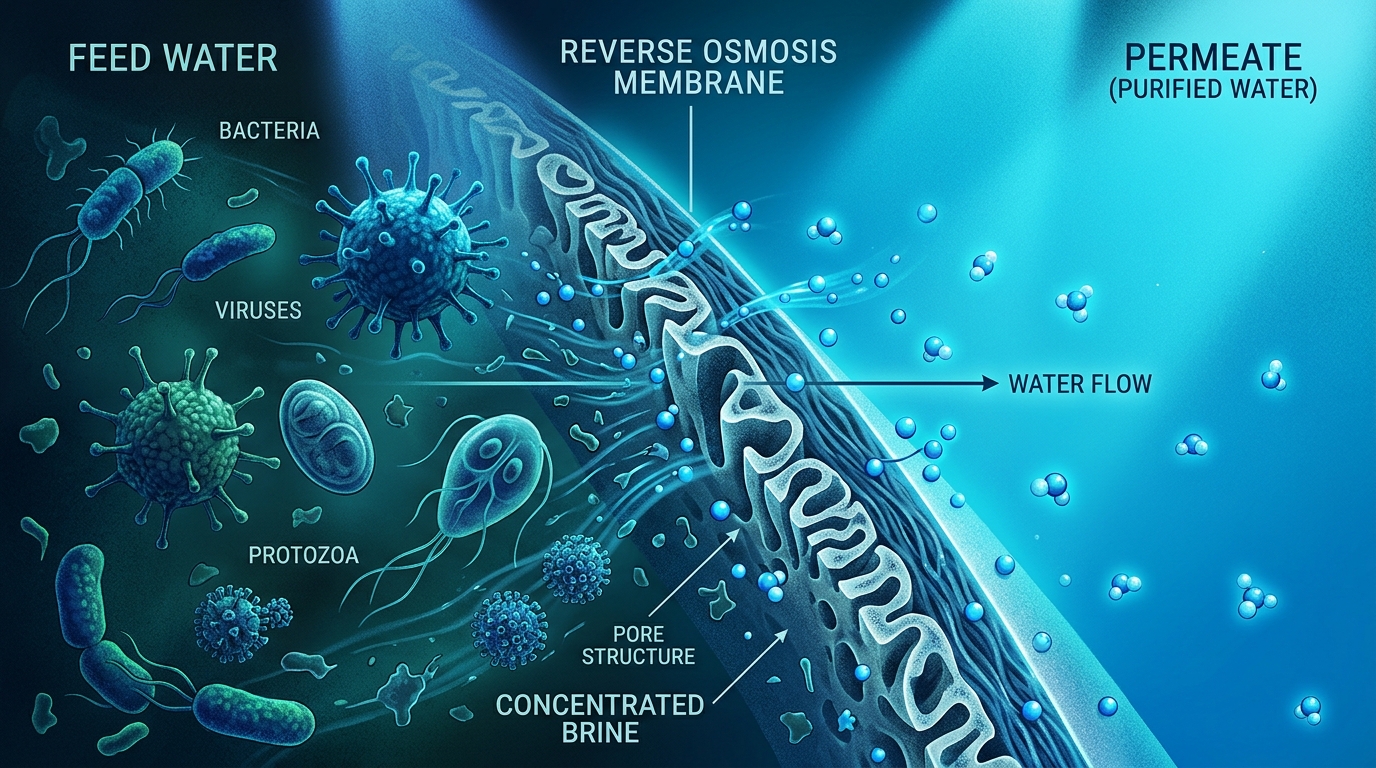

Quick Answer: When cyanobacteria bloom in lakes, reservoirs, and rivers used for drinking water, it creates serious treatment problems. You get cyanotoxins like microcystins, cylindrospermopsins, and saxitoxins, which can be dangerous for your health. Plus, they make the water taste and smell bad, thanks to compounds like geosmin and 2-MI. Good news: advanced water treatment, especially reverse osmosis, really helps with these water quality issues. AMPAC USA builds commercial and industrial systems specifically to handle these problems, and their performance is certified and proven.
Zamyadi, Arash; Henderson, Rita K.; Newton, Kelly; Capelo-Neto, Jose; Newcombe, Gayle
WATER, 10 (5):10.3390/w10050590 MAY 2018
Abstract: In recent years, we’ve seen more and more potentially toxic cyanobacteria show up in water supplies all over the world. For more than thirty years, people have focused on how to manage cyanobacteria in source water and throughout the drinking water treatment process. But even with tons of research and published guides, we still have knowledge gaps. These gaps make it tough to confidently apply specific treatment strategies to reduce the taste, odor, and health risks from cyanobacteria and their byproducts at a large scale.
This project aims to give the water industry a set of tools and other resources. These will help put in place a regulatory framework for water quality management, so we can better assess and manage the aesthetic and toxicity risks from cyanobacteria. This study did two main things:
First, we created a guide for treatment plant operators. It uses real-world examples to show them how to audit their plants and do investigative sampling. This helps them assess cyanobacteria risks and check how well their current processes work.
Second, we validated a treatment model. You can use this model at any plant as a guide to see how much cyanobacteria and its byproducts get removed, and what quality of treated water you can expect, even when cyanobacteria levels are challenging.
We collected full-scale samples from 14 water treatment plants in three Australian regions to validate the model. The results here give us a huge database of how well different water quality and treatment processes remove 2-methylisoborneol (MIB) and geosmin.
Here are the main things we found:
- The investigative sampling procedures we developed work well, and utilities have successfully used them.
- Routine monitoring data is important, but investigative sampling within the treatment plant gives you much more detailed and useful information about how effective each process is.
This paper also points out what we still don’t know and where we need more studies.
ISSN:2073-4441
http://www.mdpi.com/2073-4441/10/5/590
The post Assessment of the Water Treatment Process’s Empirical Model Predictions for the Management of Aesthetic and Health Risks Associated with Cyanobacteria appeared first on Facts About Water.
Source: Water Feed
AMPAC USA engineers custom water purification systems for commercial, industrial, and emergency applications — from 500 GPD to multi-million GPD. Trusted by municipalities, military, and industry worldwide.