
Zero liquid discharge (ZLD) used to mean one thing: a nine-figure mega-project bolted onto a coal plant or a chemical complex, justified only by a regulatory consent decree. That’s changing. The global ZLD systems market is on pace to grow from an estimated $8.42 billion in 2025 to $12.40 billion by 2030 — an 8.0% compound annual growth rate — according to a March 2026 MarketsandMarkets report. The driver isn’t just heavy industry anymore. It’s mid-size manufacturers who are discovering that ZLD doesn’t have to be all-or-nothing — and that industrial reverse osmosis is usually the affordable part of the system, not the expensive part.
What Zero Liquid Discharge Actually Requires
Zero liquid discharge means exactly what it sounds like: a facility treats its wastewater so thoroughly that nothing gets discharged to a sewer, river, or storm drain — every drop is either reused on-site or converted to a solid residue for disposal. In practice, that requires two distinct stages working together: a concentration stage that removes clean water from wastewater and shrinks the remaining volume, and a finishing stage — evaporation, crystallization, or both — that drives what’s left down to a dry or near-dry solid. Most of the cost and complexity in a ZLD system lives in that second, thermal stage, which is exactly why the first stage matters so much.
The mistake a lot of procurement teams make is picturing ZLD as one large piece of equipment. It’s actually a treatment train, and the sizing of each stage depends entirely on how much volume-reduction work happens before the water reaches the thermal equipment. That’s where reverse osmosis comes in.
Reverse Osmosis Does Most of the Volume-Reduction Work
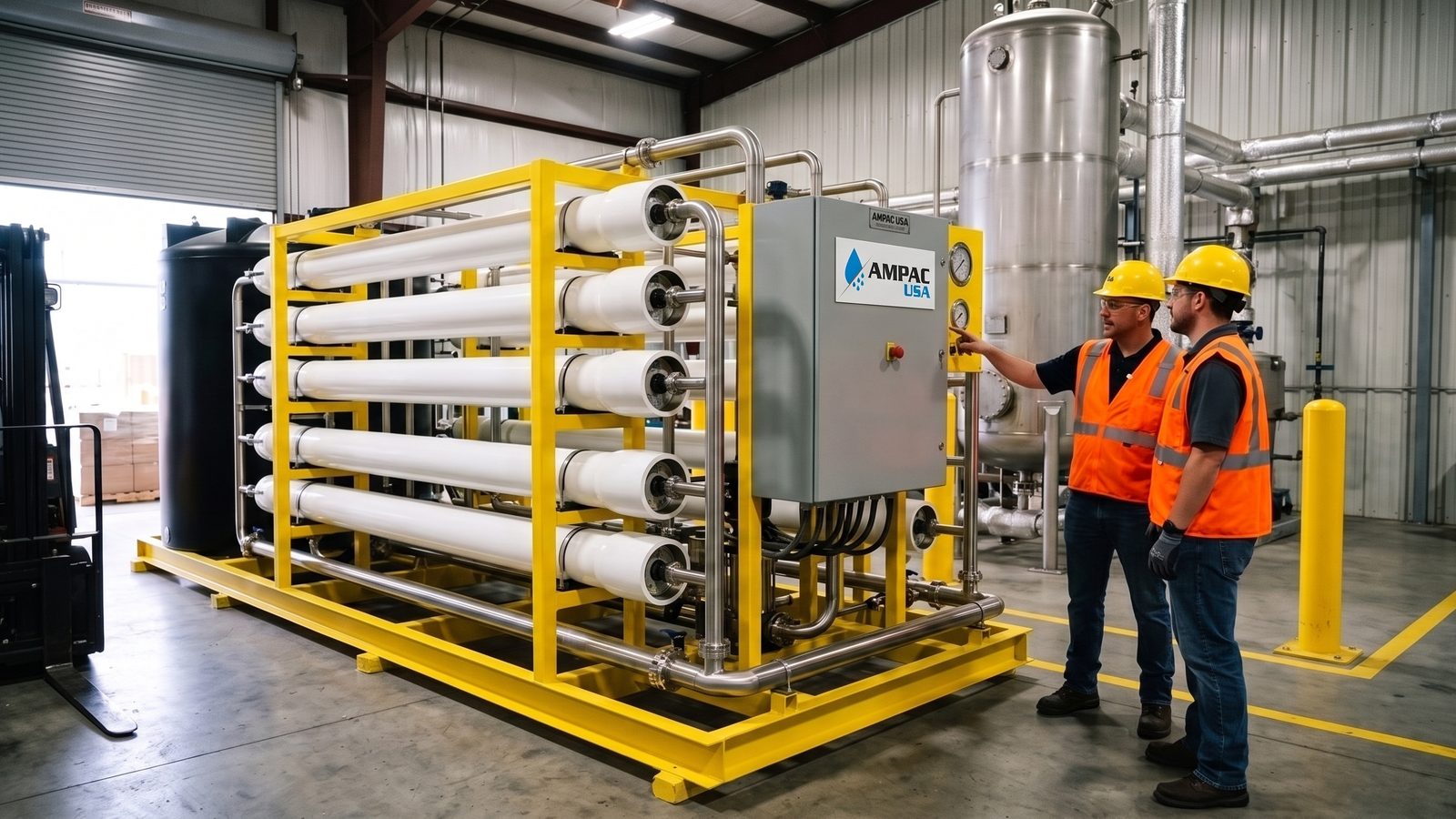
Reverse osmosis is the first-stage concentrator in nearly every modern ZLD design, and it does the majority of the volume reduction before water ever reaches a thermal evaporator. RO uses membrane pressure rather than heat to separate clean permeate from a shrinking concentrate stream, and because membrane separation is far less energy-intensive than boiling water, it’s the economical place to do as much of the concentrating as the feed chemistry allows. As one technical explainer from Water Online lays out, cutting a concentrate stream in half with membrane treatment before it reaches thermal equipment cuts the downstream thermal load by half; pushing that reduction further — down to roughly 30% of the original volume — cuts thermal-stage volume by around 70%.
That relationship is the entire economic case for ZLD as a staged system rather than a single machine. Evaporators and crystallizers are priced and operated by the gallon they have to process, and every gallon RO removes upstream is a gallon the thermal stage never has to touch. A well-designed industrial RO system can typically recover a large majority of incoming water as clean permeate before the remaining concentrate ever reaches a brine concentrator, which is why engineering firms increasingly describe RO as the workhorse of a ZLD train and thermal equipment as the finisher.
Why ZLD Is Moving From Mega-Project to Mainstream
Three forces are pulling ZLD out of the niche-industrial-giant category and into plans for mid-size manufacturers: tightening ultrapure-water supply in electronics manufacturing, real (if uneven) regulatory pressure on industrial discharge, and the cost of ordinary permitted discharge itself, which keeps rising. None of these forces requires a company to be a Fortune 500 chemical producer to feel them.
Semiconductor and electronics water demand
A single semiconductor fab can consume up to 10 million gallons of ultrapure water per day — more than 33,000 U.S. households use daily, according to EPA figures cited in an August 2025 Manufacturing Dive report. Manufacturing operations account for roughly 76% of the total water a fab withdraws, and purity targets are moving from parts-per-billion toward parts-per-quadrillion, meaning both the water going in and the water coming out require heavier treatment than a generation ago. TSMC reported replacing 12% of its water resources with reclaimed water in 2023, and Intel’s Phoenix-area campus now restores more water to its watershed than it consumes — evidence that reclaim-and-reuse loops, the same logic that underpins ZLD, are becoming standard practice rather than a compliance afterthought.
Regulatory direction, even where deadlines slip
Regulators keep writing zero-discharge requirements into federal rules, even when they extend the timelines to comply. The EPA’s steam electric power generating effluent guidelines, finalized December 31, 2025, pushed the zero-discharge compliance deadline for several wastewater streams from 2029 out to 2034 — but the zero-discharge requirement itself stayed on the books. That’s the pattern worth watching: deadlines move, the destination doesn’t. Manufacturers in sectors with tightening effluent limits gain more by building toward that destination early than by waiting for the next extension.
State regulators are rewriting the reuse rules too
It isn’t only federal rulemaking pushing manufacturers toward water reuse. Texas, one of the largest industrial states in the country, issued a new 2026 Multi-Sector General Permit for industrial stormwater that took effect August 14, 2026, and the Texas Commission on Environmental Quality is simultaneously developing new permitting pathways for reusing treated industrial and produced water rather than disposing of it. States tightening reuse and discharge permitting at the same time regulators extend federal deadlines send the same signal from two directions: the expectation is reuse, and facilities that build toward it now aren’t waiting on anyone’s compliance calendar.
The cost of ordinary discharge keeps climbing
Even facilities with no ZLD mandate feel the cost pressure directly through sewer surcharges. King County, Washington’s industrial waste program, for example, charges high-strength dischargers $0.4890 per pound of biological oxygen demand and $0.5675 per pound of total suspended solids, effective January 1, 2026 — fees that scale directly with how much organic load a facility sends to the sewer. Food and beverage processors, in particular, pay these surcharges on every pound of BOD and TSS in their wastewater, which means reducing discharge volume and strength isn’t just an environmental goal, it shows up on the utility bill.
Right-Sized RO Is a Practical Entry Point, Not an All-or-Nothing Bet
Most content written about ZLD treats it as a binary: either you build the full mega-project or you don’t do ZLD at all. That framing made sense when ZLD meant a solar-evaporation-pond-scale project for a refinery or a coal plant. It doesn’t hold up anymore, because the concentration stage — the RO train that does most of the volume-reduction work — is modular, scalable, and can be specified for a facility’s actual flow rate rather than an industry-wide worst case.
A manufacturer facing rising discharge surcharges or a looming water-reuse mandate doesn’t have to commission a crystallizer on day one. The practical sequence looks more like this: install a right-sized reverse osmosis system to recover and reuse the bulk of process water and shrink the waste stream first, then evaluate whether the remaining concentrate is small enough to handle with a modest thermal finishing step, contract hauling, or a phased addition later. That sequencing lets a company capture most of the water-reuse savings and most of the discharge-cost reduction immediately, using equipment that’s a known quantity to procurement and engineering teams already familiar with industrial RO from other parts of the plant.
This is also where the semiconductor sector’s experience is instructive for other manufacturers, not just a curiosity. Fabs didn’t jump straight to zero discharge either — they built up through incremental reclaim loops, as TSMC’s and Intel’s reported reuse figures show. A mid-size manufacturer facing its own water-reuse mandate, rising discharge fees, or a stressed local water supply can follow the same incremental logic: concentrate first, decide on the finishing stage once the RO system reveals how small the remaining problem actually is.
What This Means for Procurement and Engineering Teams
The practical takeaway for a plant facing a water-reuse mandate or a rising sewer bill is to size the RO stage against real flow and chemistry data before assuming a full ZLD build is required or unaffordable. Because RO handles the bulk of the volume reduction, getting that stage right determines the size — and cost — of everything downstream. Facilities considering this path should generally:
- Pull actual wastewater flow, TDS, and organic-load data rather than relying on industry averages, since RO recovery rates depend heavily on feed chemistry and fouling potential.
- Model the RO recovery rate that’s realistic for the feed water, not the theoretical maximum, to get an honest picture of how small the remaining concentrate stream will be.
- Treat thermal finishing (evaporation or crystallization) as a separate, later decision once the concentrate volume from RO is known, rather than sizing it up front.
- Compare the RO-first cost against current and projected discharge surcharges, not just against the price of a full ZLD system, since the RO stage alone often pays for itself through reuse and reduced surcharge exposure.
None of this requires guessing. It requires a pilot or a feed-water study, an RO system sized to real numbers, and a willingness to treat the thermal stage as a decision for later rather than a reason to delay starting at all.
The teams that get this wrong tend to make one of two mistakes: they either treat ZLD as an eventual someday-project and take no action while surcharges and reuse pressure keep building, or they scope a full evaporation-and-crystallization system before confirming how much volume RO alone can remove. Both mistakes are avoidable with the same fix — start the sizing conversation with the concentration stage, on real flow and chemistry data, before pricing anything downstream of it.
Frequently Asked Questions
What is zero liquid discharge (ZLD)?
Zero liquid discharge is a wastewater treatment approach where a facility recovers and reuses essentially all of its process water, leaving no liquid discharge to a sewer or waterway. It combines a concentration stage, typically reverse osmosis, with a thermal finishing stage such as evaporation or crystallization that converts the remaining concentrate into a solid for disposal.
Do I need a full ZLD system, or can I start smaller?
Most manufacturers can start with a right-sized reverse osmosis system that concentrates wastewater and recovers reusable permeate, then decide later whether a thermal finishing stage is needed for the remaining volume. Since RO handles most of the volume reduction, this staged approach captures most of the reuse and cost benefits without committing to a full ZLD build immediately.
How much of the water volume does reverse osmosis remove before thermal treatment?
The exact recovery rate depends on feed water chemistry and fouling potential, but RO is designed to do the bulk of the volume-reduction work in a ZLD train. Industry technical guidance shows that concentrating a wastewater stream to roughly a third of its original volume with membrane treatment can cut the volume reaching thermal equipment by around 70%.
Is ZLD only worthwhile if regulation requires it?
No. Many facilities pursue partial or full water-reuse systems purely for cost reasons, since sewer surcharges for high-strength wastewater and rising water-acquisition costs can make recovering and reusing process water pay for itself independent of any discharge mandate. Regulatory pressure accelerates the timeline, but it isn’t the only justification.
Which industries are adopting ZLD or near-ZLD approaches now?
Semiconductor and electronics manufacturing is a leading driver due to ultrapure-water demand and water-reuse targets, but chemicals, pharmaceuticals, food and beverage, and power generation facilities are also expanding water-reuse and concentration systems as discharge costs and water-reuse mandates increase across those sectors.
ZLD doesn’t have to start as a mega-project. For most manufacturers, the practical first move is sizing an industrial reverse osmosis system to real feed-water data and letting that concentration stage show you how small the remaining problem actually is before committing to anything more.