
Every factory floor, chip fab, and data center runs on two things people rarely think about together: electricity and water. The power grid gets the headlines. Water doesn’t, until the well runs low.
That’s starting to happen in places nobody expected. Not just drought-prone deserts, but some of the most industrially advanced economies on earth: the United States, Japan, South Korea, Germany, China. Countries with deep infrastructure, strong environmental regulation, and decades of water management experience are now watching industrial water demand climb faster than local supply can keep up.
In short: roughly 38% of U.S. states already face medium-to-high or extremely high water stress, a figure projected to spread to 40 of the 50 states by 2050, according to Industrial Info Resources. Globally, the World Resources Institute counts 25 countries, home to a quarter of the world’s population, in the “extremely high water stress” category, using more than 80% of their renewable water supply every year. This isn’t a future problem. It’s showing up in permit delays, site-selection decisions, and utility bills right now.
Why Is Industrial Water Demand Suddenly a Problem in Rich, Developed Countries?
Industrial water stress in wealthy nations is being driven less by drought and more by concentrated, fast-growing demand from a handful of industries: semiconductors, AI data centers, and advanced manufacturing. That demand is landing in specific regions faster than local water infrastructure can absorb it.
Two industries are doing most of the pulling: chips and AI.
According to research cited by Eco-Business, roughly 40% of existing global semiconductor fabs, and more than 40% of new fabs announced since 2021, sit in locations projected to face high or extremely high water stress by 2030. Chip fabrication is an extraordinarily water-hungry process. Ultrapure water gets used to rinse silicon wafers between nearly every step, and a single large fab can consume millions of gallons a day.
Data centers are close behind, and the AI boom has made the math worse. MSCI Research found that roughly two-thirds of new U.S. data centers built or in development since 2022 sit in high-water-stress states, California, Arizona, and Texas among them. A peer-reviewed study published in AGU Advances puts the water cost of AI directly in numbers: data centers evaporate between 0.26 and 2.4 gallons of water for every kilowatt-hour of server energy used for cooling. Every prompt, every training run, has a water footprint most people never see.
Bloomberg’s analysis of global data center water risk found that roughly one in four existing facilities could face more frequent water-scarcity days by 2050, with Chile, Brazil, Mexico, Turkey, and Australia flagged as particularly exposed.
How Bad Is Water Stress in the United States, Specifically?
The clearest U.S. figure comes from Industrial Info Resources: 38% of states currently sit at medium-to-high or extremely high water stress, with that number expected to climb to 40 of 50 states by 2050. Arizona and Texas, both major chip-fab and data-center hubs, are among the states already under the most pressure.
There’s a useful counter-data point here too. USGS figures show U.S. industrial and manufacturing self-supplied water withdrawal fell to about 14.8 billion gallons per day as of the most recent published five-year survey, down roughly 43% from the 1970 peak of 47 billion gallons per day. That’s not a small improvement. It’s proof that decades of process efficiency and treatment technology already work at scale. The current stress isn’t happening because industry got worse at conserving water. It’s happening because new demand from chips, AI, and data centers is concentrating faster than even that efficiency gain can absorb.
Isn’t Japan Supposed to Be Water-Secure? What’s Changing There?
Japan has historically been considered water-secure, but localized industrial demand, particularly from semiconductor manufacturing, is now straining specific regions faster than infrastructure and regulation can adapt.
Kumamoto Prefecture is the clearest example. The Japan Times reported in December 2025 that TSMC’s first fab there pumps up to 30,000 metric tons of water a day, with roughly three-quarters of it sourced through recycling. Combined demand from the first and second fabs is projected to reach around 8 million metric tons a year, and the second fab, expected online in 2027, could more than triple current water demand at the site.
The knock-on effects are already visible. About 80% of household water in Kumamoto comes from groundwater, the same source many local farms depend on. TSMC has funded farmer-led groundwater restoration projects, and in fiscal year 2025, those projects reportedly restored three times the volume TSMC pumped. But the program is straining in its own way. The average farmer in one restoration district is 74 years old, and there’s a real question about who continues this work in ten years. Kumamoto’s revised guidelines now require companies to restore groundwater equivalent to what they consume, often through paddy-field flooding. It’s a genuinely creative regulatory approach, but one that depends on a shrinking, aging agricultural workforce to actually carry it out.
What About South Korea, China, and Other Major Manufacturing Economies?

South Korea and China are facing their own versions of the same pressure, tied closely to their roles as global chip-manufacturing hubs.
In South Korea, Samsung alone uses an estimated 344,000 tonnes of water a day, a serious number for a country where microchips are the single largest export category. Regulators have responded by strengthening the Water Environment Conservation Act and Sewage Act, particularly around PFAS control in industrial discharge.
In China, Xi’an, a key chip-manufacturing hub, is dealing with a less straightforward problem: growing demand colliding with upstream withdrawals and contamination. Some industry analysts think that combination could eventually push chip production further south, toward regions with more reliable water supply.
Taiwan, meanwhile, has taken a pricing approach. New rules fully in force in 2025 charge high-volume industrial water users an extra roughly $0.09 per cubic meter during the dry season, a direct financial signal to conserve, aimed squarely at the island’s massive semiconductor sector.
Zoom out and the pattern holds across borders. The World Resources Institute estimates that $70 trillion in global GDP, 31% of the world total, will be exposed to high water stress by 2050, up sharply from $15 trillion (24% of global GDP) in 2010. India, Mexico, Egypt, and Turkey together account for more than half of that projected 2050 exposure.
Can Industrial Water Treatment Actually Solve This, Or Just Slow It Down?
Modern treatment and reuse technology can meaningfully reduce a facility’s net water demand, often by 70% or more, but it works alongside conservation and regulation, not as a standalone fix for regional water stress.
The most concrete example available right now is TSMC’s water reclamation plant under construction in Arizona: a 15-acre facility designed to recycle up to 90% of fab wastewater. That’s an ambitious target, but it’s not coming out of nowhere. semiconductor fabs already recycle more than 70% of their process water today, and that bar is expected to keep rising through 2030 and beyond as water risk becomes a standard line item in site-selection decisions.
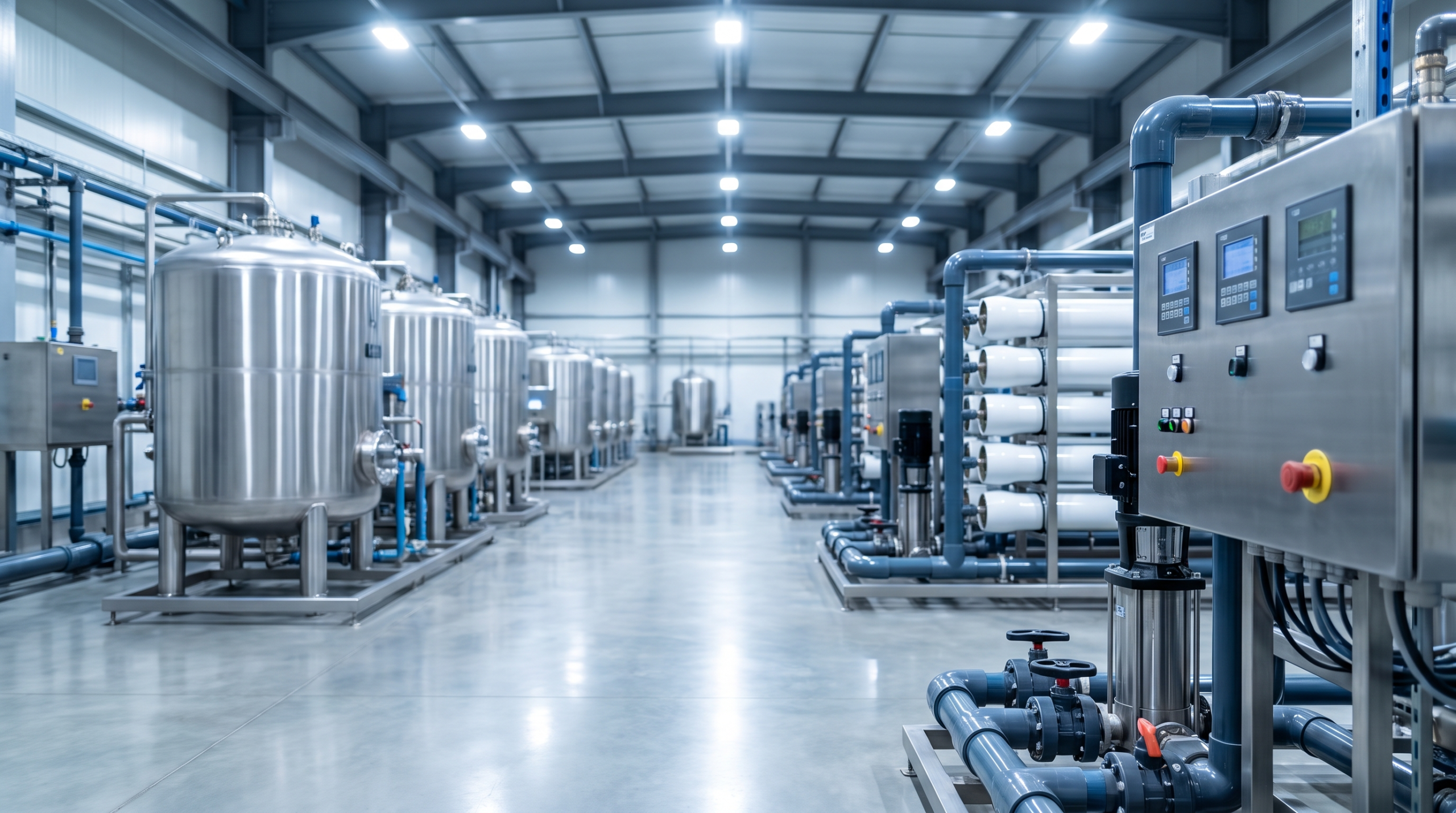
The underlying technology isn’t exotic. It’s reverse osmosis, membrane filtration, and biological or chemical wastewater treatment, engineering that’s existed in industrial form for decades, now deployed at a scale and precision that matches how much water a modern fab or manufacturing plant actually uses. A well-designed system doesn’t just clean water once and discharge it. It closes the loop: recovering process water for reuse, recovering wastewater for non-potable applications like cooling and irrigation, and cutting how much fresh water a facility needs to pull from a stressed local supply in the first place.
This is the space AMPAC USA works in. We design and manufacture industrial reverse osmosis systems, wastewater treatment equipment, and water reuse systems for exactly this kind of demand: facilities that need serious volume, consistent quality, and a real reduction in freshwater draw, not just a compliance checkbox. It’s not a silver bullet for a 25-country water stress problem. But it’s the piece of the puzzle that’s actually inside a company’s control, and the data above suggests it’s a piece more manufacturers are going to need soon, not eventually.
What Should Manufacturers and Facility Planners Take Away From This?
Water risk is becoming a real site-selection and operating-cost factor, not just a background sustainability concern. The companies moving early on treatment and reuse capacity are the ones avoiding the permit delays and emergency-water premiums already showing up in stressed regions.
Environment+Energy Leader has reported permit timelines stretching 18 to 36 months in some water-stressed regions, with emergency trucked-in water carrying a cost premium reported as high as 10x normal rates. That’s not a number that shows up in most facility budgets, until it does.
Here’s the honest picture: industrial water scarcity isn’t a distant risk confined to arid regions. It’s showing up in Arizona, in Kumamoto, in Xi’an, in Seoul, in some of the most industrially sophisticated places on the planet, driven by exactly the technologies (chips, AI, advanced manufacturing) that these economies are racing to build more of. The demand side of that equation isn’t slowing down. The supply side of water isn’t expanding. The gap gets closed by treatment, reuse, and smarter engineering, or it doesn’t get closed at all.
Frequently Asked Questions
Why is water scarcity a problem for wealthy, industrialized countries and not just developing ones?
Because industrial water demand is now concentrated in specific high-growth sectors, semiconductors, AI data centers, and advanced manufacturing, that are expanding faster than local water infrastructure in the regions where they’re built, regardless of a country’s overall wealth or engineering capability.
How much water does a typical semiconductor fab use?
Individual fab water use varies widely by size and process, but TSMC’s first Kumamoto, Japan fab alone pumps up to 30,000 metric tons of water per day, according to reporting by The Japan Times, with a second fab expected to more than triple site demand once it comes online.
What percentage of process water can industrial recycling systems recover?
semiconductor fabs currently recycle more than 70% of process water, and newer facilities, like TSMC’s Arizona reclamation plant, under construction as of late 2025, are targeting up to 90% recycling, according to Robeco.
Is industrial water scarcity mainly caused by drought?
Not primarily. While drought plays a role in some regions, the current wave of industrial water stress is driven more by rapidly concentrated demand from specific industries, chips, data centers, and AI, outpacing supply in areas that weren’t originally built for that level of consumption.
What can manufacturers do to reduce their exposure to water stress?
Investing in on-site water treatment and reuse systems, reverse osmosis, membrane filtration, and wastewater recovery, reduces how much fresh water a facility needs to draw from local, potentially stressed supply, and can shorten the permitting and risk-assessment process for new or expanding facilities.
Sources: Industrial Info Resources; World Resources Institute (Aqueduct); Eco-Business; MSCI Research; AGU Advances (Wiley); Bloomberg; The Japan Times; Robeco; U.S. Geological Survey; Environment+Energy Leader.