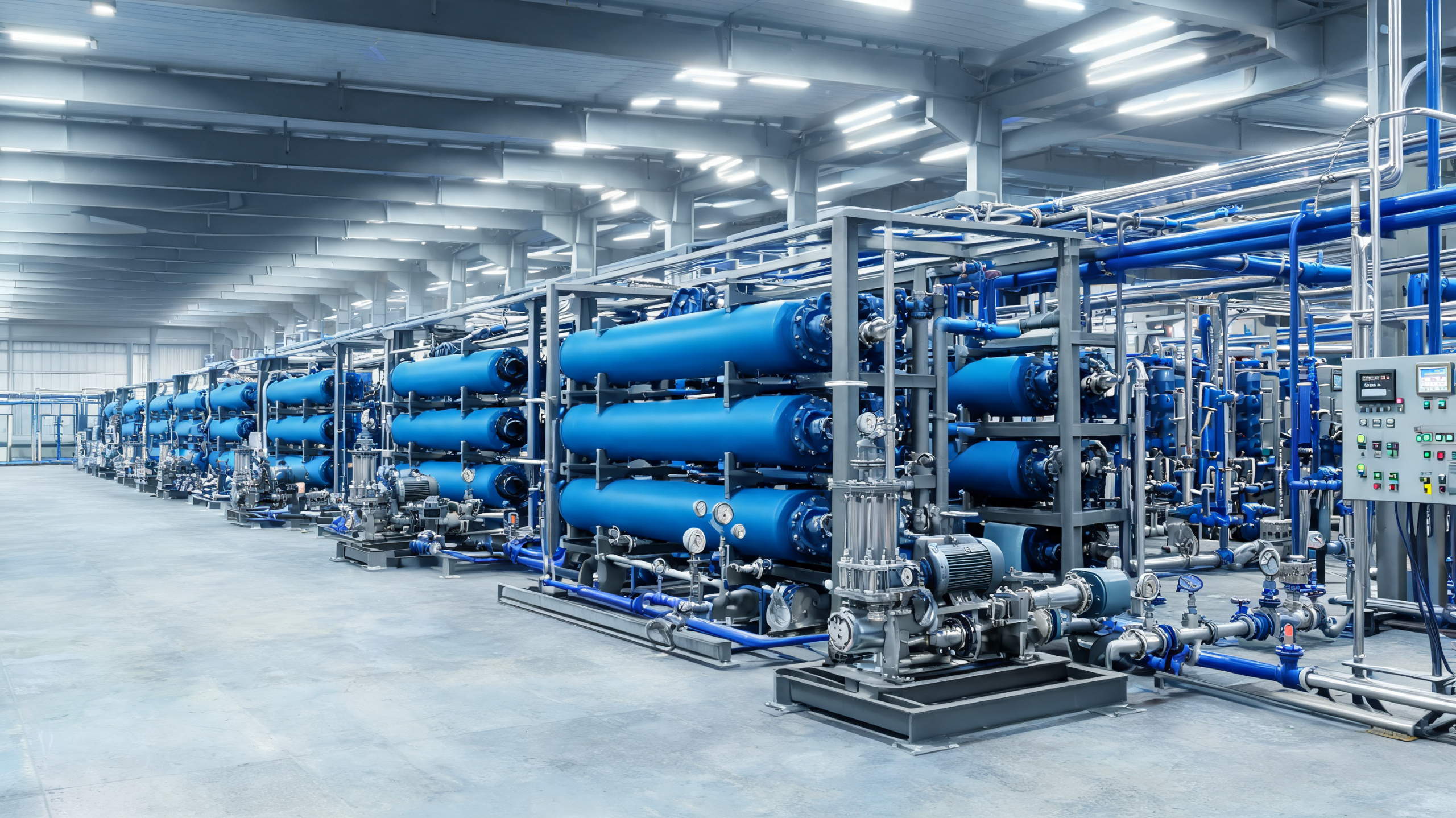

At 150 psi on the low end and 1,200 psi on the high, industrial reverse osmosis doesn’t mess around. These systems pull dissolved salts, heavy metals, and organics out of feedwater at volumes that would overwhelm a smaller unit – and they do it continuously, in facilities where downtime costs real money. You’ll find them in power plants, semiconductor fabs, pharmaceutical cleanrooms, and food processing lines. Here’s how they work, what they’re made of, and what happens when operators get the settings right.
The science of reverse osmosis in industrial settings
Osmosis versus reverse osmosis
Normally, water moves across a semi-permeable membrane from a weaker solution toward a stronger one. Reverse osmosis flips that by pushing in external pressure – enough to overcome the membrane’s natural pull. Water molecules squeeze through; contaminants don’t. The pressure required depends on how salty the incoming water is and how much recovery the operator needs from each pass.
Membrane selectivity and rejection rates
Thin-film composite membranes block 95 to 99 percent of dissolved ions: sodium, chloride, sulfate, heavy metals. But that number isn’t fixed. Temperature, pH, and fouling potential all shift performance. Good pretreatment keeps those variables from creeping out of range. (Which, honestly, is where most systems either earn their keep or fall apart.)
Core components of an industrial reverse osmosis system
- Feedwater intake and pretreatment: Multimedia filters, cartridge filters, and antiscalant dosing keep particles and scale off the membranes.
- High-pressure pump: Stainless-steel centrifugal or positive-displacement pumps generate the force needed to push past osmotic pressure.
- Membrane vessels and elements: 8-inch spiral-wound elements sit inside pressure vessels arranged in stages or arrays based on the recovery target.
- Instrumentation and controls: Conductivity sensors, pressure transducers, flow meters, and PLCs handle automated operation and data logging.
- Post-treatment: UV disinfection, pH adjustment, or degasification finishes the permeate for specific end uses.
Step-by-step operation
- Raw water moves through the pretreatment train, where suspended solids and chlorine get removed.
- Conditioned feedwater enters the high-pressure pump and hits the first-stage membrane array.
- Permeate passes through the membrane; concentrate goes to a second stage or to discharge.
- Sensors track permeate quality continuously and divert off-spec water to drain.
- Operators adjust concentrate flow to hit recovery targets – usually 50 to 85 percent – without triggering scaling.
- When normalized flow drops past set points, the system starts automated clean-in-place cycles. No manual trigger needed.
Key industrial applications
Power generation and boiler feedwater
Combined-cycle plants need demineralized water to protect high-pressure boilers from scale and corrosion. Reverse osmosis gets them the purity they need without the chemical regeneration cycles that older ion exchange setups required.
Food and beverage processing
Breweries, dairies, and bottled-water plants use RO to standardize ingredient water, concentrate juices, and cut wastewater volume. FDA and EU standards set the floor. Reverse osmosis clears it.
Pharmaceutical and biotechnology manufacturing
USP-purified water and water-for-injection both start with reverse osmosis as the primary purification step. Downstream polishing stages bring conductivity and TOC down to required levels from there.
Semiconductor and electronics fabrication
Ultrapure water loops start with RO to strip out silica and ions that cause wafer defects. Recovery rates get balanced against water costs and concentrate disposal – it’s a real trade-off, not a simple dial to turn up.
Textile dyeing and metal finishing
These sectors use reverse osmosis to recycle rinse water, recover dyes or metals, and stay within discharge limits for TDS and heavy metals.
Design considerations and performance optimization
So what does “properly sized” actually mean in practice? It starts with a full water analysis and a realistic projection of recovery versus fouling risk. Modeling software then forecasts permeate quality and membrane life across changing temperatures and seasonal feedwater shifts. Energy recovery devices – pressure exchangers specifically – cut operating costs by 30 to 50 percent in high-pressure setups. That’s not a rounding error on the utility bill.
Maintenance practices that protect system longevity
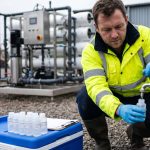
- Check normalized permeate flow, differential pressure, and salt passage every week.
- Run clean-in-place cycles once flow drops 10 to 15 percent or differential pressure climbs 15 percent. No exceptions.
- Change cartridge filters based on differential-pressure readings, not fixed schedules.
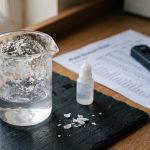
- Confirm antiscalant dosage through jar testing – under-dosing scales membranes, over-dosing wastes money without helping.
Wrapping up
Industrial reverse osmosis isn’t complicated in principle. Pressure, membrane, separation – that’s the whole story. Getting consistent performance at scale is the harder part, and it comes down to pretreatment quality, realistic recovery targets, and disciplined maintenance timing. Engineers who get those three right run their systems for years. The ones who skip steps spend that time chasing replacement schedules they didn’t see coming.
Related Articles
- USP Purified Water TDS Requirements and How Pharmaceutical-Grade Reverse Osmosis Systems Meet Them
- Effective Reverse Osmosis Water Filter for Microplastics in Industrial Applications
- Whole House Reverse Osmosis System for Commercial & Industrial Water Treatment
- Boiler Feed Water Treatment: Why Industrial Facilities Need Reverse Osmosis
Frequently Asked Questions
What pressure range do industrial reverse osmosis systems operate at?
From 150 psi on the low end up to 1,200 psi on the high end, depending on feed water salinity and the recovery rate required from each pass.
What industries rely on industrial reverse osmosis systems?
Power generation and boiler feedwater, food and beverage processing, pharmaceutical and biotechnology manufacturing, semiconductor and electronics fabrication, and textile dyeing and metal finishing.
How much do energy recovery devices save on industrial RO operating costs?
Pressure exchangers used as energy recovery devices cut operating costs by 30-50 percent in high-pressure setups, a meaningful reduction on the utility bill for large systems.
When should an industrial RO system run a clean-in-place cycle?
Once normalized permeate flow drops 10-15 percent or differential pressure climbs 15 percent, without exception. Cartridge filters should be changed based on differential-pressure readings rather than a fixed schedule.