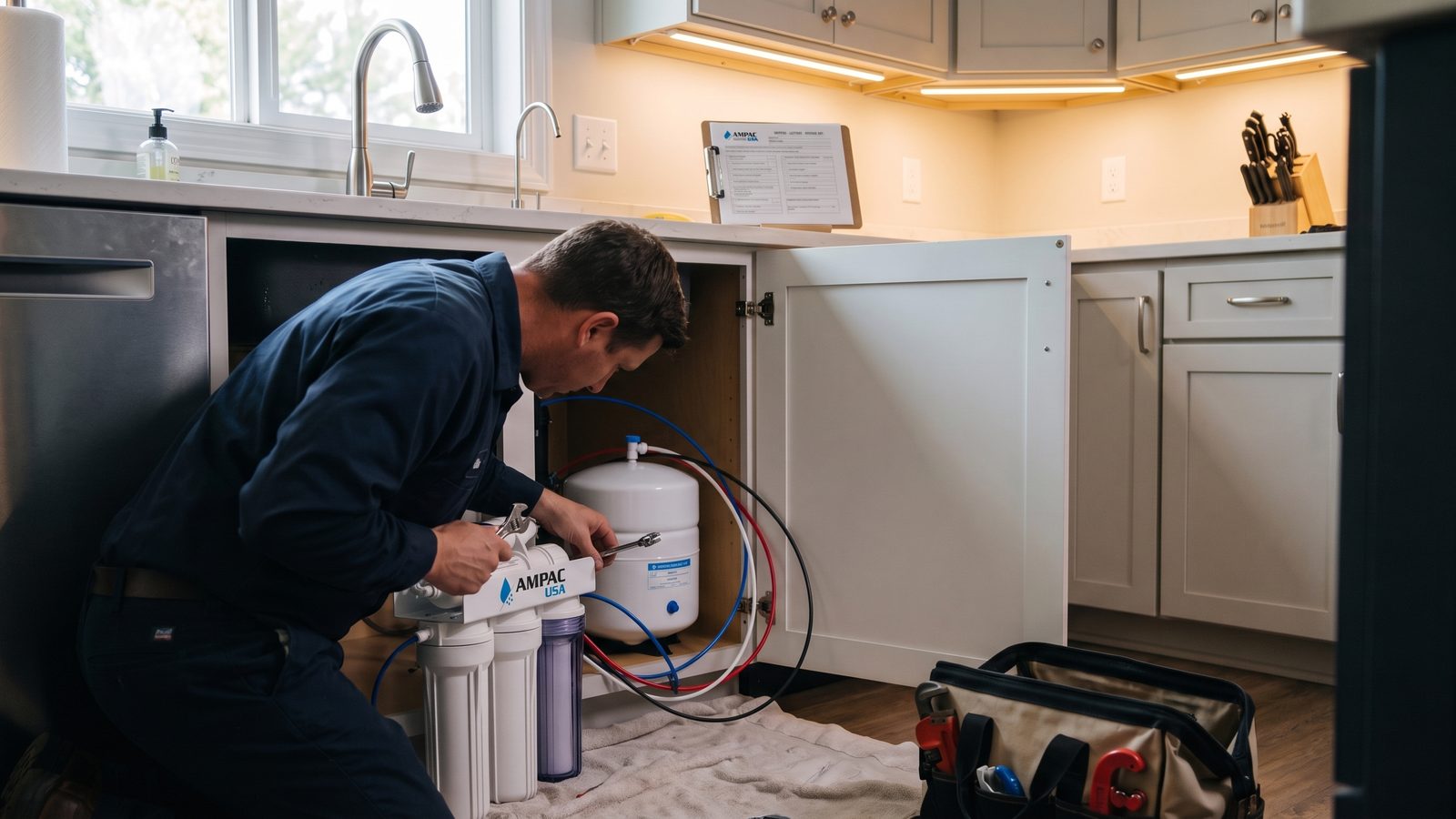

Hiring a plumber to install a reverse osmosis system sounds straightforward until you start making calls and realize half the plumbers you reach have never installed an RO system in their lives. Not every plumber knows the difference between the feed line, the product line, and the drain line on an RO unit – and if those get swapped, you’ve paid for an installation that does nothing.
Here’s what you need to know before hiring, including realistic costs, the right questions to ask, and what to do if you’re considering the DIY route instead.
What Does It Actually Cost to Have an RO System Professionally Installed?
For a standard under-sink five-stage system, the all-in cost typically runs $450 – $1,100, with most homeowners landing around $600 – $800. That breaks down roughly as:
- Equipment: $150 – $600 (a quality 5-stage system averages around $300)
- Labor: $300 – $500 for a standard installation; up to $700 for tight cabinet access or more complex configurations
Whole-house systems run considerably more – anywhere from $1,000 to $4,800 installed, with an average around $2,500. Plumber hourly rates range from $45 – $200 depending on your region, so complex installations that stretch beyond 3 hours can push costs higher.
These numbers assume a reasonably straightforward installation: existing shutoff valves, adequate cabinet space, and no plumbing surprises. Older homes often have neither – in which case, budget higher and ask for an in-person estimate before committing.
Should You DIY or Hire a Plumber?
Honestly? For a countertop or freestanding RO unit, DIY is perfectly reasonable. Plug in a hose, connect to the faucet, done. For under-sink systems, the answer is more nuanced.
DIY under-sink installation can work fine if you’re comfortable with basic plumbing – you’re mostly dealing with push-to-connect fittings, a drain saddle, and a few supply lines. You’ll save $300 – $500 on labor. But the failure modes are specific and expensive when they happen:
- Loose push-to-connect fittings cause drip leaks inside cabinets that can go undetected for weeks, quietly rotting out your cabinet floor
- Swapped lines – feed, product, and drain tubing usually look identical – means the system runs backward and produces no purified water
- Skipping the initial flush (you need to fill and drain the tank 1-2 times post-installation) means the first water you drink carries residue from the new membrane
- Inadequate incoming water pressure – RO needs a minimum 60 PSI; below 40 PSI, production drops sharply and you may need a booster pump
Whole-house RO systems? Don’t DIY. The plumbing complexity, pressure requirements, and bypass valve configurations make professional installation non-negotiable.
What Certifications and Licenses Should a Plumber Have?
This is where homeowners often skip their due diligence. A licensed plumber can legally do plumbing work – but that doesn’t mean they’ve installed an RO system before. Look for both.
State plumbing license – Required in all 50 states. Don’t hire anyone without one. You can verify any plumber’s license through your state’s contractor licensing board website. Takes about two minutes and has caught fraudulent contractors more than once.
Water Quality Association (WQA) certification – This is voluntary but meaningful. WQA-certified technicians have completed training specifically in water treatment systems. Not every excellent RO installer has it, but it’s a strong indicator that the person has done more than basic plumbing.
General liability insurance and workers’ compensation – Ask for proof before they start. If a plumber damages your cabinet, cracks a supply line, or gets injured on your property and isn’t insured, you’re potentially liable.
How Long Does Installation Take?
A professional with RO experience completes a standard under-sink installation in 1-3 hours. If your cabinet is unusually tight, your drain connection is non-standard, or the shutoff valves are frozen from disuse, budget for 3-5 hours.
Whole-house systems take 4-8 hours depending on system complexity, location, and whether bypass plumbing is included. Get a time estimate upfront – most professionals can give you a reasonable range after a quick walk-through.
Seven Questions to Ask Before You Hire
Print these or save them. A good plumber answers all of them without hesitation; the wrong ones get evasive on numbers 1, 2, and 5.
- Are you licensed in this state, and can you give me your license number? (Verify it yourself at the state licensing board)
- Do you carry liability insurance and workers’ comp? (Ask for a certificate, not just a verbal yes)
- Have you installed RO systems before, specifically under-sink point-of-use? How many?
- Will you test my incoming water pressure before installation? (Under 60 PSI may require a booster pump)
- What’s your warranty on the installation itself? (Most reputable installers cover their labor for at least 1 year)
- Will the work meet local plumbing code?
- If I have a slow leak after you leave, who do I call and what’s the response time?
Common Installation Mistakes to Watch For
Even experienced plumbers occasionally skip steps that matter. When the installation is complete, run through this yourself:
- Tug each push-to-connect fitting firmly – it should not give at all
- Ask the installer to label or confirm which line is feed, product, and drain before they leave
- Confirm they’ve flushed the system (ran the tank through a full fill-and-drain cycle at least once)
- Check that a dedicated shutoff valve is installed on the feed line – it makes filter changes much easier and gives you a quick way to isolate the system in an emergency
- Run the faucet after installation and check for any drips under the sink after 15-20 minutes
Finding a Plumber Who Knows RO
The best approach: call AMPAC USA’s team first. We work with installation networks across the country and can often recommend a local technician with specific RO experience. If you’re finding a plumber independently, look for reviews that specifically mention water treatment – general plumbing reviews don’t tell you whether someone knows their way around an RO unit.
Ready to get started? Browse AMPAC USA’s under-sink reverse osmosis systems – most include step-by-step installation guides, and our team can walk you through what to look for when you’re hiring installation help.
Related Articles
- Whole House Reverse Osmosis System for Commercial & Industrial Water Treatment
- Cannabis Water Treatment: Why Commercial Grows Use Reverse Osmosis
- Commercial Reverse Osmosis System Buyer's Guide: 100 to 10,000 GPD
- Does Reverse Osmosis Remove PFAS? What Commercial Operators Need to Know
Frequently Asked Questions
Can I install a reverse osmosis system myself?
Yes, if you possess fair mechanical knowledge and are comfortable installing home appliances, you can likely install a reverse osmosis system yourself. However, if you lack confidence, hiring a professional plumber is the recommended approach to ensure proper setup.
What should I ask a plumber before hiring them to install an RO system?
When contacting plumbers, inquire if they have prior experience with RO system installations. Also, ask about their pricing structure, such as hourly rates, and if there are any additional charges beyond the basic installation. It’s helpful to mention you’ve already purchased the RO filter.
What size reverse osmosis system is recommended for home installation?
A 50 GPD (Gallons Per Day) reverse osmosis system is generally recommended for home use. This size offers better performance in colder water conditions and as the membrane ages, without significantly increasing the initial cost compared to lower-producing models.
How can I find a qualified plumber to install my reverse osmosis system?
Start by searching online for local plumbers on reputable review sites like Google, Yelp, or Angie’s List. Prioritize plumbers with positive reviews and specific experience in water filtration or RO system installations. Don’t hesitate to ask for references if they don’t have direct RO experience.
Does AMPAC USA offer installation support for its reverse osmosis systems?
Yes, AMPAC USA provides comprehensive support to its customers, including assistance with RO system installation. Our well-trained experts are available to help; you can contact us at our Toll-Free number, 877-611-8530, for expert guidance.
Who installs reverse osmosis systems if I would rather not call an outside plumber?
Local plumbing services typically handle the drinking water line tie-in, tapping into your existing kitchen sink water supply for under-sink units. That said, some RO and water softeners dealers include installation services with the purchase, and a few offer financing options or a free water quality test to help you compare solutions for your home before committing. AMPAC USA’s residential reverse osmosis systems ship with full installation documentation either way, so your plumber (or you) has everything needed on day one.
AMPAC USA engineers custom water purification systems for commercial, industrial, and emergency applications — from 500 GPD to multi-million GPD. Trusted by municipalities, military, and industry worldwide.