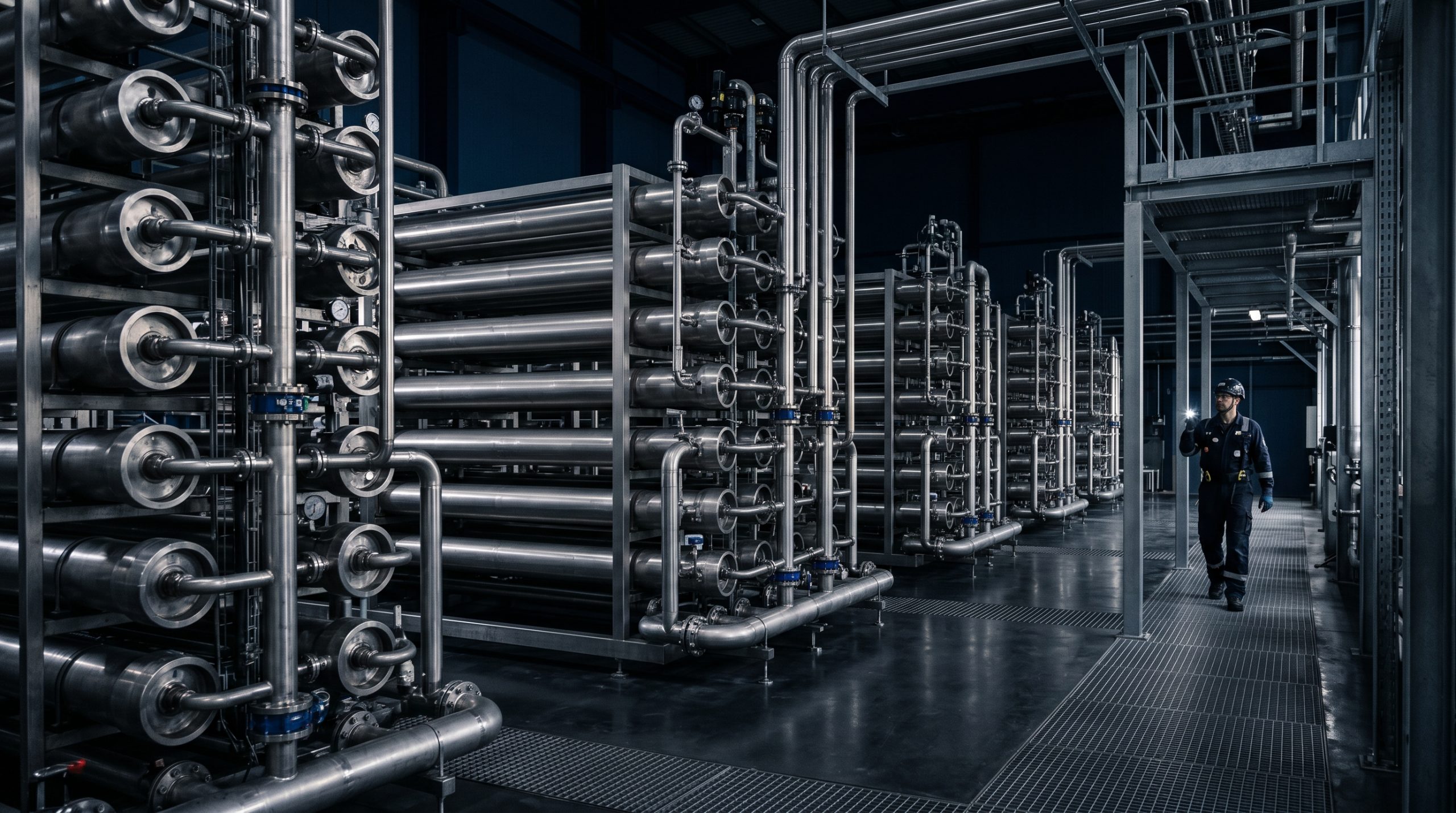

Industrial reverse osmosis systems don’t fail dramatically. They degrade – slowly, measurably, in ways that experienced operators learn to read before they become expensive. The difference between a facility spending $20,000 on an emergency membrane replacement and one that spends $3,000 on a scheduled cleaning service call is, almost always, a maintenance program that treated service as optional.
Here’s what industrial RO service actually looks like, what it costs when you skip it, and the specific maintenance tasks that determine whether your system runs for 5 years or 15.
The Maintenance Schedule That Keeps Industrial RO Systems Running
Industrial RO maintenance is tiered by frequency. Miss any tier consistently and the downstream consequences compound.
Daily monitoring – this is operator-level observation, not a service call:
- Feed pressure, differential pressure across pre-filters, and trans-membrane pressure (TMP)
- Permeate flow rate and conductivity/TDS
- Antiscalant and biocide dosing rates verified against setpoints
- Log everything – trending data is what catches problems before they become failures
Monthly inspection:
- Pre-filter differential pressure review – at 10 psi across cartridge filters, replace them (most run 3-6 months before replacement is needed, but high-TSS feed water can clog them faster)
- Pump seal and o-ring visual inspection
- Review performance trend data against normalized baselines – flag any 10% deviation
Annually:
- Chemical Clean-In-Place (CIP) – full membrane cleaning protocol, minimum once per year, more frequently on challenging feed water
- Full system inspection: manifold integrity, pressure vessel condition, high-pressure pump bearing wear, valve operation
- Instrument calibration – flow meters, pressure gauges, conductivity probes drift over time; uncalibrated instruments give you false confidence
Every 2-5 years:
- RO membrane replacement – 2-3 years without proper pre-treatment; 3-5 years with adequate pre-treatment and water chemistry management; up to 6+ years with best-practice programs
Signs Your RO Membranes Need Replacement
Membranes don’t give you a warning light. You have to read the data. The following indicators, individually or together, mean it’s time to evaluate membrane condition:
- Permeate flow drops 15% from the normalized baseline at the same operating pressure – classic membrane fouling or scaling sign
- Salt rejection drops 10% – permeate conductivity rising means the membrane’s rejection capacity is degrading
- Differential pressure increase 10-15% across a stage – indicates fouling building up
- CIP recovery <85% – membrane returns to only 85% of original performance after a full cleaning cycle; that remaining 15% loss is typically permanent physical or chemical damage
- Persistent biological growth that doesn’t respond to standard disinfection protocols
Track these numbers against the system’s normalized performance baseline (NPB), not just raw readings. Temperature, feed pressure, and recovery rate all affect permeate flow – normalization accounts for them.
Chemical Cleaning Procedures: Getting It Right
CIP (Clean-In-Place) is the most important service event in industrial RO maintenance. Done correctly and on schedule, it restores performance and extends membrane life. Done too late, it can’t recover a membrane that’s already permanently fouled.
Standard two-phase cleaning protocol:
Phase 1 – Alkaline wash (for organic fouling and biofouling):
- pH 11-12, typically sodium hydroxide + surfactant
- Circulate solution at low pressure for 30-60 minutes, then soak for 1-4 hours
- Flush thoroughly with product-quality water before next phase
Phase 2 – Acid wash (for mineral scaling – calcium carbonate, sulfates, silica):
- pH 2-3, typically citric acid or hydrochloric acid
- Same circulation and soak procedure
- Final flush before returning to service
Trigger CIP when normalized permeate flow drops 10% or differential pressure rises 15% – don’t wait until the system is underperforming badly. Membranes cleaned at the right inflection point recover 85-100% of performance. Delayed cleaning risks permanent fouling layers that no amount of chemistry will remove.
Preventive Maintenance vs. Reactive Repair: The Real Cost Difference
The numbers on this are clear and consistent across industries, including water treatment specifically.
Organizations with comprehensive preventive maintenance programs see 25-40% lower total maintenance costs and 60-80% better equipment reliability compared to reactive-only approaches. Preventive maintenance ROI runs consistently at 10:1 to 30:1 – the cost of the service is a fraction of the cost of the failure it prevents.
For industrial RO specifically: a single membrane vessel replacement can cost $3,000 – $15,000 per vessel, and large systems use dozens. Emergency repairs compound this with downtime costs, expedited part shipping, and potential product quality failures if the system is in a food/pharmaceutical/power generation application. A scheduled CIP service call, by comparison, runs $500 – $2,000 depending on system size and chemical cost.
Energy Efficiency: Often Overlooked, Always Worth Addressing
The high-pressure pump driving an industrial RO system consumes 70-80% of the total system’s energy. That’s a significant operating cost lever.
Variable Frequency Drive (VFD) on the feed pump is the single highest-ROI upgrade for most industrial systems. By adjusting motor speed to actual demand rather than running full power continuously, VFDs typically reduce energy consumption by 25-35%. One pharmaceutical facility documented a 28% energy reduction from VFD alone. Upfront cost: $2,000 – $8,000. Typical payback: 18-24 months.
Energy Recovery Devices (ERDs) – now standard on larger systems – capture pressure energy from the concentrate stream and transfer it to the feed stream, reducing net energy consumption by 30-50% in high-pressure applications.
Keep membranes clean. A fouled membrane requires significantly higher feed pressure to maintain the same permeate output. Running a partially-fouled membrane at elevated pressure doesn’t just consume more energy – it accelerates membrane degradation.
For a complete industrial RO service review or to explore maintenance programs for your system, AMPAC USA’s engineering team works with operations at every scale. Explore our commercial and industrial RO systems and contact us about service and support options.
Related: AMPAC USA industrial RO systems are built for low-maintenance, continuous duty operation. See the full range of industrial reverse osmosis systems, or read our boiler feed water treatment guide for maintenance-critical pretreatment applications.
Frequently Asked Questions
How often should industrial RO membranes be cleaned?
RO membrane cleaning is crucial for maintaining efficiency and extending lifespan. Based on source water quality and system usage, AMPAC USA engineers recommend cleaning the RO membrane preferably every 3-12 months. This proactive measure prevents fouling and ensures consistent purification performance, a critical factor in industrial applications.
What are the main components of an industrial reverse osmosis system?
An industrial RO system comprises three primary stages: pre-treatment components, the RO membrane, and post-treatment components. Pre-treatment removes larger contaminants and softens water, protecting the core RO membrane. The RO membrane performs the primary purification, while post-treatment stabilizes the purified water, balancing pH and reintroducing essential minerals.
Why is monitoring pressure critical for industrial RO system maintenance?
Monitoring pressure readings is critical because a significant drop can signal underlying issues like clogs or leaks within the system. Early detection through vigilant pressure monitoring allows for prompt intervention, preventing potential damage and ensuring the system operates efficiently. AMPAC USA’s field experience shows this simple check can save substantial repair costs and downtime.
What is the purpose of pre-treatment in an industrial RO system?
Pre-treatment components serve as the first line of defense in an industrial RO system, protecting the sensitive RO membrane. They eliminate larger contaminants and soften the water, preventing premature degradation or overwhelming the membrane with substantial particles or excessive hard water ions. This crucial step ensures the longevity and optimal performance of the entire purification process.
How do software updates impact industrial RO system performance?
Many contemporary industrial RO systems feature integral software for management and monitoring. Regular software updates are vital to ensure your system runs with the latest technological advancements and security protocols. This keeps the system optimized, enhances operational efficiency, and allows for better data analysis and control, as advised by AMPAC USA’s engineering team.
What does a full industrial reverse osmosis service include?
A complete industrial reverse osmosis service covers membrane cleaning and replacement, pre-treatment filtration system checks, dissolved solids and conductivity testing, and pump/pressure calibration – all aimed at keeping the treatment system running at high purity output. AMPAC USA services both our own industrial reverse osmosis systems and commercial reverse osmosis systems from other manufacturers, and every visit is designed to deliver high quality, consistent water without unplanned downtime.
AMPAC USA engineers custom water purification systems for commercial, industrial, and emergency applications — from 500 GPD to multi-million GPD. Trusted by municipalities, military, and industry worldwide.