


Seawater desalination is simply taking the salt and gunk out of ocean water to make it fresh enough for drinking, farming, and industrial use. Think about it: 2.2 billion people don’t have safe drinking water right now (UN, 2023), and by 2030, we’ll need 40% more freshwater than nature can provide. That’s why seawater desalination has become one of the most important water technologies out there.
- Globally, over 20,000 desalination plants make more than 95 million cubic meters of freshwater daily.
- About 70% of the world’s desalination capacity uses reverse osmosis (RO).
- RO plants with energy recovery use 3–5 kWh/m³ of energy, way less than the 15+ kWh/m³ for older thermal methods.
- Israel gets 60% of its household water from desalinated seawater.
- Saudi Arabia, UAE, and Kuwait each get over half their city water from desalination.
- AMPAC USA has put seawater desalination systems in over 40 countries since 1989.
- Seawater RO recovers 35–50% of the water, and that’s getting better with new tech.
The World’s Water Problem: It’s Getting Urgent
The Earth is mostly covered by oceans, 71% in fact. But only 2.5% of all that water is fresh, and even less than 1% of that is easy to get as surface water or shallow groundwater. The rest is stuck in glaciers, ice caps, or deep underground.
The United Nations World Water Development Report 2023 tells us that roughly 2.2 billion people worldwide can’t get safely managed drinking water. The UN’s Food and Agriculture Organization (FAO) predicts that by 2030, our demand for freshwater will be about 40% higher than what’s available. Why? More people, growing cities, expanding farms, and industry all play a part.
Climate change just makes this worse. The World Health Organization (WHO) expects that by 2025, 1.8 billion people will face extreme water shortages, and two-thirds of the world will live with water stress. Glaciers, which supply seasonal freshwater to billions in Asia, South America, and the western US, are melting faster. We can even see aquifers shrinking from space, thanks to NASA’s GRACE satellite. Big aquifers in California’s Central Valley, the High Plains Ogallala Aquifer, the North China Plain, and northern India are all showing serious drops.
Given all this, seawater desalination offers a truly important solution: it lets us make freshwater from the one source that’s practically endless, the oceans. They cover 71% of our planet and hold 97% of all its water.
What is Seawater Desalination, Really?
Seawater desalination uses physical and chemical processes to pull out dissolved salts, things like sodium chloride, magnesium sulfate, calcium chloride, and potassium chloride, from ocean water. The goal is to make freshwater that meets drinking water standards (the WHO says less than 500 mg/L of total dissolved solids) or specific needs for industrial use.
Two main types of technology do most of the work for commercial seawater desalination:
Reverse Osmosis (RO) – The Go-To Modern Method
Seawater reverse osmosis (SWRO) pushes seawater through special membranes using high pressure, usually 55–80 bar (800–1,160 PSI). These membranes have super tiny holes, about 0.0001 microns. Water molecules get through, but dissolved salts, bacteria, viruses, and other organic stuff get left behind and exit as concentrated brine. Modern SWRO systems block 99–99.7% of salts and, with energy recovery devices, use only 3–5 kWh per cubic meter of clean water.
SWRO now handles about 70% of the world’s desalination. It’s replaced older thermal methods over the last twenty years because it uses way less energy and is more flexible to operate.
Thermal Distillation – Multi-Effect Distillation (MED) and Multi-Stage Flash (MSF)
Thermal desalination heats seawater to evaporate it, often using waste heat from power plants. The steam then condenses into freshwater, leaving concentrated brine behind. MSF plants were big in the Arabian Gulf from the 1960s to the 1990s, and huge ones still run in Saudi Arabia, Kuwait, and the UAE. These plants use 7–15 kWh/m³ of electrical energy equivalent, but since they can use low-grade waste heat, they make sense where power is also generated.
AMPAC USA focuses on seawater reverse osmosis technology. We build systems from small 5,000 GPD marine watermakers to big land-based desalination plants. Check out our seawater desalination solutions.
Why Seawater Desalination is So Important Today
1. A Water Source That Doesn’t Care About The Weather
Unlike reservoirs, rivers, and groundwater, which all rely on rainfall, seawater desalination gives us freshwater no matter what the weather does. Desalination plants don’t need rain. They don’t depend on melting snow. They just keep making water at a steady pace, even during droughts, heat waves, or shifting rain patterns.
Look at Israel. After a bad, multi-year drought in the early 2000s, Israel built five large SWRO desalination plants along its Mediterranean coast. By 2022, these plants were making over 600 million cubic meters of water each year, about 60% of the country’s household water. This completely freed Israel’s water supply from yearly rainfall. During that same time, Israel went from a country always worried about water to actually exporting it.
2. Helps Grow Economies and Secure Food
Not enough water really holds back economic growth and farm output in dry regions. The money lost from less farming, reduced industrial production, health problems from bad water, and social unrest costs far more than building and running desalination plants.
In places without much water, desalinated water makes irrigated farming possible where it couldn’t exist before. Saudi Arabia, for instance, uses desalinated water to support some food production, even though it has almost no natural freshwater. The UAE uses desalinated water for city landscaping, hotels, and light industry, all of which add hundreds of billions of dollars to their economy every year.
For industries like power generation, making medicines, or oil and gas processing, having reliable, high-quality process water isn’t an option, it’s a must. Industries in water-scarce areas rely on desalination to keep running when freshwater isn’t available.
3. Proven Technology and Lower Costs
The cost of seawater desalination has gotten much better over the last thirty years. Energy use for SWRO has dropped from over 10 kWh/m³ in the 1980s to 3–5 kWh/m³ today, thanks to modern, efficient pumps, energy recovery devices, and better membranes. Building costs have also gone down as manufacturing has scaled up and membranes have improved.
The Sorek B plant in Israel, which started up in 2023, produces water for about $0.50 per cubic meter. That’s competitive with many other options, including moving water long distances or building new surface water systems. The International Desalination Association (IDA) expects costs to keep falling as desalination powered by renewable energy cuts fuel expenses and next-generation membranes recover even more water.
4. Supports Military and Humanitarian Work
Military operations, disaster relief, and humanitarian emergencies need portable ways to purify water that don’t rely on existing infrastructure. Seawater desalination systems that can go on ships, in remote coastal spots, or on mobile platforms provide vital water security in tough places.
AMPAC USA, started in 1989, has contracts with the US military and government for deployable seawater desalination systems. Our reverse osmosis water purification units (ROWPUs) and marine watermakers have been used by US military units, humanitarian groups, and disaster relief operations all over the world. We build our systems to work reliably in the harshest conditions, from naval operations in the Arctic to disaster response in the tropics.
Thinking About the Environment with Modern Seawater Desalination
While seawater desalination gives us crucial water security, it does come with environmental challenges. Building desalination infrastructure responsibly means understanding and reducing these impacts.
Energy Use and Carbon Footprint
SWRO still uses a lot of energy. A plant making 100 million liters (26 MGD) per day, using 4 kWh/m³, consumes about 400 MWh of electricity daily. That’s enough to power 15,000–20,000 homes. If that electricity comes from fossil fuels, it creates a lot of CO₂ emissions.
The industry is quickly adding renewable energy. Solar photovoltaic-powered SWRO is now available commercially at various sizes, from small 2,500 GPD off-grid systems to large plants in the Middle East, North Africa, and Australia. Wind-powered desalination also works in many places. As renewable energy costs drop and RO energy use decreases, zero-carbon desalination is becoming much more realistic.
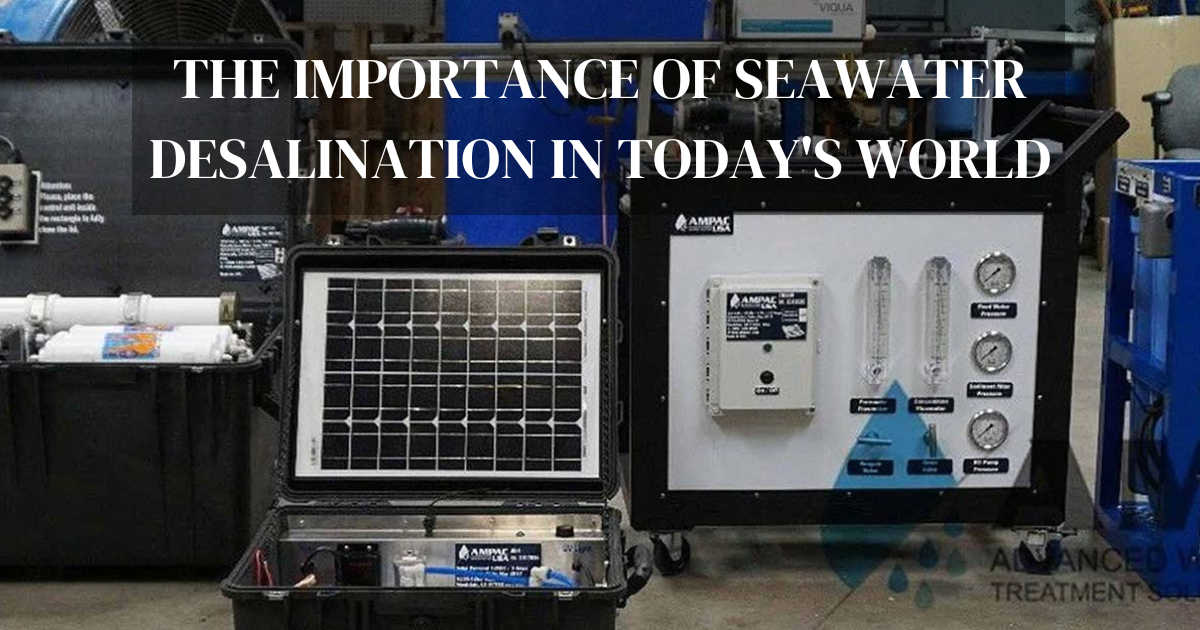
AMPAC USA offers solar-powered seawater desalination systems for off-grid and remote areas where grid electricity isn’t available or reliable.
Managing Brine Discharge
SWRO systems produce a concentrated brine stream. This is about 50–65% of the original water volume, with typical water recovery rates around 35–50%. This brine is about 1.5–2 times saltier than the seawater it came from. Managing this brine discharge properly is key to minimizing harm to marine life, especially sensitive areas like seagrass beds and coral reefs.
Good practices include: using multi-port diffuser systems to quickly dilute the brine, discharging offshore away from sensitive coastal habitats, doing environmental impact assessments and monitoring, and, increasingly, finding ways to extract minerals from the brine to reduce the amount discharged.
Intake Screening and Impingement
Open-ocean seawater intakes can impinge marine organisms on intake screens. Modern desalination plants address this through fine-mesh traveling screens with fish return systems, velocity caps that reduce intake flow velocity, and environmental design guidelines that limit the maximum intake velocity to levels consistent with organism avoidance.
Seawater Desalination vs. Other Water Supply Options
| Water Source Option | Climate Dependence | Water Cost ($/m³) | Scalability | Reliability |
|---|---|---|---|---|
| Surface water (rivers, reservoirs) | High | $0.10–0.50 | Limited by hydrology | Variable (drought risk) |
| Groundwater (aquifer) | Medium | $0.15–0.80 | Limited by recharge rate | Medium (depletion risk) |
| Water recycling/reclamation | Low | $0.30–0.80 | Limited by supply volume | High |
| Long-distance water transfer | Medium | $0.50–2.00+ | High capital, fixed route | Medium |
| Seawater desalination (SWRO) | None | $0.50–1.50 | Highly scalable | Very High |
Seawater desalination’s primary advantages over alternatives are its complete independence from natural precipitation patterns and its unlimited source water supply. These characteristics make it uniquely valuable as a baseline supply source for water-scarce regions. Explore AMPAC USA’s applications across multiple water supply sectors.
AMPAC USA’s Role in Global Seawater Desalination
AMPAC USA, founded in 1989, is a US-based manufacturer of seawater reverse osmosis systems certified to ISO 9001:2015, with NSF/ANSI 58 certified components for drinking water applications. With installations spanning 40+ countries across six continents, AMPAC USA brings proven engineering expertise to seawater desalination projects at every scale:
- Marine watermakers: 2,500–15,000 GPD compact SWRO systems for vessels, offshore platforms, and island resorts
- Industrial SWRO: 50,000–500,000 GPD land-based systems for coastal manufacturing, power generation, and resort/hospitality
- Military systems: Ruggedized deployable SWRO for US military and allied force field operations
- Solar-powered SWRO: Grid-independent systems for remote coastal communities and off-grid industrial sites
- Emergency response systems: Rapidly deployable SWRO for disaster relief and humanitarian operations
Learn more about AMPAC USA’s company history and capabilities, browse our water treatment systems product range, or explore our seawater desalination applications.
Frequently Asked Questions: Seawater Desalination
What is seawater desalination and how does it work?
Seawater desalination is the process of removing dissolved salts and impurities from seawater to produce freshwater. The dominant technology is seawater reverse osmosis (SWRO), which uses hydraulic pressure of 55–80 bar (800–1,160 PSI) to force seawater through semi-permeable membranes, rejecting 99–99.7% of dissolved salts and contaminants. The purified water (permeate) exits the membrane at low pressure while concentrated brine is discharged. Modern SWRO systems equipped with energy recovery devices consume 3–5 kWh per cubic meter of product water, making them the most energy-efficient large-scale desalination technology available.
How important is seawater desalination globally?
Seawater desalination is critically important for water security in over 150 countries that operate desalination capacity. Globally, over 20,000 plants produce more than 95 million cubic meters of freshwater daily — sufficient to meet the daily drinking water needs of approximately 300 million people. In the most water-scarce nations, desalination is existential: Saudi Arabia, Kuwait, UAE, Qatar, and Bahrain each source over 50% of their municipal water supply from desalinated seawater. As climate change accelerates freshwater scarcity worldwide, the strategic importance of desalination as a climate-independent water source will only increase.
Is seawater desalination environmentally sustainable?
Seawater desalination has real environmental impacts — primarily energy consumption and brine discharge — but these are manageable through responsible design and operation. Modern SWRO systems powered by renewable energy can achieve near-zero carbon emissions. Brine discharge impacts are mitigated through offshore multi-port diffusers that achieve rapid dilution. Environmental impact assessments and ongoing monitoring programs are standard for large-scale projects. The broader sustainability context matters: in water-scarce regions, the environmental cost of desalination is typically far lower than the ecological damage from aquifer over-extraction, long-distance water transfer, or the economic and social consequences of water insecurity.
What are the main challenges of seawater desalination?
The primary challenges are: energy consumption (though falling dramatically with improved technology and renewable integration), capital cost (large plants represent significant infrastructure investment), brine management (concentrated discharge requires careful environmental management), membrane biofouling from marine organisms and algae (managed through pre-treatment), and public perception in some markets. The industry is actively addressing all of these through technology innovation: graphene oxide and aquaporin-based next-generation membranes promise further efficiency gains; advanced pre-treatment reduces fouling; and renewable energy integration eliminates carbon emissions.
How much does seawater desalination cost per liter?
The cost of desalinated seawater has fallen substantially over the past two decades. At large-scale modern SWRO plants (100,000 m³/day and above), production costs range from $0.50–$0.80 per cubic meter ($0.0005–$0.0008 per liter). Smaller systems have higher unit costs: a 50,000 GPD industrial system typically produces water at $1.50–$3.00 per cubic meter. Off-grid solar-powered systems may range from $2–$5 per cubic meter including annualized capital costs. The cost depends on energy source, plant scale, feed water salinity, local construction costs, and financing terms. AMPAC USA provides project-specific cost modeling as part of feasibility assessments.
What countries rely most on seawater desalination?
The most desalination-dependent nations include Saudi Arabia (world’s largest desalination capacity; 50%+ of municipal supply), UAE (60%+ of municipal supply from desalination), Kuwait (95%+ of freshwater from desalination), Qatar (over 99% of freshwater from desalination), Bahrain, Oman, and Israel (60% from desalination after major investment in SWRO capacity). Outside the Middle East, significant desalination capacity exists in Spain, Australia (all major cities have SWRO plants), United States (Florida, California, Texas), Singapore, and China. AMPAC USA has supplied systems in all of these regions.
How does AMPAC USA design seawater desalination systems?
AMPAC USA’s seawater desalination system design process begins with complete source water chemistry analysis — full ion panel, SDI, turbidity, TOC, biological load, temperature range, and seasonal variation data. This data drives all engineering decisions: membrane selection (high-rejection SWRO elements for saline feeds), pre-treatment design (coagulation, filtration, UF membrane pre-treatment for high-turbidity or biologically active feeds), operating pressure and pump sizing, energy recovery device specification, antiscalant program, and post-treatment for final product water quality. AMPAC USA, founded in 1989 with ISO 9001:2015 manufacturing certification, has deployed systems in 40+ countries and provides full project support from initial feasibility through commissioning and ongoing service. Contact our team to discuss your project.
The Future of Seawater Desalination
The trajectory of seawater desalination technology points toward lower energy consumption, higher water recovery, better brine management, and tighter integration with renewable energy. Next-generation membrane materials — including graphene oxide composites and aquaporin biomimetic membranes — are in advanced development, promising 30–50% reductions in operating pressure and energy consumption. Solar-powered SWRO at utility scale, already demonstrated in Australia and the UAE, is becoming the deployment model of choice for new capacity in sun-rich regions.
Forward osmosis (FO) and pressure-retarded osmosis (PRO) technologies offer pathways to further energy recovery and novel desalination configurations. Hybrid thermal/RO systems optimize energy use in locations with available waste heat. Brine valorization — recovering lithium, magnesium, potassium, and other valuable minerals from concentrate — is receiving increasing research attention as a path to both reduced brine volume and economic returns that partially offset operating costs.
As water scarcity intensifies globally and the strategic importance of freshwater continues to grow, investment in seawater desalination technology and infrastructure will accelerate. AMPAC USA is committed to delivering the most advanced, reliable, and efficient seawater desalination systems available — built on 35+ years of engineering expertise and deployed in some of the world’s most challenging water environments.
Contact AMPAC USA to discuss your seawater desalination project, or learn more about our water treatment systems, seawater desalination applications, and company history.
Conclusion
This post highlighted how emergency and military-grade water purification systems provide safe drinking water rapidly in the most challenging field conditions. For organizations requiring deployable water treatment capability, AMPAC USA engineers portable and trailer-mounted systems built to perform wherever they are needed. Contact our team at info@ampac1.com or (909) 548-4900 to discuss your emergency water treatment requirements.
AMPAC USA engineers custom water purification systems for commercial, industrial, and emergency applications — from 500 GPD to multi-million GPD. Trusted by municipalities, military, and industry worldwide.