
Short answer: yes, but not because reverse osmosis fails to do its job. RO membranes reject more than 99% of bacteria at the point of filtration. The risk shows up later, downstream, in storage tanks, dead legs, and distribution piping where regrowth conditions take over after the water leaves the membrane. A 2019 pilot-plant study published in Water Research found that even with 99.5% bacterial rejection, RO permeate still carried enough residual organic carbon to support regrowth of 10²–10³ cells per mL past the membrane outlet, and Legionella species were detectable in that regrowth (Farhat et al., ScienceDirect). The membrane isn’t the villain. What happens after the membrane is where engineering decisions matter.
That distinction gets lost a lot, usually by people trying to sell a fear story or a system that costs more than it should. AMPAC USA builds reverse osmosis systems for commercial and industrial clients, so we have a direct stake in getting this right. RO is not a Legionella risk on its own. A poorly designed distribution loop sitting behind an RO system is.
Why Would Legionella Grow in Water That’s Been Filtered Down to Near-Purity?
Because RO removes bacteria, not the trace nutrients that let a small surviving population multiply once it settles somewhere with the right temperature and no flow. RO rejection isn’t 100%. It’s typically around 90% for total organic carbon and roughly 80% for assimilable organic carbon, the fraction of carbon bacteria can actually metabolize (ScienceDirect, Farhat et al. 2019). That remaining sliver is enough. Drop a handful of surviving organisms into a warm, stagnant section of pipe with almost no competition from other microbes, and you’ve built exactly the low-nutrient environment Legionella pneumophila is adapted to exploit.
This isn’t theoretical. A 2025 study on shower biofilms in households supplied by RO-treated water from a large-scale desalination plant found active biofilm colonization inside shower plumbing over a 3-to-17-month sampling window, with material composition and seasonal shifts both affecting how the biofilm assembled (Water, MDPI, 2025). RO-treated water isn’t sterile water. It’s low-nutrient water, and low-nutrient water still needs a place to sit still and warm up before it becomes a problem.
Does Legionella Need Rich Water to Grow, or Can It Thrive on Almost Nothing?
It can thrive on almost nothing, which is the uncomfortable part. Legionella pneumophila doesn’t grow well as a free-floating organism in open water. It needs a host. Research published in PLOS One found that L. pneumophila persists inside biofilms formed by other common plumbing bacteria, Klebsiella pneumoniae, Flavobacterium, and Pseudomonas fluorescens, reaching concentrations as high as 4×10⁴ CFU per square centimeter of steel surface and surviving for at least 12 days under flow conditions (PLOS One, 2012; PMC).
More recent work confirms it colonizes fast. A study in npj Biofilms and Microbiomes tracked drinking-water biofilm formation and found L. pneumophila became the dominant Legionella species, with culturable concentrations peaking at 3.1 × 10⁴ MPN per square centimeter after just four weeks (Nature, npj Biofilms and Microbiomes, 2024). Building plumbing is a low-nutrient environment by design. Legionella evolved to use other biofilm bacteria as its food source in exactly that kind of environment. That’s why the fix isn’t “add more nutrients” or “add more chlorine” in isolation. It’s controlling the conditions that let biofilm form in the first place.
What Actually Causes Legionella Regrowth Downstream of an RO System?
Four factors drive it, and none of them are unique to RO, they’re the same conditions that cause Legionella problems in any premise plumbing system: temperature, stagnation, disinfectant residual, and biofilm/sediment (CDC, Controlling Legionella in Potable Water Systems). Legionella grows best between 77°F and 113°F, and it can survive down to 68°F (CDC). RO permeate tanks, recirculation loops, and hot water storage sitting in that range without active temperature control are functioning as incubators, regardless of how clean the water was when it left the membrane.
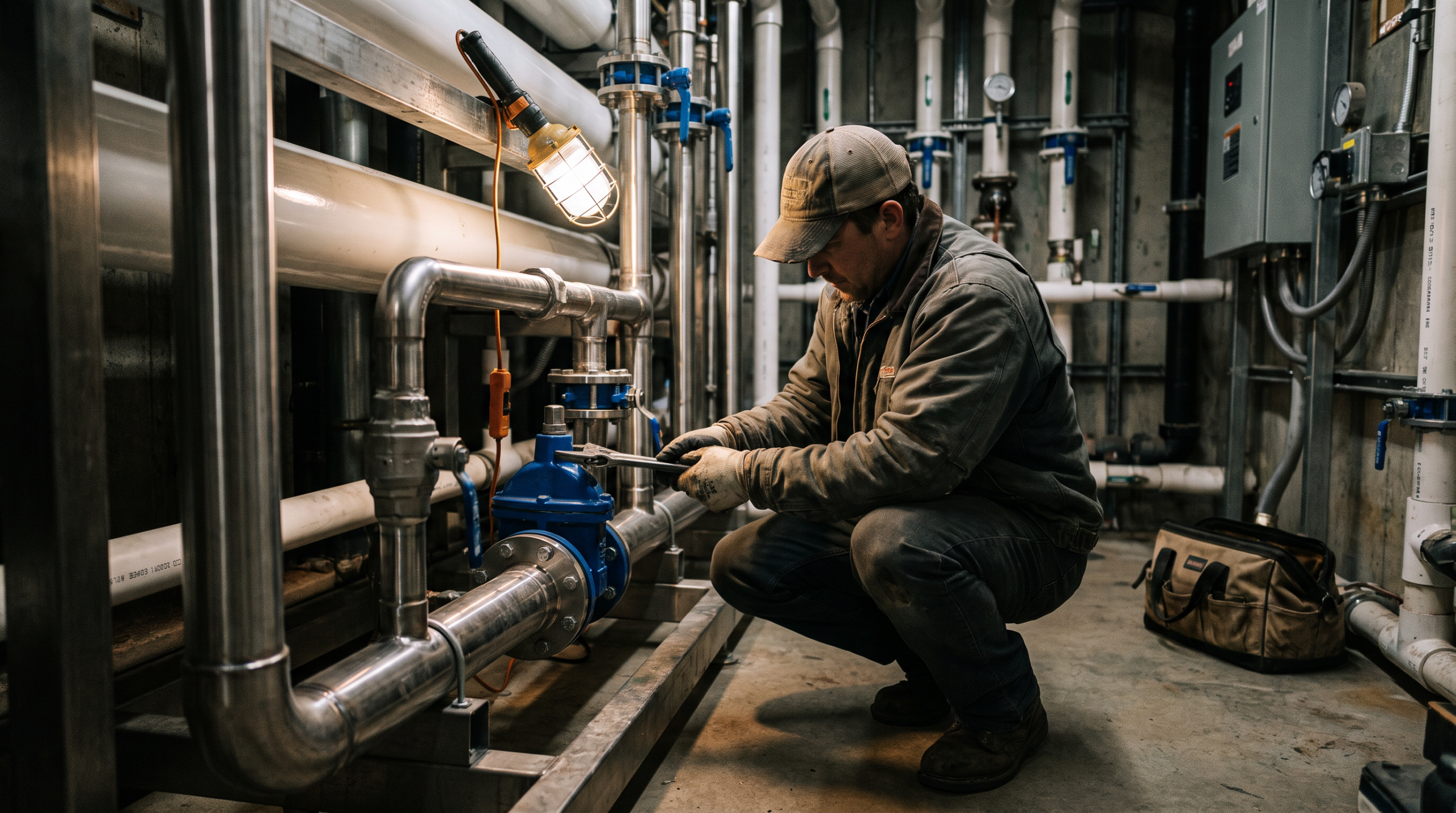
Stagnation compounds it. CDC guidance specifically flags dead legs, sections of piping with little or no flow, as a driver of Legionella colonization, and recommends flushing low-flow runs and infrequently used fixtures at least weekly. Disinfectant residual matters just as much: as water sits longer in a system (higher “water age”), residual chlorine or chloramine depletes, and the gap between incoming and point-of-use disinfectant levels is itself a warning sign CDC tells facilities to monitor. A building with extensive dead legs, low disinfectant residual, tepid hot water, and minimal flow can develop a substantial Legionella problem within weeks to months (CDC). An RO system upstream of that plumbing doesn’t prevent any of it. It can’t. RO’s job ends at the membrane.
Is Reverse Osmosis Actually Making the Problem Worse, or Better?
Neither, by itself, and that’s the point people miss. RO reduces the total organic load entering a facility’s water system, which is a genuine advantage over untreated feedwater. But because RO strips out competing microbes and most nutrients, the water that comes out is close to a blank slate. If that blank slate then sits in a poorly designed loop, the handful of organisms that do survive filtration face less competition than they would in raw water, and colonize faster once conditions allow it (Water Research, Farhat et al., 2019; MDPI Water, 2025).
That’s an argument for finishing the job properly, not for avoiding RO. A properly engineered system pairs the membrane with:
– Continuous or point-of-use disinfection maintained downstream of the RO unit, not just at the source
– Distribution loops sized and routed to eliminate dead legs and keep water moving
– Storage tanks and hot water systems held outside the 77–113°F Legionella growth band, or actively disinfected if they can’t be
– Scheduled flushing of low-use branches and fixtures
– Routine monitoring of disinfectant residual at point of use, not just at the treatment skid
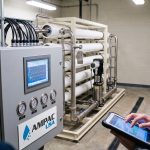
This is exactly the kind of system-level thinking that separates a commercial reverse osmosis system engineered for a specific facility from an off-the-shelf unit bolted onto existing plumbing and left alone. The membrane is one component. The distribution design around it is what determines whether that water stays safe from the tank to the tap.
Who Actually Needs to Worry About This?
Any facility with hot water storage, long distribution runs, or intermittently used branches downstream of treated water, which in practice means hospitals, senior living facilities, hotels, large office buildings, and industrial sites with process water loops feeding cooling towers or wash-down systems. This isn’t a niche concern. Legionnaires’ disease incidence in the US rose roughly 6.5-fold between 2000 and 2019, peaking at a national rate of 3.04 cases per 100,000 people in 2018 (CDC). CMS now requires healthcare facilities to maintain ASHRAE 188-compliant water management programs as a condition of participation, not a voluntary best practice, and recent outbreaks, including one in Albany, New York in September 2024 that caused four deaths and 20 hospitalizations within days, keep the regulatory pressure current rather than historical.
For facilities running an industrial reverse osmosis system to feed process water, cooling towers, or high-purity applications, the same logic applies at larger scale. A system that produces excellent permeate quality but discharges into a poorly maintained loop hasn’t solved the water safety problem. It’s relocated it downstream, into piping that’s usually less monitored than the treatment equipment itself.
What Should a Facility Manager Actually Check?
Start with the four CDC-identified risk factors rather than assuming the treatment system is the whole answer. Check water temperature at storage tanks and hot water systems against the 77–113°F growth range. Map dead legs and confirm a flushing schedule actually exists and gets followed, not just documented. Verify disinfectant residual is tested at point-of-use fixtures, not only at the treatment skid, since the drop-off between source and tap is often where the real risk shows up. And confirm the facility has an actual written water management plan, since ASHRAE 188 and CDC’s toolkit both exist specifically because “we have an RO system” and “we have a Legionella control program” are not the same statement, even though they’re frequently treated as interchangeable.
None of this makes reverse osmosis a liability. It makes RO one piece of a system that needs to be designed, not just installed. Facilities that treat distribution design, temperature control, and disinfectant monitoring as part of the water treatment project, rather than someone else’s problem after handoff, are the ones that don’t end up in an outbreak report.
Frequently Asked Questions
Can Legionella survive the reverse osmosis process itself?
Almost none does. RO membranes reject over 99% of bacteria, including Legionella, at the point of filtration. The risk isn’t survival through the membrane, it’s regrowth afterward, when trace organic carbon that does pass through supports new bacterial colonization in storage tanks or piping downstream.
Does adding more chlorine to RO-treated water solve the problem?
Not by itself. Disinfectant residual is one of four factors CDC identifies as necessary controls, but Legionella hides inside biofilm formed by other bacteria, which can shield it from disinfectant that would kill free-floating cells. Effective control combines residual disinfectant with eliminating dead legs, controlling temperature, and removing sediment and biofilm buildup.
What temperature range should storage tanks and hot water systems avoid?
Legionella grows best between 77°F and 113°F (25°C to 45°C) and can survive as low as 68°F, according to CDC. Hot water systems should be kept above that range or actively disinfected, and cold water systems should be kept below it where feasible.
Is this a reason to avoid reverse osmosis for a commercial facility?
No. RO reduces the organic and microbial load entering a facility’s water system compared to untreated feedwater, which is a genuine benefit. The risk comes from what happens after the membrane, not from the membrane itself, and it’s addressed through distribution design and a documented water management plan, not by skipping treatment.
How often should low-flow plumbing branches be flushed to prevent Legionella growth?
CDC guidance recommends flushing dead legs and low-flow piping runs at least weekly, with infrequently used fixtures flushed as needed to keep water moving and disinfectant residual from depleting in stagnant sections.
Sources: Farhat et al., “Legionella growth potential of drinking water produced by a reverse osmosis pilot plant,” Water Research/ScienceDirect (2019); “Shower Biofilms and the Role of Plumbing Materials in Reverse Osmosis Water Networks,” Water, MDPI (2025); Stewart et al., “Legionella pneumophila Persists within Biofilms Formed by Klebsiella pneumoniae, Flavobacterium sp., and Pseudomonas fluorescens under Dynamic Flow Conditions,” PLOS One (2012); “Dynamics of drinking water biofilm formation associated with Legionella spp. colonization,” npj Biofilms and Microbiomes, Nature (2024); CDC, “Controlling Legionella in Potable Water Systems” and “Monitoring Building Water” toolkits; CDC Legionnaires’ disease surveillance data.
AMPAC USA engineers custom water purification systems for commercial, industrial, and emergency applications — from 500 GPD to multi-million GPD. Trusted by municipalities, military, and industry worldwide.