Home Products Industries Applications Solutions Support Blog Contact Us
Back to Blog
Aug 2, 2019·13 min read
seawater desalination reverse osmosis watermaker 100 gpd 380 lpd 140

An All-You-Need-To-Know Guide On Marine Watermakers

An All-You-Need-To-Know Guide On Marine Watermakers

Quick Answer: Lead enters drinking water primarily from lead service lines, brass fixtures, and lead solder in premise plumbing — not from source water. NSF Standard 53-certified point-of-use filters and reverse osmosis systems are proven to reduce lead to below EPA action levels (15 ppb). There is no safe level of lead exposure for children.

Do you love sailing? Then you have probably understood what this is about. While at sea, fresh water is a very precious commodity. With the vast open sea in front of you and the wind in your hair, stopping at a port every time you need fresh water can be a buzzkill. Which is why marine watermakers that important before you are off to your next voyage. And if you were wondering which one would be the best-suited watermaker for you, you have come to the right place.

How Does A Watermaker Help?

We have already established that one cannot be at the sea for long without freshwater. And water weighs 8.3 pounds per gallon. If you opt to store the freshwater instead, in large quantities, water can be a deadweight decreasing fuel economy and taking up space. Marine watermakers offer you the comfort of getting fresh water at your disposal by just employing reverse osmosis on the salt water, which of course, is pretty abundant in the sea.

How Do I Know If Mine Is The Perfect Watermaker?

Your yacht or ship is one of many that come with a different set of specifications. It can have a limited number of people aboard and different fuel consumption based on speed, time and many other factors. How do you know if your watermaker is perfect for all your adventures? Here’s the answer.

  1. It is an open frame. This means a visual inspection is easy on your system and routine, onsite maintenance is easy.
  2. It is made of high-grade alloys like stainless steel and bronze. All the critical components are safe from cracking this way.
  3. Essential components like motors are coated for safety from corrosion and materials in the system are commercial, i.e. easily available at the market.
  4. It can utilize low RPM components to process different degrees of salinity. This helps avoid frequent filter changes.
  5. It is worth the priced that was paid. It has all the necessary features that should be included in the price you bought it for.
  6. It can easily be customized for your minute to minute requirements in space, modification, monitoring, and space.
  7. You have the best warranty coverage and it covers you for individual components as well as the whole system.

Oops! Mine Isn’t Perfect. Where Do I Get One?

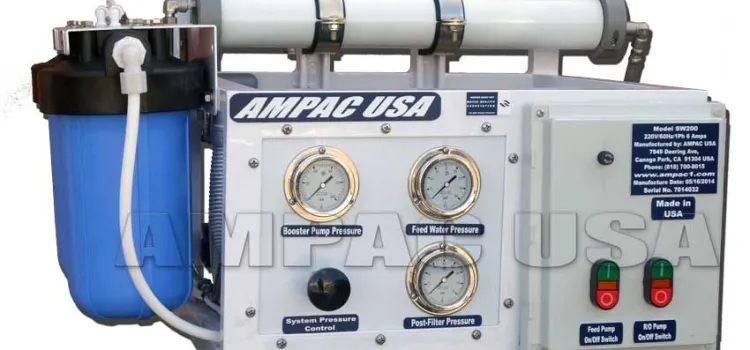
AMPAC USA where else? We offer all these features and more. Every AMPAC USA system comes equipped with a highly advanced reverse osmosis system delivered and installed by our experts for your convenience. Our marine watermakers

  • Occupy minimum space
  • Offer maximum quality
  • Are reliable and durable
  • Customized for AC/DC systems
  • Customized according to your ship/yacht
  • Are compact, horizontal and all in a single frame.

All this combined with AMPAC USA’s 24×7 customer service and experts at your disposal. Have a marine watermaker requirement? Get in touch with us today!

What flow rates are available for emergency water treatment?

AMPAC USA's emergency systems range from 1,500 GPD portable units to 50,000+ GPD trailer-mounted systems. Military-specification units are available for forward operating base deployment, producing potable water meeting EPA and WHO drinking water standards from virtually any source.

Are emergency RO systems suitable for disaster relief operations?

Yes. AMPAC USA's emergency systems are used by FEMA, the U.S. military, and international NGOs for disaster relief. They treat flood water, contaminated groundwater, and brackish sources, removing bacteria, viruses, and chemical contaminants to produce safe drinking water on-site.

What power sources can emergency water purification systems use?

AMPAC USA's emergency systems can run on generator power (120/240V or 480V 3-phase), solar panels with battery backup, or vehicle power take-off (PTO). Low-power models consume as little as 0.5 kW, making them viable for off-grid deployment.

How durable are military-grade water purification systems?

AMPAC USA's military systems are built to MIL-SPEC standards with stainless steel frames, powder-coated components, and UV-resistant materials. They are designed to operate in temperatures from -20°F to 120°F and are vibration-tested for transport in military vehicles.

Conclusion

This post highlighted how emergency and military-grade water purification systems provide safe drinking water rapidly in the most challenging field conditions. For organizations requiring deployable water treatment capability, AMPAC USA engineers portable and trailer-mounted systems built to perform wherever they are needed. Contact our team at [email protected] or (909) 548-4900 to discuss your emergency water treatment requirements.

Lead in Drinking Water: Sources, Standards, and Treatment

Lead contamination of drinking water is primarily a distribution and premise plumbing problem, not a source water problem. The EPA’s Lead and Copper Rule (LCR) and its 2021 revision (LCRR) establish an action level of 15 ppb (µg/L) at consumer taps — a level that triggers mandatory utility response when exceeded in more than 10% of sampled homes. However, the CDC and WHO have clearly stated that there is no safe level of lead exposure, particularly for children under six, where neurodevelopmental effects can occur at blood lead levels previously considered safe.

The primary lead sources in building plumbing are lead service lines (LSLs) connecting the water main to homes (estimated 6–10 million still in service across the US), lead-containing solder used in copper plumbing before 1986, and brass fixtures and faucets that can leach lead through corrosion. Corrosive water chemistry — low pH, low alkalinity, high dissolved oxygen, elevated chloramines — accelerates lead leaching from all of these sources. Orthophosphate corrosion inhibitors added by utilities reduce but do not eliminate lead leaching; the Flint, Michigan crisis demonstrated the catastrophic consequences when corrosion control treatment is inadequate.

For building owners and consumers who cannot wait for service line replacement programs, point-of-use treatment offers reliable protection. NSF/ANSI Standard 53-certified lead reduction filters (solid carbon block or reverse osmosis) reduce lead by greater than 99% at the tap. RO systems operating at standard pressures achieve lead levels well below 1 ppb in product water. AMPAC USA NSF-certified RO systems are specifically designed for lead-affected buildings and provide the most consistent and verifiable protection available without infrastructure replacement.

Q: What is the EPA action level for lead in drinking water?

A: The EPA Lead and Copper Rule sets an action level of 15 parts per billion (µg/L) at consumer taps. However, the CDC and WHO state there is no safe level of lead exposure — any detectable lead in drinking water represents a health concern, especially for children and pregnant women.

Q: Does a water filter remove lead?

A: Yes — NSF/ANSI Standard 53-certified filters (solid carbon block or RO) are independently tested to reduce lead to below action levels. Not all filters remove lead — verify NSF Standard 53 certification specifically for lead reduction before purchasing.

Q: Can you taste or smell lead in water?

A: No. Lead is colorless, odorless, and tasteless in water, even at toxic concentrations. The only way to know if your water has elevated lead levels is to test it — home test kits or certified laboratory testing are available.

Q: Who is most at risk from lead in drinking water?

A: Children under six are at highest risk — developing nervous systems are particularly vulnerable to lead neurotoxicity. Pregnant women and infants on formula are also high-risk groups. Long-term exposure in adults is associated with hypertension and kidney damage.

Q: How do I test my water for lead?

A: Contact your state health department, local water utility (they may offer free testing), or a certified private laboratory. EPA recommends first-draw sampling after at least 6 hours of non-use, which captures the highest potential lead contribution from premise plumbing.

Q: What should I do if lead is found in my drinking water?

A: Use only cold water for drinking, cooking, and formula preparation (hot water leaches more lead). Install an NSF Standard 53 or 58-certified point-of-use filter. Run the tap for 30 seconds to 2 minutes before use if you have not filtered it. Contact your utility to request lead service line replacement.

Lead in Drinking Water: Sources, Standards, and Treatment

Lead contamination of drinking water is primarily a distribution and premise plumbing problem, not a source water problem. The EPA’s Lead and Copper Rule (LCR) and its 2021 revision (LCRR) establish an action level of 15 ppb (µg/L) at consumer taps — a level that triggers mandatory utility response when exceeded in more than 10% of sampled homes. However, the CDC and WHO have clearly stated that there is no safe level of lead exposure, particularly for children under six, where neurodevelopmental effects can occur at blood lead levels previously considered safe.

The primary lead sources in building plumbing are lead service lines (LSLs) connecting the water main to homes (estimated 6–10 million still in service across the US), lead-containing solder used in copper plumbing before 1986, and brass fixtures and faucets that can leach lead through corrosion. Corrosive water chemistry — low pH, low alkalinity, high dissolved oxygen, elevated chloramines — accelerates lead leaching from all of these sources. Orthophosphate corrosion inhibitors added by utilities reduce but do not eliminate lead leaching; the Flint, Michigan crisis demonstrated the catastrophic consequences when corrosion control treatment is inadequate.

For building owners and consumers who cannot wait for service line replacement programs, point-of-use treatment offers reliable protection. NSF/ANSI Standard 53-certified lead reduction filters (solid carbon block or reverse osmosis) reduce lead by greater than 99% at the tap. RO systems operating at standard pressures achieve lead levels well below 1 ppb in product water. AMPAC USA NSF-certified RO systems are specifically designed for lead-affected buildings and provide the most consistent and verifiable protection available without infrastructure replacement.

Q: What is the EPA action level for lead in drinking water?

A: The EPA Lead and Copper Rule sets an action level of 15 parts per billion (µg/L) at consumer taps. However, the CDC and WHO state there is no safe level of lead exposure — any detectable lead in drinking water represents a health concern, especially for children and pregnant women.

Q: Does a water filter remove lead?

A: Yes — NSF/ANSI Standard 53-certified filters (solid carbon block or RO) are independently tested to reduce lead to below action levels. Not all filters remove lead — verify NSF Standard 53 certification specifically for lead reduction before purchasing.

Q: Can you taste or smell lead in water?

A: No. Lead is colorless, odorless, and tasteless in water, even at toxic concentrations. The only way to know if your water has elevated lead levels is to test it — home test kits or certified laboratory testing are available.

Q: Who is most at risk from lead in drinking water?

A: Children under six are at highest risk — developing nervous systems are particularly vulnerable to lead neurotoxicity. Pregnant women and infants on formula are also high-risk groups. Long-term exposure in adults is associated with hypertension and kidney damage.

Q: How do I test my water for lead?

A: Contact your state health department, local water utility (they may offer free testing), or a certified private laboratory. EPA recommends first-draw sampling after at least 6 hours of non-use, which captures the highest potential lead contribution from premise plumbing.

Q: What should I do if lead is found in my drinking water?

A: Use only cold water for drinking, cooking, and formula preparation (hot water leaches more lead). Install an NSF Standard 53 or 58-certified point-of-use filter. Run the tap for 30 seconds to 2 minutes before use if you have not filtered it. Contact your utility to request lead service line replacement.

Lead in Drinking Water: Sources, Standards, and Treatment

Lead contamination of drinking water is primarily a distribution and premise plumbing problem, not a source water problem. The EPA’s Lead and Copper Rule (LCR) and its 2021 revision (LCRR) establish an action level of 15 ppb (µg/L) at consumer taps — a level that triggers mandatory utility response when exceeded in more than 10% of sampled homes. However, the CDC and WHO have clearly stated that there is no safe level of lead exposure, particularly for children under six, where neurodevelopmental effects can occur at blood lead levels previously considered safe.

The primary lead sources in building plumbing are lead service lines (LSLs) connecting the water main to homes (estimated 6–10 million still in service across the US), lead-containing solder used in copper plumbing before 1986, and brass fixtures and faucets that can leach lead through corrosion. Corrosive water chemistry — low pH, low alkalinity, high dissolved oxygen, elevated chloramines — accelerates lead leaching from all of these sources. Orthophosphate corrosion inhibitors added by utilities reduce but do not eliminate lead leaching; the Flint, Michigan crisis demonstrated the catastrophic consequences when corrosion control treatment is inadequate.

For building owners and consumers who cannot wait for service line replacement programs, point-of-use treatment offers reliable protection. NSF/ANSI Standard 53-certified lead reduction filters (solid carbon block or reverse osmosis) reduce lead by greater than 99% at the tap. RO systems operating at standard pressures achieve lead levels well below 1 ppb in product water. AMPAC USA NSF-certified RO systems are specifically designed for lead-affected buildings and provide the most consistent and verifiable protection available without infrastructure replacement.

Frequently Asked Questions

Q: How does lead get into drinking water?

A: Lead does not come from reservoirs or source water — it leaches from plumbing. Lead service lines (the pipe connecting the main to your home), pre-1986 lead solder in copper pipe joints, and brass faucets and fixtures are the main sources. Corrosive water chemistry accelerates leaching.

Q: What is the EPA action level for lead in drinking water?

A: The EPA Lead and Copper Rule sets an action level of 15 parts per billion (µg/L) at consumer taps. However, the CDC and WHO state there is no safe level of lead exposure — any detectable lead in drinking water represents a health concern, especially for children and pregnant women.

Q: Does a water filter remove lead?

A: Yes — NSF/ANSI Standard 53-certified filters (solid carbon block or RO) are independently tested to reduce lead to below action levels. Not all filters remove lead — verify NSF Standard 53 certification specifically for lead reduction before purchasing.

Q: Can you taste or smell lead in water?

A: No. Lead is colorless, odorless, and tasteless in water, even at toxic concentrations. The only way to know if your water has elevated lead levels is to test it — home test kits or certified laboratory testing are available.

Q: Who is most at risk from lead in drinking water?

A: Children under six are at highest risk — developing nervous systems are particularly vulnerable to lead neurotoxicity. Pregnant women and infants on formula are also high-risk groups. Long-term exposure in adults is associated with hypertension and kidney damage.

Q: How do I test my water for lead?

A: Contact your state health department, local water utility (they may offer free testing), or a certified private laboratory. EPA recommends first-draw sampling after at least 6 hours of non-use, which captures the highest potential lead contribution from premise plumbing.

Q: What should I do if lead is found in my drinking water?

A: Use only cold water for drinking, cooking, and formula preparation (hot water leaches more lead). Install an NSF Standard 53 or 58-certified point-of-use filter. Run the tap for 30 seconds to 2 minutes before use if you have not filtered it. Contact your utility to request lead service line replacement.

Scroll to Top