

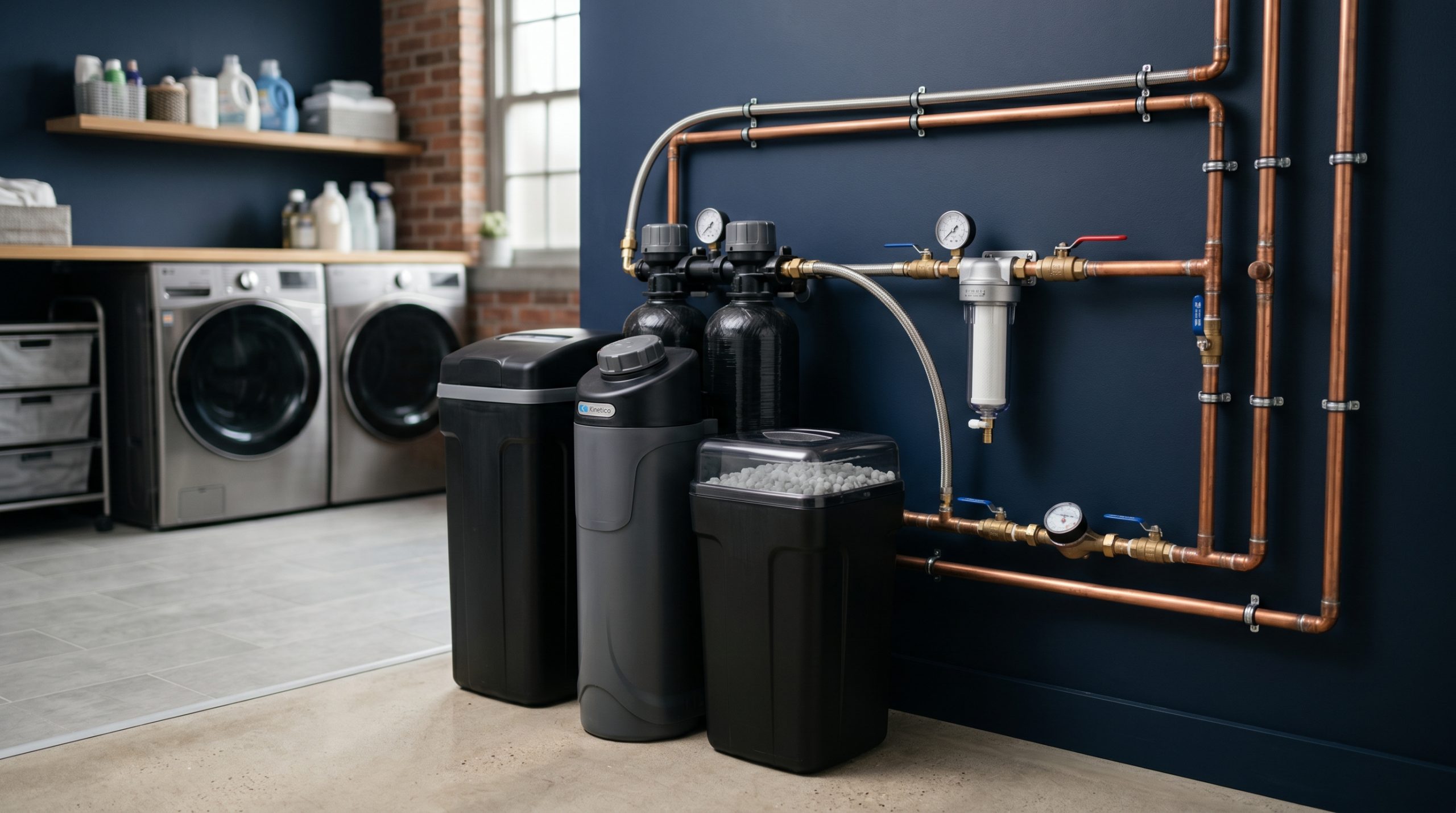

Well water presents different challenges than municipal water. Without a utility treatment process between the aquifer and your tap, whatever is in the ground comes directly to your household. For many well owners, that means hard water combined with iron, manganese, hydrogen sulfide, and potentially bacteria or nitrates. A water softener addresses one important piece of this profile, but well water treatment often requires a multi-stage approach to manage the full range of issues.
Why Well Water Is Often Hard
Groundwater picks up calcium and magnesium as it moves through limestone, chalk, and dolomite formations. The USGS classifies water hardness in grains per gallon: anything above 7 GPG is considered hard. Many well water sources in limestone-heavy regions test at 15-25 GPG or higher. Hard water leaves scale deposits in water heaters, pipes, and appliances, reducing service life and efficiency.
How Water Softeners Work
A traditional ion exchange water softener passes hard water through a tank of charged resin beads. Calcium and magnesium ions exchange with sodium ions on the resin surface, producing softened water. When the resin is exhausted, the system regenerates by flushing with a sodium chloride brine. The softener adds approximately 8 mg/L of sodium per GPG of hardness removed. Those on sodium-restricted diets may prefer potassium chloride as an alternative to sodium chloride.
Selecting the Right Softener Capacity
Softener capacity in grains determines how long the resin lasts before regeneration. Calculate your daily grain load by multiplying your water hardness in GPG by your daily household water use in gallons. A family of four using 300 gallons per day with 20 GPG hardness has a daily grain load of 6,000 grains, requiring a 32,000-grain or larger unit regenerating every 5 days, or a larger unit regenerating weekly.
Iron content significantly affects softener sizing. Water with more than 0.3 ppm dissolved iron adds to the effective hardness load and may require an iron-rated softener or a separate iron pre-filter. Iron above 3 ppm will foul standard softener resin over time.
Iron in Well Water
Iron is one of the most common well water problems in the US and significantly complicates softener selection. Dissolved ferrous iron is invisible in clear water but stains fixtures and laundry orange-red when it contacts air. Particulate ferric iron is already oxidized and visible as rust particles. For iron above 3 ppm, a dedicated iron filter installed ahead of the softener is the standard approach, oxidizing dissolved iron to particulate form and filtering it out before it reaches the resin bed.
What a Softener Does Not Do
A softener is not a whole-house purification system. It does not remove bacteria, viruses, nitrates, PFAS, arsenic, hydrogen sulfide, or tannins. The Water Quality Association recommends that all private well owners test annually for bacteria, nitrates, pH, hardness, iron, and locally relevant contaminants. A comprehensive test reveals what treatment stages are actually needed before you invest in equipment.
Complete Well Water Treatment Systems
AMPAC USA designs complete well water treatment systems that address the full contaminant profile of your specific source water. A typical system for a household with hard, iron-containing well water might include a sediment pre-filter, an air injection iron and hydrogen sulfide filter, a water softener sized for actual hardness and iron load, and an under-sink reverse osmosis system for drinking water to remove nitrates, arsenic, and PFAS.
Contact AMPAC USA with your water test results and we will specify the right treatment sequence for your well.
Frequently Asked Questions
Can a water softener damage a well pump or pressure tank?
No. A softener does not directly affect well pump or pressure tank performance. Softeners are installed after the pressure tank in the treatment sequence. The regeneration cycle uses existing water pressure. Ensure your pressure tank and pump are sized for the additional demand during regeneration cycles.
Should I soften all the water in my house?
Most whole-house softeners treat all water. Some homeowners bypass a cold water line to maintain unsoftened water for an outdoor tap or refrigerator. For appliance protection, softening all hot water is essential since scale damage occurs in water heaters regardless of the source.
How often does a well water softener need salt?
A household of four with 20 GPG hardness typically uses 8-12 pounds of salt per regeneration cycle. Running weekly regeneration means 30-50 lbs per month. Most homeowners add a 40-lb bag of softener salt every 4-6 weeks. Check the brine tank monthly when first installed to establish your actual consumption rate.
Sources: USGS Water Hardness | Water Quality Association | EPA Drinking Water | NSF International
Related Articles
- Is Distilled Water Good for Babies? Everything Parents Need to Know
- Everything You Need to Know About Water Neutralization
- Deionized Water Vs. Distilled Water- Everything You Need to Know
- Water Fasting- Everything You Need to Know
Conclusion
Well water brings its own set of challenges that a standard softener wasn’t built to solve alone — iron staining, sulfur odor, and hardness levels that swing depending on the season and the aquifer. A softener sized correctly for your household will handle the calcium and magnesium, but if your well water tests show iron or other well-specific issues, you’ll likely need it paired with additional treatment rather than expecting one unit to do everything. Getting the sizing and treatment combination right upfront saves you from replacing equipment that was never matched to your water in the first place. Contact our team at info@ampac1.com or (909) 548-4900 and we’ll help you build a well water treatment system suited to your actual water report, not a generic setup.
Well Water Softening: Treatment Requirements and System Design
Softening well water is frequently more complex than softening municipal supply because well water quality is highly variable and often contains problem constituents that conventional ion exchange softeners cannot address — and can be damaged by. Hardness (calcium and magnesium) is the target of conventional ion exchange softeners, but well water commonly contains iron (Fe2+ ferrous iron, Fe3+ ferric iron, colloidal iron), manganese, hydrogen sulfide (rotten egg odor), tannins, low pH (corrosive to plumbing and softener components), and sometimes bacteria. Each of these requires specific, sequential treatment before or alongside softening.
Iron is the most common complication in well water softening. Ferrous (dissolved) iron up to 3-5 ppm can be handled by some high-capacity softener resins with iron-removing salt. Above this level or when ferric (particulate) iron is present, an oxidizing filter (greensand, Birm, or catalytic carbon) must precede the softener. Failure to address iron adequately leads to resin fouling, reduced capacity, and eventual resin replacement. Manganese, which causes black staining at low concentrations (0.05 mg/L MCL), requires similar oxidation pre-treatment. Hydrogen sulfide requires aeration or chemical oxidation and can destroy softener resin at elevated concentrations.
pH below 7.0 (acidic water) is common in granitic aquifer regions and coastal areas. Acidic water accelerates corrosion of copper and galvanized piping, leaches lead from solder, and can damage softener components over time. Acid neutralizer filters using calcite (calcium carbonate) or a calcite/magnesium oxide blend raise pH to 7.0-7.8 and should precede softening. AMPAC USA designs comprehensive well water treatment systems based on laboratory analysis of your specific well water chemistry, ensuring each treatment component is properly sized and sequenced.
Frequently Asked Questions
What contaminants does a water softener remove from well water?
A traditional ion exchange water softener primarily removes calcium and magnesium ions, which cause water hardness. It does not effectively remove iron, manganese, hydrogen sulfide, bacteria, sediment, or nitrates, which are common in well water. Addressing these additional contaminants often requires a multi-stage water treatment system, including pre-filtration or oxidation, tailored to your specific well water profile.
How do I size a water softener for well water?
To size a water softener for well water, calculate your daily grain load by multiplying your water hardness in GPG by your daily household water usage in gallons. For example, a family using 300 gallons per day with 20 GPG hardness needs a 6,000-grain daily capacity. It’s crucial to also account for iron content, as dissolved iron above 0.3 ppm adds to the effective hardness load and may necessitate a larger or iron-rated unit.
Does a water softener remove iron from well water?
Standard water softeners can remove low levels of dissolved ferrous (clear water) iron, typically up to 3 ppm, by exchanging it like hardness minerals. However, they are not designed to remove ferric (red water) iron, iron bacteria, or higher concentrations of dissolved iron. For well water with iron levels above 3 ppm, or any ferric iron, a dedicated iron filtration system or an iron-rated softener is usually required as a pre-treatment.
What makes well water treatment different from municipal water treatment?
Well water treatment differs significantly from municipal water treatment because there is no utility treatment process between the aquifer and your tap. This means well owners must directly address all contaminants present in the ground, including hardness, iron, manganese, hydrogen sulfide, low pH, bacteria, and sediment. Municipal water, conversely, has already undergone extensive treatment to meet safety standards before reaching homes.
How much sodium does a water softener add to well water?
A traditional ion exchange water softener adds approximately 8 milligrams of sodium per liter (mg/L) for every grain per gallon (GPG) of hardness removed. For instance, if your well water has 20 GPG hardness, the softened water would contain an additional 160 mg/L of sodium. For those on sodium-restricted diets, potassium chloride can be used as an alternative regenerant.
AMPAC USA engineers custom water purification systems for commercial, industrial, and emergency applications — from 500 GPD to multi-million GPD. Trusted by municipalities, military, and industry worldwide.
