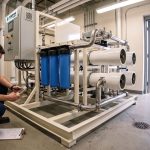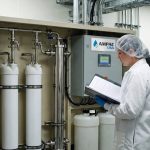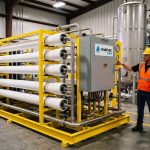
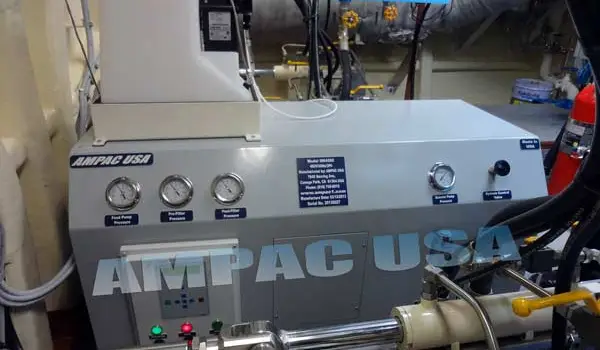

AMPAC USA won a contract with the Republic of Korea Navy. Our job? Design and build seawater desalination watermakers for their patrol ships. These systems make fresh drinking water right from the ocean, giving crew members plenty of water during long missions. No more heading back to shore just for water, these watermakers boost a ship’s endurance from 3 days to 30 days. That’s a huge change for the fleet’s range and what missions they can take on.
- Client: Republic of Korea (South Korean) Navy patrol vessel fleet
- Supplier: AMPAC USA — started in 1994, systems in over 40 countries
- Application: Making fresh drinking water from seawater for the crew
- Impact: Ships can stay at sea for 30 days instead of 3 days
- Technology: Military-grade seawater reverse osmosis (SWRO) watermakers
- AMPAC USA holds U.S. military contracts and ISO 9001:2015 certification
Why Ships Need Their Own Water Supply for Naval Missions
Fresh water is the biggest hurdle for naval operations. Any ship carrying a limited amount of drinking water has to return to port, or meet up with a supply ship, as soon as that water runs out. For fast patrol vessels and smaller combat ships, this dependency can limit how far they can go to just a few days of travel. It basically ties the fleet to its home base.
This really impacts how a navy operates. A patrol ship that has to come back to port every three days for water spends a lot of its mission time just traveling, not actually on station. The costs, for fuel, for crew time, for less surveillance coverage, add up fast across a whole fleet. For navies working in areas with long coastlines or contested waters, this reliance on resupply is a real weak spot.
The fix? It’s been around for a while in ship design: making water right on the ship. A vessel with a specially designed seawater reverse osmosis (SWRO) watermaker can constantly make fresh drinking water from the ocean around it. This makes the ship water-independent for as long as it has fuel, food, and its crew is ready. Global Water Intelligence says marine watermakers are now standard on almost all major naval combat ships and more and more patrol and auxiliary vessels worldwide are getting them installed.
What the South Korean Navy Needed, and How AMPAC USA Delivered
The Republic of Korea Navy has a fleet of patrol vessels. They watch over South Korean territorial waters, the demilitarized zone sea boundary, and the wider Yellow Sea and Sea of Japan. These ships work in tough conditions and need to stay on patrol for long stretches without shore support.
Their water needs were clear: each vessel needed a watermaker big enough to provide all the daily drinking, cooking, and hygiene water for the full crew, indefinitely. Their old setup, where ships could only stay at sea for three days before needing water, was holding them back. The goal after AMPAC USA installed our watermakers was at least 30 days of endurance, a ten-fold improvement.
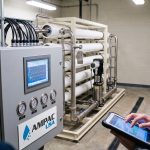
AMPAC USA custom-built seawater desalination systems for each type of patrol ship. Each watermaker takes raw seawater, which usually has about 35,000 parts per million (ppm) of dissolved solids, and turns it into drinking water. This new water meets World Health Organization and Korean military standards. The finished water has less than 500 ppm of dissolved solids, rejects over 99.4% of salt, and is safe for all uses on board without any extra treatment.
How Military Seawater Desalination Watermakers Work
A naval seawater reverse osmosis system isn’t like a commercial marine watermaker in a few key ways. It has to run reliably in conditions with lots of vibration, salty air, extreme temperatures, and power changes. And it must keep working through things that would make a commercial system shut down.
Getting Water In and Pre-Treatment
Seawater comes from the ship’s sea chest, an intake fitting below the waterline. It then goes through several pre-treatment steps. This usually means coarse straining to remove big particles, sediment filtration, and adding anti-scalant chemicals. These chemicals stop minerals from building up on the RO membranes. Sometimes, a media filter with anthracite or other materials further reduces cloudiness before the water hits the membranes.
High-Pressure Pumping
Seawater reverse osmosis needs operating pressures between 800–1,200 psi (55–83 bar). That’s to overcome the natural osmotic pressure of seawater and push water molecules through the semi-permeable membranes. Military-grade high-pressure pumps are built for continuous work at these pressures with very little maintenance. They use materials that stand up to seawater corrosion: duplex stainless steel, titanium, and high-performance polymer parts.
The RO Membrane Stage
At the core of the system is the RO membrane array. Here, pressurized seawater touches spiral-wound semi-permeable membranes. These membranes let water molecules pass through, but they block salt ions, bacteria, viruses, and all other dissolved and suspended contaminants. The clean water stream, called permeate, comes out at low pressure as fresh water. The waste stream, called brine, contains the concentrated salts and goes back overboard. A well-designed SWRO system typically turns 30–40% of the incoming water into clean product, with the rest discharged as brine.
Energy Recovery
The high-pressure waste brine still has a lot of hydraulic energy. Advanced SWRO systems include energy recovery devices (ERDs), like pressure exchangers or Pelton wheel turbines. These devices capture some of that energy and send it back to the feed pump. This cuts overall power use by 30–50% compared to systems without recovery. For ships with limited generator capacity, saving energy isn’t just about cost, it’s essential for operations.
Post-Treatment and Remineralization
RO product water has very few minerals and is slightly acidic. To meet drinking water standards and stop corrosion in the ship’s pipes, post-treatment usually involves a calcite contactor or carefully adding calcium and bicarbonate. This raises the pH and hardness to acceptable levels. Then, final disinfection with chlorine or UV keeps the water microbiologically safe in the storage and distribution system. Who wants rusty pipes, right?
AMPAC USA’s Experience with Military and Naval Watermakers
AMPAC USA has provided watermakers to naval and military clients on many continents. We’ve worked on U.S. military contracts, systems for allied foreign navies, and deployments in some of the world’s toughest operational places. We build every system under our ISO 9001:2015 quality management system. This ensures consistent design, production, and testing standards across all the systems we deliver.
What makes AMPAC USA military-grade watermakers different?
- Military specification compliance: Systems are designed to relevant MIL-SPEC standards for vibration, shock, corrosion resistance, and electromagnetic compatibility (EMC)
- Compact, space-optimized design: Naval vessels have strict space and weight budgets. AMPAC USA engineers systems to the smallest possible footprint while maintaining full redundancy for critical components
- Simplified maintenance: Watermaker systems on patrol vessels are maintained by ship’s crew, not specialist technicians. AMPAC USA designs for intuitive operation and maintenance with minimal special tools
- Spare parts logistics support: Global supply chain and in-country support agreements ensure that spare parts are available wherever vessels operate
- Warranty and lifecycle support: Full system warranty and planned maintenance support extending through the intended service life of the vessel
Comparison: Watermaker Technologies for Naval Applications
| Technology | Typical Naval Use | Advantages | Limitations |
|---|---|---|---|
| Seawater RO (SWRO) | Primary production on patrol/combatant vessels | Low energy (with ERD), compact, proven reliability | Membranes require pre-treatment; fouling risk in turbid water |
| Flash Distillation (MSF/MED) | Large surface combatants with waste heat available | Robust to feed water variability; very long membrane life | High energy use; large footprint; not practical for patrol craft |
| Vapor Compression (VC) | Medium naval vessels; remote land bases | Tolerant of biological fouling; no membrane replacement | Higher energy than SWRO with ERD; moving parts require maintenance |
| Electrodeionization (EDI) | High-purity water for specific shipboard systems | Continuous ultra-pure output; no chemical regeneration | Requires RO pre-treatment; not suited for primary potable production |
Operational Impact: From 3-Day to 30-Day Endurance
The operational significance of extending water endurance from 3 to 30 days cannot be overstated in naval planning terms. A patrol vessel on a 30-day independent deployment mission can cover vastly more ocean area, maintain sustained presence in distant patrol zones, and respond to developing situations without being constrained by the logistical clock.
Consider the arithmetic: a patrol fleet of 10 vessels, each requiring a water resupply run every 3 days, must dedicate a significant portion of its collective operating hours to transit between patrol station and port. If the average round-trip transit takes 12 hours, and each vessel must transit twice per week, the fleet loses 24 vessel-hours per week — or more than 1,200 vessel-hours per year — purely to water logistics. Multiply by fuel costs for high-speed transit and the economics of onboard water generation become immediately compelling, quite apart from the operational benefits.
With AMPAC USA watermakers installed, each vessel in the South Korean Navy patrol fleet became genuinely water-independent. Mission planning is no longer constrained by the water clock. Patrol zones can be assigned based on strategic need rather than logistical proximity to resupply. Emergency response capability is extended to the full range of the vessel’s fuel endurance.
AMPAC USA’s Global Naval and Military Track Record
The South Korean Navy contract is one of many military and naval projects completed by AMPAC USA since 1994. Our watermakers and water purification systems have been deployed on naval vessels in Asia, the Middle East, South America, and Europe, as well as on U.S. military forward operating bases and expeditionary installations where no local water supply is available.
For civilian maritime applications, AMPAC USA manufactures a full range of seawater desalination systems for commercial vessels, island communities, coastal resorts, and offshore platforms. The same engineering disciplines that produce military-grade reliability translate directly to demanding civilian applications where downtime is costly and technical support may be far away.
Beyond marine applications, AMPAC USA’s water treatment expertise extends to brackish water desalination, industrial process water treatment, and chiller makeup water systems. Contact our engineering team to discuss naval, maritime, or remote-deployment water treatment requirements. Explore our full range of water treatment systems and learn more about AMPAC USA.
Frequently Asked Questions: Navy and Military Seawater Desalination Watermakers
How do AMPAC USA watermakers improve naval operational endurance?
AMPAC USA’s military-grade seawater reverse osmosis (SWRO) watermakers extend the operational endurance of naval vessels, such as South Korean Navy patrol ships, from 3 days to 30 days. This eliminates the need to return to shore for fresh water, fundamentally changing the fleet’s range and mission capability by reducing logistical dependency and increasing time on station.
What technology does AMPAC USA use for its naval seawater desalination systems?
AMPAC USA employs military-grade Seawater Reverse Osmosis (SWRO) technology for its naval watermakers. These purpose-designed systems continuously produce fresh drinking water directly from the surrounding ocean, making vessels water-independent for extended at-sea operations.
Which naval fleet recently contracted AMPAC USA for seawater desalination systems?
The Republic of Korea (South Korean) Navy recently awarded AMPAC USA a contract for seawater desalination watermakers. These systems are designed for their patrol vessel fleet to produce fresh drinking water for crew members during extended deployments, enhancing their operational range.
What certifications and experience does AMPAC USA have in military water purification?
AMPAC USA has over 30 years of experience designing and manufacturing commercial/industrial reverse osmosis systems, including military applications. The company holds U.S. military contracts and is ISO 9001:2015 certified, demonstrating its expertise and adherence to stringent quality standards for critical deployments across 150+ countries.
What is the strategic benefit of onboard water generation for naval vessels?
Onboard water generation, through systems like AMPAC USA’s SWRO watermakers, eliminates fresh water as a primary logistical constraint for naval operations. This extends a vessel’s operational radius, reduces costly transit time to port for resupply, and allows fleets to spend more time on station, enhancing surveillance and mission effectiveness.
Related Articles
- AMPAC USA Seawater Desalination Watermakers for Marine Industry
- Ampac USA has just Installed a Seawater Desalination System on a Philippine's New Navy Ship
- AMPAC USA Portable Seawater Desalination Solution for Boats
- Harnessing the Power of Desalination to Tackle the Global Water Crisis
Conclusion
Going from 3 days to 30 days of endurance isn’t just a nice upgrade for the South Korean Navy — it changes what a patrol fleet can actually do, freeing ships to hold station in contested waters instead of running supply loops back to port. That kind of gain comes down to the same engineering fundamentals we build into every naval system: MIL-SPEC vibration and corrosion resistance, energy recovery devices cutting power draw 30-50%, and maintenance simple enough for a ship’s own crew to handle. If your fleet needs the same kind of water independence, take a look at our seawater desalination watermakers or contact our engineering team at info@ampac1.com or (909) 548-4900.
AMPAC USA engineers custom water purification systems for commercial, industrial, and emergency applications — from 500 GPD to multi-million GPD. Trusted by municipalities, military, and industry worldwide.