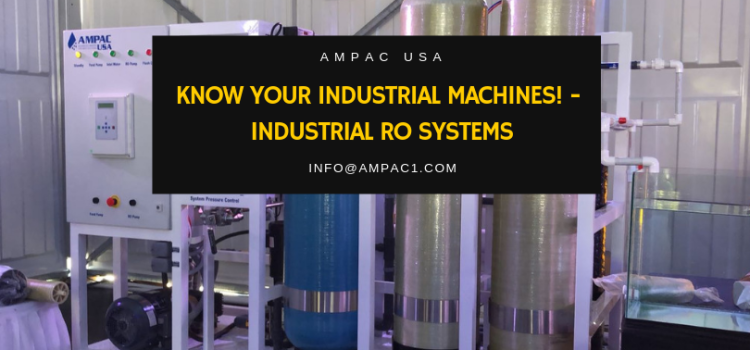

Factories across the U.S. and the world rely on Industrial RO systems. These aren’t just pieces of equipment, they’re assets, crucial for purifying incoming water and treating outgoing wastewater. But how well do you really know your Industrial RO?
Many industries lose money because they pick the wrong reverse osmosis machine. When you run a business, even a small mistake can turn that machine into a problem instead of a solution. So, choosing the right kind, capacity, and type of RO system is super important. Here are some of the key Industrial RO systems you should know about.
Industrial Reverse Osmosis System (LX Series):
The AP-SM-LX series from Ampac USA offers fully automated, fully equipped, top-quality drinking water purification reverse osmosis systems. They’re built on an aluminum, fully welded skid with an aluminum diamond plate, perfect for water store applications. These are ideal for bottling plants, beverage production, pharmaceutical companies, and more. Capacities range from 6,000 to 100,000 GPD.
Emergency Portable Reverse Osmosis (LX-C Series):
These AP-LX-C series systems are custom-built to client needs. They’re essential for companies that need a lot of fresh water, fast. Big NGOs or companies doing CSR work often order these for emergencies like natural disasters or areas struggling with water scarcity. This system has a 20,000 GPD capacity and uses reverse osmosis. Since they’re portable, you can easily move them from one place to another.
Mobile Trailer Water Purification system (TR-LX Series):
This particular product, the TR-LX, is vital for getting fresh water to remote locations on a large scale. These units are completely self-contained in trailers or shipping containers. They’re good for most water treatment jobs, using things like separation, filtration, ion exchange, carbon treatment, chemical injection, ultrafiltration, reverse osmosis, UV disinfection, and pH adjustment. These units are tough, light, and affordable, even for the most distant spots. They come in two versions: the TR40K-LX Mobile RO system with 40,000 GPD capacity and the Mobile Turnkey TR80K-LX RO system with 80,000 GPD capacity.
Mobile Brackish Water Industrial Reverse Osmosis (ROWPU Series)
Just like Mobile RO systems, these are specifically designed to treat brackish water. These rowpu100k-lx.ROWPU units give you reliable, higher purity water and better efficiency for various manufacturing processes. They’re a good choice for temporary settlements that need a lot of fresh water, coming in capacities of 100,000 GPD.
Industrial Turnkey Brackish Water Reverse Osmosis (BWRO-LX Series):
These BWRO-LX units are tough, light, and affordable, even for the most remote locations. Emergency Mobile Water Purification Systems are available, providing quick response for a full range of process water purification, drinking water purification, seawater desalination, groundwater treatment, wastewater treatment, reverse osmosis purification, water filtration, demineralization, and softening treatment on demand. They come in 80,000 GPD capacities and are incredibly helpful in emergencies.
Each of these systems includes top-tier reverse osmosis systems with pre and post-treatment filters. They’re a reliable option, giving you the best water at a reasonable cost.
Choosing the right system really depends on what you need it for. The easiest way to pick one is to hire an expert from AMPAC USA. Our specialists will find you the perfect product, meeting all your requirements, tailored to your specifications, and at the best price. Need an Industrial RO? Contact us today!
Related reading: Revealing the Key Benefits of Industrial Reverse Osmosis, Why is Industrial Reverse Osmosis different from the home?, Benefits from Industrial Reverse Osmosis Systems.
Frequently Asked Questions
How do industrial RO systems differ from residential systems?
Industrial RO systems are engineered for continuous 24/7 operation with flow rates from 1,000 GPD to millions of GPD, unlike smaller residential units. They feature larger 4-inch or 8-inch commercial membranes, automated controls, integrated pre-treatment, and CIP cleaning capabilities. Designed for a 10-20+ year service life, these systems include advanced performance monitoring instrumentation.
What are the typical flow rates for industrial reverse osmosis systems?
Industrial reverse osmosis systems are designed for continuous operation, handling flow rates from 1,000 GPD (gallons per day) up to millions of GPD. This substantial capacity allows them to meet the demanding water purification needs of large-scale commercial and industrial applications, ensuring a reliable water supply.
Which AMPAC USA industrial RO system is best for bottling plants and beverage production?
For bottling plants, beverage production, and pharmaceutical companies, the AMPAC USA AP-SM-LX series Industrial Reverse Osmosis System is ideal. These fully automated systems are built on aluminum skids and offer capacities ranging from 6,000 to 100,000 GPD for superior quality drinking water purification.
When are AMPAC USA’s emergency portable RO systems utilized?
AMPAC USA’s AP-LX-C series Emergency Portable Reverse Osmosis systems are essential for situations requiring large-scale, instant freshwater. They are custom-built for NGOs, companies undertaking CSR initiatives, or for deployment in emergency situations like natural disasters and water-stressed areas, providing 20,000 GPD capacity.
What water treatment processes are integrated into AMPAC USA’s mobile trailer systems?
AMPAC USA’s TR-LX Mobile Trailer Water Purification systems integrate multiple advanced treatment processes for remote locations. These self-contained units can include Separation, Filtration, Ion Exchange, Carbon treatment, Chemical Injection, Ultrafiltration, Reverse Osmosis, and Ultra Violet Disinfection to ensure comprehensive water purification.
AMPAC USA engineers custom water purification systems for commercial, industrial, and emergency applications — from 500 GPD to multi-million GPD. Trusted by municipalities, military, and industry worldwide.