
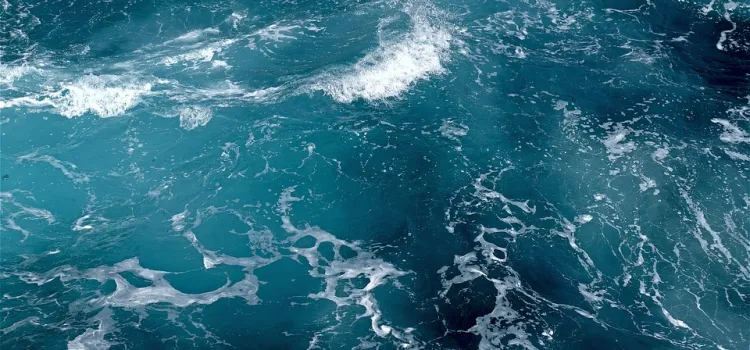

Seawater is the world’s most abundant water source – 96.5% of Earth’s water is in the oceans. The catch is the salt. Seawater contains roughly 35,000 ppm of dissolved salts (primarily sodium chloride), compared to the WHO’s guideline of 500 ppm for safe drinking water. Seawater desalination is the process that bridges this gap, and understanding how it works is increasingly relevant as freshwater scarcity intensifies globally.
The Core Challenge: Osmotic Pressure
Before understanding how desalination works, it helps to understand why it’s difficult. Water naturally moves through semi-permeable membranes from areas of low salt concentration to high salt concentration (osmosis). To reverse this – to push water from saltwater to freshwater – you have to apply pressure greater than the osmotic pressure of seawater.
Seawater’s osmotic pressure is approximately 27 bars (400 PSI). Seawater reverse osmosis (SWRO) systems typically operate at 55-85 bars (800-1,200 PSI) to overcome this osmotic pressure and drive water through the membrane at practical flow rates. This high pressure is why seawater desalination is more energy-intensive than treating brackish groundwater (which operates at 10-40 bars).
Step-by-Step: The Seawater Desalination Process
Step 1: Intake and Pre-Screening
Raw seawater enters through intake structures – either open ocean intakes or subsurface/beach well intakes. Open intakes draw from the surface or mid-depth and require more aggressive screening. Subsurface intakes (horizontal collector wells, beach galleries) use the seabed itself as a natural filter, drawing cleaner water with lower turbidity and biological load.
Initial screening removes large debris (fish, seaweed, plastics) through bar screens and drum screens. This protects downstream equipment and membranes from physical damage.
Step 2: Pre-Treatment
Pre-treatment is arguably the most critical stage for membrane protection and long-term system performance. Seawater contains suspended solids, organic matter, algae, bacteria, and scaling minerals that will foul or destroy RO membranes without proper pre-treatment. Options include:
- Coagulation and flocculation: Chemical dosing (typically ferric sulfate or aluminum sulfate) causes fine particles to aggregate into larger flocs for easier removal
- Sedimentation: Gravity settling of the flocculated particles
- Dual-media or multimedia filtration: Sand and anthracite filters to remove remaining turbidity
- Cartridge filtration (5-10 micron): Final guard before the membranes
- Antiscalant dosing: Chemical addition to prevent calcium carbonate and sulfate scale formation on membrane surfaces
- Biocide dosing: Chlorination to reduce biological activity, followed by dechlorination with sodium metabisulfite before the membrane (polyamide membranes are destroyed by free chlorine)
In favorable coastal conditions (low turbidity, low biological activity), ultrafiltration (UF) membranes are increasingly replacing conventional pre-treatment. UF produces more consistent pre-treated water quality and is less sensitive to seasonal source water variation.
Step 3: High-Pressure Pumping
Pre-treated seawater is pressurized to 55-85 bar by high-pressure pumps. Energy consumption at this stage is the largest single operating cost in SWRO – typically 50-60% of total power used. High-pressure pump selection (centrifugal pumps with precision engineering for this pressure range) significantly affects long-term reliability and efficiency.
Step 4: Reverse Osmosis Membranes
Pressurized seawater passes along the surface of spiral-wound polyamide thin-film composite (TFC) membranes arranged in pressure vessels. Water molecules are forced through the membrane; dissolved ions and molecular contaminants are rejected. The membrane achieves 99-99.8% salt rejection in seawater applications.
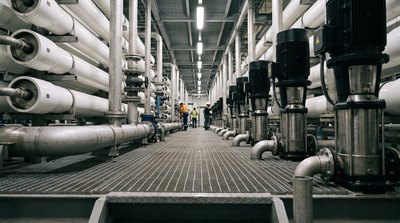
The output is two streams:
- Permeate (product water): Low-TDS water containing typically 200-500 ppm dissolved solids – nearly fresh, though requiring post-treatment before distribution
- Concentrate (brine): Highly concentrated saltwater (roughly twice the salinity of seawater) that must be managed carefully in discharge
Recovery rates in SWRO typically run 35-45% – meaning 35-45% of the intake water becomes permeate, and 55-65% becomes concentrate. This is physically limited by the osmotic pressure of the concentrate stream: as water is removed and concentrate becomes more saline, the osmotic pressure increases until further recovery becomes uneconomical.
Step 5: Energy Recovery
The high-pressure concentrate still carries significant hydraulic energy. Modern SWRO systems capture this energy using pressure exchangers (isobaric energy recovery devices) that transfer pressure from the concentrate stream to incoming feed water. Energy Recovery Inc.’s PX Pressure Exchanger operates at 94-98% efficiency and can reduce overall plant energy consumption by up to 60% compared to early-generation SWRO plants.
Energy recovery devices are now standard in commercial SWRO plants. Without them, specific energy consumption runs 4-6 kWh/m³ of permeate. With modern ERDs, this drops to 2-3 kWh/m³.
Step 6: Post-Treatment
Permeate water from SWRO membranes is purified but not yet potable. Post-treatment adjusts it for distribution:
- Remineralization: Addition of calcium and magnesium to raise pH and protect distribution pipes from corrosion (very low-TDS water is chemically aggressive to concrete and metal pipes)
- pH adjustment: Lime or sodium hydroxide addition to reach target pH (typically 7.5-8.5)
- Disinfection: Chlorination or UV for final microbial safety and residual protection in distribution
- Fluoridation: Where required by regulation
Step 7: Brine Disposal
Responsible brine disposal is one of the most significant environmental considerations in seawater desalination. High-salinity discharge can damage marine ecosystems if concentrated brine settles on the seabed near sensitive habitats. Mitigation approaches include:
- Diffuser outfalls that mix brine rapidly with ambient seawater
- Co-discharge with power plant cooling water (dilution)
- Offshore discharge at depth
- Zero Liquid Discharge (for inland applications where ocean discharge isn’t available)
Scale and Applications
Today, roughly 22,000 seawater desalination plants operate globally, producing over 100 million cubic meters per day of fresh water. The largest plants – Israel’s Sorek facility, Saudi Arabia’s NEOM plants – produce hundreds of millions of gallons per day. Compact SWRO systems for marine vessels and remote communities produce as little as 200-500 gallons per day.
AMPAC USA designs and manufactures seawater desalination systems from compact marine watermakers to large-scale land-based SWRO plants – using the same high-rejection membranes and energy-efficient designs that define modern seawater desalination.
AMPAC USA’s seawater desalination systems run this same sequence, from compact marine watermakers up to land-based SWRO plants.
Related Articles
- 6 Key Benefits of Using Seawater Desalination
- Improvements in Seawater Desalination Technologies
- Benefits of a Seawater Desalination Plant
- How Reverse Osmosis Works: The Complete Technical Guide | AMPAC USA
Frequently Asked Questions
Why is seawater desalination increasingly vital for addressing global water scarcity?
Seawater desalination is crucial because nearly 97.5% of Earth’s water is saline, while freshwater sources are strained by population growth, industrial expansion, and climate change. It provides a consistent, weather-independent water supply, transforming abundant ocean water into a usable resource for drinking, industry, and agriculture. AMPAC USA recognizes this as a core solution for sustainable water management.
What are the first two critical steps in the seawater desalination process?
The process begins with Seawater Intake, drawing water from coastal areas using open or subsurface methods, engineered to minimize environmental impact. This is followed by Pre-Screening, which removes large debris, fish, and particulates with bar screens and coarse filters to protect downstream components from fouling and mechanical damage.
How does pre-treatment prepare seawater for the main desalination unit?
Pre-treatment is a vital stage that eliminates suspended solids, biological contaminants, and chemical pollutants from the seawater. This multi-component process, including coagulation, flocculation, and various filtration steps, is critical for ensuring the long-term performance and extending the lifespan of the core desalination membranes, a key factor in system reliability.
What types of filtration are employed during the pre-treatment phase of desalination?
Pre-treatment utilizes several filtration methods. After chemicals like ferric chloride cause particles to aggregate, dual or multi-media filters trap fine particulates. Finally, cartridge filtration, typically using 5-micron filters, removes residual impurities, ensuring the water is adequately prepared for the sensitive desalination membranes.
Which chemicals are commonly used in the pre-treatment stage of seawater desalination?
In pre-treatment, chemicals like ferric chloride or aluminum sulfate are used for coagulation and flocculation to aggregate suspended particles. Additionally, chemical dosing introduces antiscalants to prevent mineral buildup on membranes, biocides to control biological growth, and pH adjusters to optimize water chemistry for subsequent processes, all critical for system efficiency.
Are all the desalination steps described here cost effective at commercial scale?
Yes, at municipal and industrial scale – reverse osmosis has become the most cost effective desalination steps sequence available, which is why it has largely replaced older thermal distillation methods worldwide. Energy recovery devices that capture pressure from the reject stream are what make modern RO plants economical; without them, the high-pressure pumping stage would dominate operating costs. Large plants in the Middle East, and a growing number in the United States (particularly California and Texas coastal facilities), rely on this same staged process at scale.
AMPAC USA engineers custom water purification systems for commercial, industrial, and emergency applications — from 500 GPD to multi-million GPD. Trusted by municipalities, military, and industry worldwide.