
)
Here’s more proof of the connection between not drinking enough and how well your brain works.
- Water is super important for your mental health. This paper wants to make it clear that we need to think of water as a must-have nutrient for a healthy brain when we do nutrition research.
- This study reviewed a lot of information and found that dehydration, even when it’s mild, makes both simple and complex brain functions worse.
- Big international nutrition websites often downplay how important water is for good nutrition. They also don’t talk about how dehydration impacts your thinking.
https://www.emeraldinsight.com/doi/abs/10.1108/IJHG-10-2018-0056
The post appeared first on .
Source: Water Feed
Why Water Quality Matters for Cognitive Health
Your brain is about 75% water. Lose just 1% of your body’s water, and you’ll notice your processing speed slows down and your working memory isn’t as good. A big study in 2019, published in Nutrients (Edmonds et al.), looked at 33 different trials. It showed that even mild dehydration consistently made people less alert and worse at short-term recall. Kids and adults over 55 felt these effects the most.
Here’s how it works: less water means less blood plasma, which means less blood flowing to your brain. That cuts down on the oxygen and sugar getting to your brain cells. Plus, even a little dehydration triggers a stress response, releasing cortisol, which makes it harder for your brain to form memories.
Bad water quality makes this problem even bigger. Things like lead (even above 5 ppb), nitrates (above 10 mg/L, the EPA limit), and disinfection byproducts (like THMs above 80 ppb) have all been linked to brain issues in scientific studies. So, just having water isn’t enough – it has to be really clean.
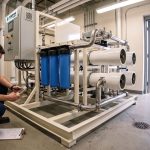
AMPAC USA commercial and industrial reverse osmosis systems solve both problems: getting you enough water and making sure it’s clean. Our systems remove over 99% of heavy metals, chlorine byproducts, and dissolved solids. They typically reduce TDS from 500-2,000 ppm to less than 10 ppm. You’ll find AMPAC systems in schools, company offices, and hospitals. We build models from small 1,500 GPD units for a single spot to massive 100,000+ GPD systems for entire facilities. Every one is NSF/ANSI 58 certified and engineered to ASME standards.
Frequently Asked Questions
How much dehydration impacts cognitive function?
Even mild dehydration, as little as 1-2% body water loss, measurably impairs cognitive performance. This can reduce processing speed, working memory capacity, and vigilance, with effects particularly pronounced in children and adults over 55.
What specific cognitive functions are affected by mild dehydration?
Mild dehydration primarily impairs attention, short-term memory, and psychomotor speed. Research, including a 2019 meta-analysis in Nutrients, consistently shows degradation in vigilance and short-term recall tasks even with minimal body water loss.
Why is water quality crucial for brain health, beyond just hydration?
Beyond simply providing hydration, water quality is critical because contaminants can directly impact neurocognitive function. Substances like lead (above 5 ppb), nitrates (above 10 mg/L as the EPA MCL), and disinfection byproducts (THMs above 80 ppb) have all been linked to cognitive deficits in peer-reviewed literature.
How does dehydration physically affect the brain?
Dehydration impairs brain function by reducing plasma volume, which decreases cerebral blood flow and thus lowers the delivery of essential oxygen and glucose to neurons. Additionally, even mild dehydration triggers a cortisol stress response that interferes with hippocampal memory consolidation.
How can AMPAC USA systems help ensure water quality for optimal cognitive health?
AMPAC USA commercial and industrial reverse osmosis systems are engineered to address both water availability and rigorous purity standards. Our systems effectively remove contaminants like lead, nitrates, and THMs, ensuring the water provided meets the high-quality benchmarks necessary for optimal cognitive function.
AMPAC USA engineers custom water purification systems for commercial, industrial, and emergency applications — from 500 GPD to multi-million GPD. Trusted by municipalities, military, and industry worldwide.