
Industrial reverse osmosis systems sit at the core of clean water production across more industries than most people realize. If you’re in pharmaceuticals, power generation, food and beverage, oil and gas, semiconductor manufacturing, or municipal water treatment, there’s a reasonable chance your operation depends on one – or should. This guide covers what industrial RO systems are, how they work, what they cost, and what’s changed in 2025-2026 that buyers need to know about. Whether you need commercial RO systems for a single facility or full industrial reverse osmosis solutions across multiple sites, the same core reverse osmosis RO systems principles apply – built for long term, reliable operation.
What Is an Industrial Reverse Osmosis System?
Reverse osmosis uses hydraulic pressure to force water through a semi-permeable membrane with pores at 0.0001 microns – small enough to block dissolved ions, heavy metals, PFAS, bacteria, and virtually all dissolved solids. On one side of the membrane you get highly purified permeate (product water); on the other you get concentrate (reject water) carrying the removed contaminants.
Industrial RO scales this core process to production rates ranging from 6,000 GPD (gallons per day) on the small end to hundreds of millions of GPD for large desalination facilities. The engineering gets progressively more complex as you scale, but the fundamental mechanism is the same: pressure, membrane, separation.
Industries That Run on Industrial RO
Each industry has different purity targets and different feed water challenges:
- Pharmaceutical and biotech: USP-grade purified water requires <1 ppm TDS and endotoxin-free production. RO is the first stage; deionization or electrodeionization (EDI) polishes to ultrapure levels. No shortcuts here – contaminated water in pharmaceutical production means product recalls, regulatory violations, and patient safety failures.
- Food and beverage: Consistent water chemistry is a product quality variable. Brewers, soft drink manufacturers, and dairy operations use RO to produce a neutral water baseline, then add minerals back at precise levels for product consistency. Variable tap water TDS produces inconsistent product.
- Power generation: Boiler feed water for steam turbines must be near-zero TDS. Even trace minerals form scale on heat exchanger surfaces, reducing efficiency and eventually causing equipment failure. RO is standard pre-treatment before final polishing.
- Oil and gas: Produced water treatment, hydraulic fracturing water recycling, and injection water all require treatment systems capable of handling highly variable, often extremely high-TDS feed water. Containerized RO units are deployed at remote well sites.
- Semiconductor manufacturing: Requires ultrapure rinse water with conductivity approaching the theoretical minimum of pure water. RO is the foundation of the ultrapure water (UPW) treatment train.
- Municipal: Brackish groundwater treatment and potable reuse (treating wastewater to drinking water standard) increasingly rely on large-scale RO systems. The 2024 EPA PFAS MCLs accelerated municipal adoption for systems dealing with PFAS contamination.
System Configurations: Skid, Containerized, and Multi-Pass
Industrial RO comes in several physical configurations depending on capacity, deployment environment, and application requirements:
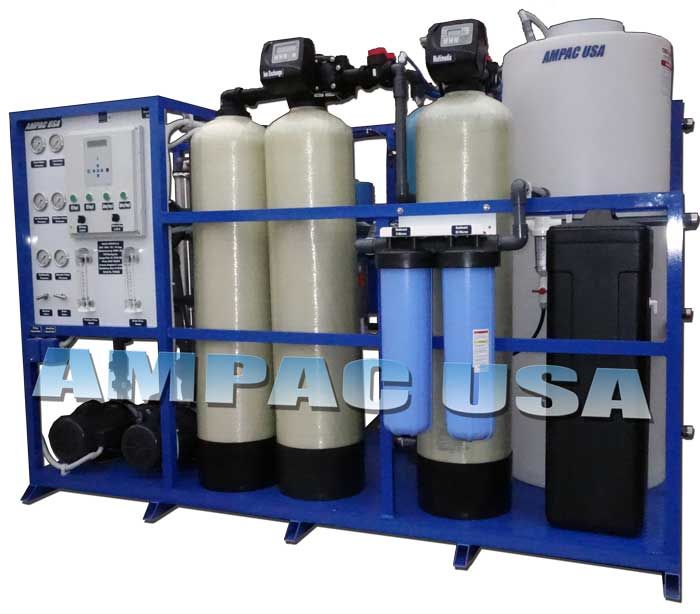
Skid-mounted systems are the most common configuration for permanent installations. Treatment components – pre-filters, high-pressure pump, membrane vessels, instrumentation – are pre-assembled on a structural steel frame and installed in a building. Compact, well-integrated, easy to maintain. AMPAC USA’s industrial skid systems cover 6,000 to 100,000 GPD; custom configurations go higher.
Containerized systems – full RO treatment plants housed in ISO shipping containers – are designed for sites that don’t have a building, need rapid deployment, or require mobility. Oil field water treatment, disaster relief, military forward operations, and remote construction projects all rely on containerized systems. Factory testing is complete before shipping; on-site installation takes days, not months.
Multi-pass RO runs product water from a first-pass RO system through a second RO membrane stage. This achieves rejection rates approaching 99.9%+ TDS removal – necessary for semiconductor rinse water, some pharmaceutical applications, and high-purity laboratory water. Energy cost is higher; purity is significantly elevated.
Key Specs That Actually Matter
Salt/TDS rejection rate: Standard industrial TFC membranes achieve 97-99% rejection. High-performance brackish membranes hit 99.5%+. Seawater membranes run 99-99.8%. Sustained rejection below 95% indicates membrane degradation.
Recovery rate: The percentage of feed water converted to product water. Brackish systems: 50-85%. Seawater systems: 35-45%. Higher recovery reduces reject water volume but increases scaling and fouling risk – it’s a balance determined by feed water chemistry.
Operating pressure: Drives energy consumption. BWRO runs at 150-400 psi; SWRO runs at 800-1,200 psi. Pressure equals cost – this is where energy recovery devices have their biggest impact.
Flux rate (GFD – gallons per square foot of membrane per day): Higher flux means more water per membrane element, but also higher fouling rate. Proper flux design for your feed water prevents premature membrane failure.
Cost Ranges for Industrial RO Systems in 2026
System costs (skid only, not installed total-project cost):
| Scale | Capacity | System Cost Range |
|---|---|---|
| Small commercial | Up to 10,000 GPD | $15,000 – $50,000 |
| Mid-range industrial | 50,000-100,000 GPD | $100,000 – $300,000 |
| Large industrial/municipal | 500,000+ GPD | $1,000,000+ |
Critical note: these are skid prices. Total installed cost – adding pre-treatment, post-treatment, storage tanks, civil and electrical work, piping, instrumentation – typically runs 2-3× the skid price. Budget accordingly.
2025-2026 Trends Every Buyer Should Know
Energy recovery devices (ERDs) are now standard at meaningful scale. Isobaric pressure exchangers – like Energy Recovery Inc.’s PX series – operate at 95-98% hydraulic efficiency, reducing energy consumption in seawater RO by up to 60%. These are no longer just for large municipal desalination plants; they’re appearing in mid-scale brackish industrial systems where energy costs are significant.
IoT-connected monitoring and AI-driven predictive maintenance. New industrial RO installations in 2025-2026 include real-time sensor arrays for TDS, flow, pressure differential, and performance trending. AI platforms processing this data claim 15-25% energy reduction and improved membrane life through predictive maintenance alerts. The shift from scheduled maintenance to condition-based maintenance is well underway.
Zero Liquid Discharge (ZLD) integration. Stricter environmental discharge regulations are pushing industries toward ZLD configurations where RO concentrate is further processed – through evaporation, crystallization, or mechanical vapor recompression – to eliminate liquid waste entirely. The ZLD market reached $7.39 billion in 2025, growing at 8.34% CAGR through 2031. RO is the economical first stage of any ZLD treatment train.
Modular/containerized systems gaining ground. Supply chain unpredictability and faster project timelines are shifting buyers from custom-engineered site-built plants toward factory-tested modular skids and containerized units. Deployment in weeks rather than months, without a permanent building, has real advantages for industrial projects with shifting site requirements.
Maintenance and Lifespan: What to Expect
RO membranes last 2-5 years under normal conditions; up to 7 years with excellent pre-treatment and proactive chemical cleaning. The pressure vessels, frame, high-pressure pump, and instrumentation routinely last 10-20 years with proper maintenance.
Annual operating costs per 50 m³/hr system typically run $5,000 – $15,000 in chemicals alone, plus energy, labor, and periodic membrane replacement. Energy represents 50-70% of total operating expenses for high-pressure systems.
Organizations with structured preventive maintenance programs see 25-40% lower total maintenance costs compared to reactive approaches. The ROI on preventive maintenance consistently runs 10:1 to 30:1 – service you schedule is cheaper than emergencies you respond to.
For a technical consultation, system sizing review, or to explore AMPAC USA’s full industrial RO product line, contact our engineering team. Our systems cover commercial and industrial reverse osmosis from 6,000 GPD to multi-million GPD applications, with over 30 years of water treatment engineering behind every design.
Related: Ready to spec a system? Browse AMPAC USA industrial RO systems or request a custom quote. For ultrapure applications, see our guide to EDI and ultrapure water systems.
Frequently Asked Questions
How does an industrial reverse osmosis system purify water?
Industrial RO systems purify water by employing a high-pressure pump to force untreated water through semi-permeable membranes. This process effectively removes dissolved salts, organic substances, and other impurities, leaving behind highly purified water. It is a critical technology for industries requiring stringent water quality standards, such as pharmaceuticals and food & beverage.
What are the critical components of an efficient industrial RO system?
An efficient industrial RO system comprises several critical components working in harmony. The membrane module is the core where desalination occurs, while the high-pressure pump propels water through these membranes. Pre-treatment filters protect the system by removing sediments and chlorine, and post-treatment units adjust pH or remineralize water to meet specific application needs.
How do I determine the correct industrial RO system capacity for my facility?
Determining the correct capacity involves assessing both your current and future water demand. Industrial RO systems vary significantly, from compact units producing a few gallons per minute to large-scale installations capable of thousands of gallons per hour. It’s crucial to choose a system that not only meets immediate operational needs but is also scalable to accommodate future expansion and evolving requirements.
What factors should I consider when selecting an industrial RO system for my specific industry?
Selecting the ideal industrial RO system hinges on understanding your industry’s unique water purity requirements. Key factors include the water source, types of contaminants present, and the desired flow rate. For instance, industries with high biological contaminants need advanced pre-treatment, while those dealing with brackish water require specialized high-salinity systems.
Why is pre-treatment essential for industrial reverse osmosis systems?
Pre-treatment is essential for industrial RO systems to ensure their longevity and optimal efficiency. It removes larger particles like sediments and harmful substances such as chlorine, which can foul or damage the delicate RO membranes. Proper pre-treatment minimizes maintenance, extends membrane lifespan, and maintains consistent water purification performance.
AMPAC USA engineers custom water purification systems for commercial, industrial, and emergency applications — from 500 GPD to multi-million GPD. Trusted by municipalities, military, and industry worldwide.