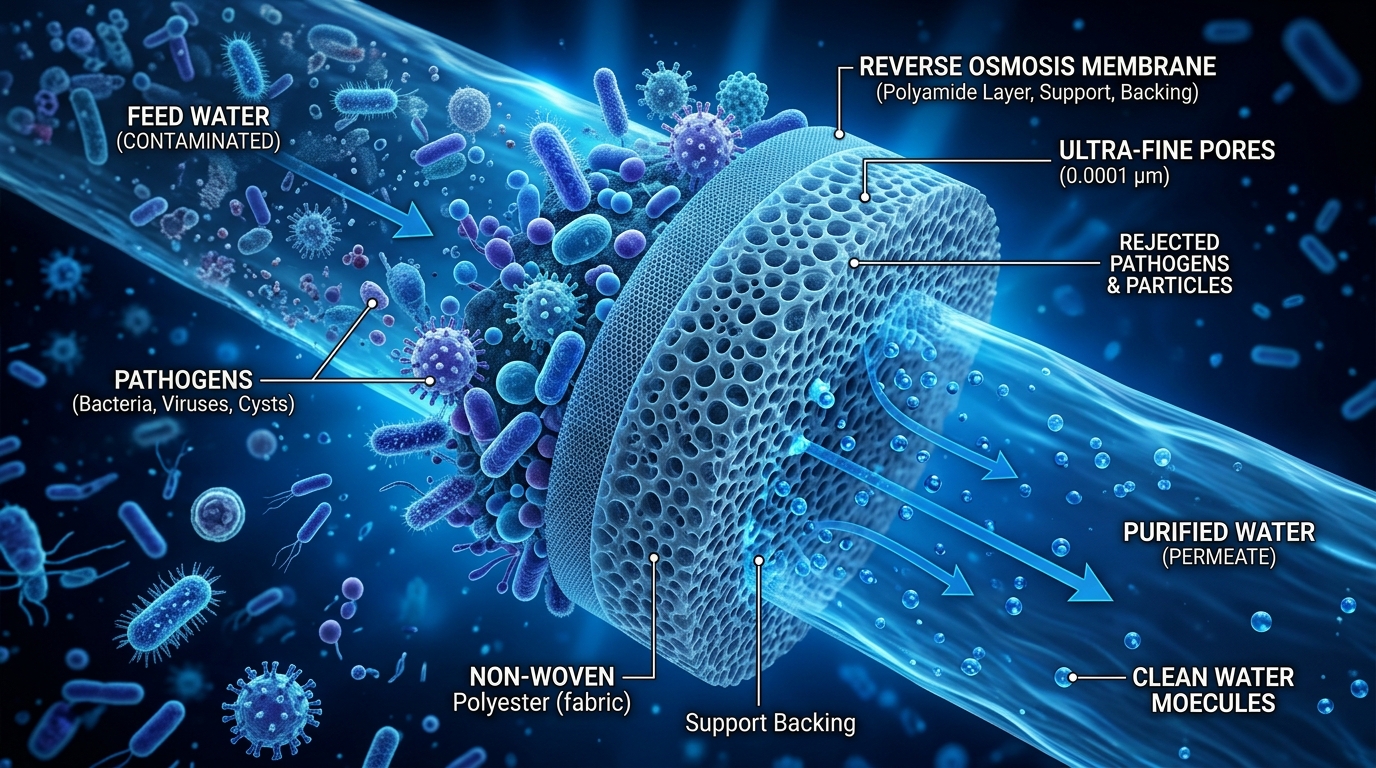

Real-time online monitoring systems can constantly check how well reverse osmosis plants remove bacteria. This lets operators catch membrane problems in minutes, instead of waiting hours for lab results.
Catching Bacteria in Reverse Osmosis Systems, Fast
Normally, when you test RO water for microbes, you use culture methods. Those take 18-48 hours to give you results. That’s a huge window of time. If a membrane or O-ring fails during that wait, millions of bacteria could get into your drinking water. Online monitoring changes that. It gives you continuous, real-time signals that show if microbes are getting through.
Here’s what we use to monitor:
- Online turbidity sensors: Turbidity gives you a general idea of how many particles and bacteria are in the water. It’s not specific to bacteria, but if permeate turbidity suddenly jumps, it’s a quick sign of physical membrane damage. Modern sensors can pick up changes as small as 0.1 NTU.
- Total organic carbon (TOC) analyzers: TOC instruments measure dissolved organic carbon right away, usually every 2-5 minutes. If permeate TOC rises, it means dissolved organic matter is passing through the membrane. This is a solid early warning of membrane breakdown, even before bacterial counts go up.
- Flow cytometry: Advanced online flow cytometers can count and identify individual cells in water samples almost instantly. They find not just culturable bacteria, but also viable but non-culturable (VBNC) organisms that regular plate counts miss. This gives you a much clearer picture of how well you’re removing biological contaminants.
- Electrical conductivity / salt rejection: If salt rejection drops, it means there’s a physical defect in the membrane. You measure this by comparing the feed water’s conductivity to the permeate’s conductivity. This is the standard, continuous way to check membrane integrity, and you should log it at least every 15 minutes.
What this means for your water system: When you build online monitoring into your SCADA system, you get automated alerts. In more advanced setups, you can even have valves automatically close, diverting bad permeate to waste before it ever reaches distribution. If you’re planning membrane upgrades, make sure to check how well the monitoring sensors work with the new membranes. These two systems need to talk to each other reliably to truly protect your water.
For industrial and municipal RO operators, investing in online monitoring pays off. You’ll avoid regulatory fines, lower the risk of illness outbreaks, and you might even reduce how often you need to do manual microbiological sampling. Many state regulations allow for less manual testing once you have good monitoring data.
Fujioka, Takahiro; Hoang, Anh T.; Aizawa, Hidenobu; Ashiba, Hiroki; Fujimaki, Makoto; Leddy, Menu
ENVIRONMENTAL SCIENCE & TECHNOLOGY LETTERS, 5 (6):389-393; 10.1021/acs.estlett.8b00200 JUN 2018
Abstract: Careful monitoring of microbial water quality is vital for safe recycled water after advanced treatment for indirect and direct potable reuse. This study looked at real-time bacterial monitoring to check reverse osmosis (RO) treatment for bacteria removal. We used a real-time continuous bacteriological counter to monitor bacterial counts online, in real time, in the RO feed and permeate water. Over 68 hours of pilot-scale testing, we monitored bacterial counts in real time. They ranged from 1 x 10(3) to 4 x 10(4) counts/mL in the RO feed (ultrafiltration treated wastewater) and from 4 to 342 counts/mL in the permeate. The results show that the bacteriological counter can track changes in bacterial counts in both the RO feed and permeate. We confirmed bacterial concentrations using epi-fluorescence microscopy for total bacterial counts. We found a strong correlation (R-2 = 0.83) between the online bacterial counts and epi-fluorescence counts in the RO feed. There was almost no correlation for the RO permeate. In this study, we checked a real-time bacteriological counter (it gives counts per milliliter every second) to make sure RO treatment continuously removes bacterial contaminants.
https://pubs.acs.org/doi/10.1021/acs.estlett.8b00200
The post Real-Time Online Monitoring for Assessing Removal of Bacteria by Reverse Osmosis appeared first on Facts About Water.
Source: Water Feed
Related Articles
- Does Reverse Osmosis Remove Coliform Bacteria? A Complete Guide
- Legionella growth potential of drinking water produced by a reverse osmosis pilot plant
- Assessing the origin of bacteria in tap water and distribution system in an unchlorinated drinking water system by SourceTracker using microbial community fingerprints
- Lead in Drinking Water: Scope, Risks, and Reverse Osmosis Solutions
Frequently Asked Questions
What are the disadvantages of traditional bacterial testing for reverse osmosis systems?
Traditional microbiological testing relies on culture methods requiring 18-48 hours for results. This significant delay means that if an RO membrane or O-ring fails, millions of bacteria could pass into the distributed water before the contamination is detected. Real-time monitoring eliminates this critical vulnerability.
What real-time online monitoring technologies are used to assess bacterial removal in RO systems?
Key real-time online monitoring technologies include nephelometric turbidity sensors (detecting changes as low as 0.1 NTU), Total Organic Carbon (TOC) analyzers with 2-5 minute cycle times, and advanced online flow cytometers. Electrical conductivity sensors are also crucial for continuously tracking salt rejection, a direct indicator of membrane integrity.
How does online flow cytometry improve bacterial detection in RO permeate?
Online flow cytometers provide near-real-time counts and characterization of individual cells in water samples. Unlike traditional plate counts, they detect not only cultivable bacteria but also viable but non-culturable (VBNC) organisms, offering a more comprehensive and accurate assessment of biological removal efficiency.
How frequently should electrical conductivity and salt rejection be monitored in a reverse osmosis plant?
Electrical conductivity and salt rejection should be logged at a minimum of every 15 minutes in a reverse osmosis plant. A decline in salt rejection directly correlates with physical membrane defects, making it a standard and essential continuous integrity check for early detection of issues.
What operational benefits do real-time online monitoring systems provide for industrial and municipal RO operators?
Real-time online monitoring systems integrate with SCADA to provide immediate alerts and, in advanced setups, can trigger automated valve closures. This allows operators to divert compromised permeate to waste within minutes of a membrane integrity failure, preventing contaminated water from reaching distribution and safeguarding public health or product quality.
AMPAC USA engineers custom water purification systems for commercial, industrial, and emergency applications — from 500 GPD to multi-million GPD. Trusted by municipalities, military, and industry worldwide.