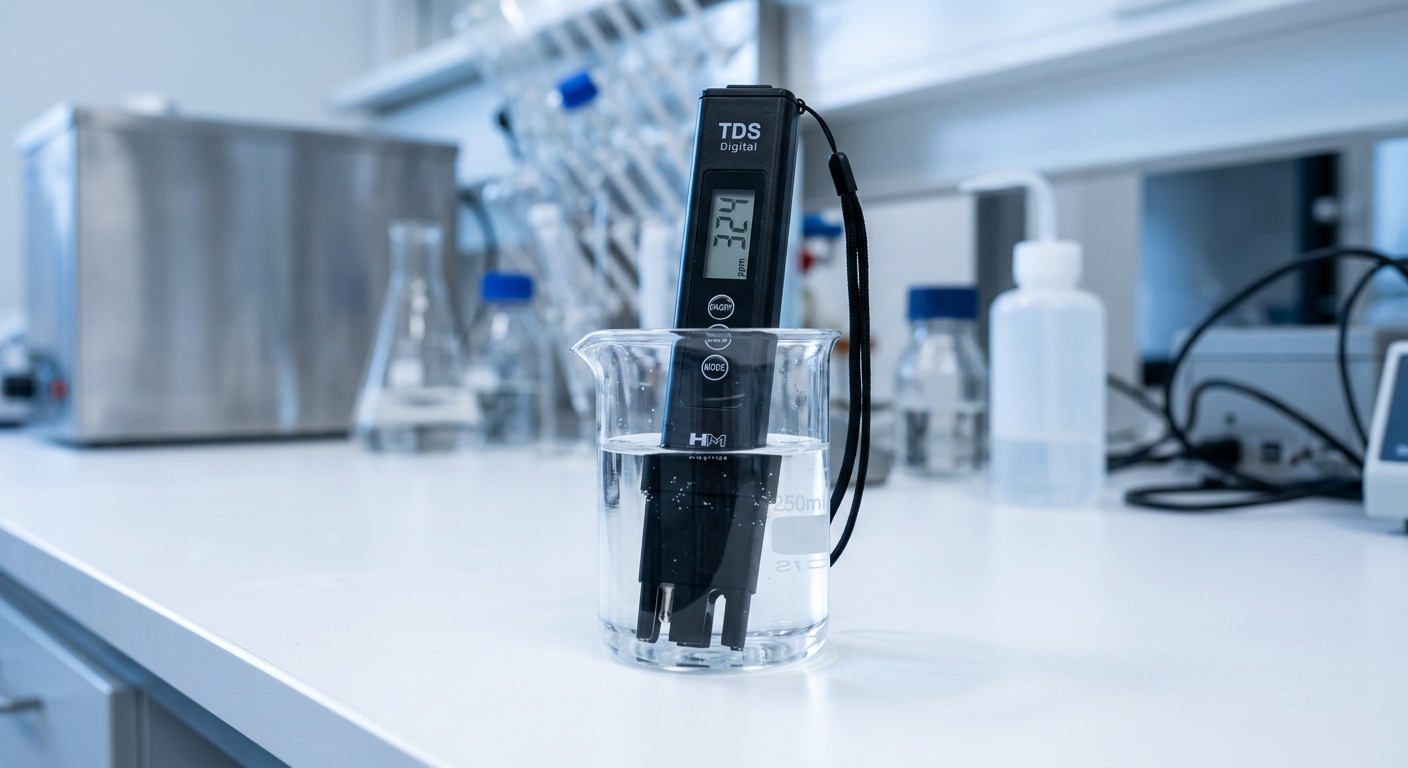

Your tap water tastes a little off. You buy a $15 TDS meter, dip the probe in a glass, and the screen reads 410. Is that dangerous? Acceptable? Time to panic? Sound familiar?
Here’s the thing: that single number tells you something real, but on its own it tells you almost nothing about whether your water is safe. TDS in water — total dissolved solids — is one of the most misunderstood numbers in residential and commercial water quality. This guide walks through what TDS actually measures, what the safe levels are in 2026, where the EPA and WHO numbers come from, and when reverse osmosis is the right answer (and when it isn’t).
Quick Answer: What Is TDS and What Level Is Safe?
TDS = total dissolved solids, measured in milligrams per liter (mg/L) or parts per million (ppm). It is the combined weight of every dissolved mineral, salt, and metal in your water — calcium, sodium, magnesium, chloride, sulfate, plus trace contaminants.
EPA secondary standard: 500 mg/L. Above that, taste and appearance suffer and scale builds up on plumbing. WHO acceptable taste range: 300 mg/L or lower. For most homes a reading of 50–300 mg/L is normal and healthy; above 500 mg/L a reverse osmosis system makes sense; above 1,000 mg/L the water is officially classified as brackish.
What TDS in Water Actually Measures
Total dissolved solids is the sum of every inorganic salt and small amount of organic matter dissolved in a water sample. The lab method is straightforward: filter a known volume of water through a 2.0-micron filter, evaporate the filtrate, and weigh the residue. The result is reported as mg/L. The Standard Methods reference is APHA 2540 C, and the EPA-approved test is Method 160.1.
Most home meters skip the evaporation. Instead they measure electrical conductivity (EC) in microsiemens and multiply by a conversion factor (0.5 for NaCl-dominated water, 0.7 for sulfate-rich water). The reading is fast and useful, but it is an estimate — not a true gravimetric TDS value. Two waters can have the same conductivity but very different mineral compositions, and a cheap meter cannot tell you which minerals are present.
That distinction matters. A 300 ppm reading dominated by calcium and magnesium (hardness) is harmless and slightly beneficial. A 300 ppm reading dominated by sodium and chloride from road-salt runoff or a softener malfunction is a different conversation entirely.
TDS Levels Chart: What Each Range Means
| TDS (mg/L) | Classification | What It Usually Means | Action |
|---|---|---|---|
| 0–50 | Very low / demineralized | RO permeate, distilled, ultrapure | Add minerals for taste if used as drinking water |
| 50–150 | Low | Soft mountain or melt-water sources | Excellent drinking water |
| 150–300 | Ideal | WHO "excellent" range, balanced municipal supply | No treatment required for taste |
| 300–500 | Acceptable | Average U.S. municipal water | Optional softener if hardness drives the number |
| 500–900 | Poor taste | EPA secondary MCL exceeded | Reverse osmosis recommended |
| 900–1,200 | Marginal | Hard well water or coastal influence | RO with pretreatment |
| 1,200–3,000 | Brackish | Inland brackish aquifers, agricultural runoff | Commercial brackish-water RO |
| 3,000–10,000 | Highly brackish | Coastal saline intrusion | High-rejection commercial RO |
| 10,000–35,000 | Saline / seawater | Ocean and bay water | Seawater desalination (SWRO) |
One important caveat: TDS is a secondary EPA standard, not a primary health-based one. That means a high reading is not, by itself, a health emergency. It is a flag that something is dissolved in your water in unusual quantity, and a complete water analysis is the next step.
Why TDS Goes Up: The Five Common Causes
Before assuming the worst, identify which group of dissolved solids is driving your reading. The cause changes the right treatment.
- Natural hardness (calcium and magnesium): Limestone aquifers across the Midwest and Texas routinely produce 300–500 mg/L of mostly hardness. Harmless to drink. Treat with a softener if scale is a problem.
- Sodium and chloride: Coastal saline intrusion, road-salt runoff in winter, or a malfunctioning softener bypass. Health-relevant for low-sodium diets.
- Sulfates and bicarbonates: Common in well water with shale or gypsum exposure. Affects taste before health.
- Nitrate, nitrite, and phosphate: Agricultural runoff. Nitrate is a primary EPA standard with a 10 mg/L MCL — a high TDS reading near a farm is a reason to test specifically for it.
- Metals (iron, manganese, copper, lead): Old plumbing or aging mains. Lead, copper, and arsenic are primary regulated contaminants and should be tested independently.
(This is where most people skip a step.) Spending $300 on a softener to fix a sodium problem makes the sodium worse — softeners exchange calcium for sodium. Always run the test before buying the treatment.
Is High TDS Bad for You?
The honest answer: usually no, sometimes yes. The EPA classifies TDS as a secondary contaminant — regulated for taste, color, and odor rather than direct health risk. The WHO 4th edition Drinking-water Guidelines state plainly that no health-based guideline value is proposed for TDS, because the health effects depend entirely on which solids are dissolved.
That said, four scenarios deserve attention. (Most people skip these.)
- High sodium in water (above 20 mg/L sodium) matters for anyone on a low-sodium prescription diet.
- High nitrate (above 10 mg/L) is a hard limit for infants under six months — methemoglobinemia is a documented risk.
- Elevated lead, even at trace levels well below 15 µg/L, is unsafe for children and pregnant women.
- Industrial settings — pharmaceutical compounding, USP-grade applications, food and beverage, semiconductor fabrication, medical equipment — have process-driven TDS limits that are far stricter than residential ones. A boiler feedwater spec might call for under 10 mg/L. A USP Purified Water spec calls for under 0.5 mg/L equivalent.
How to Measure TDS Correctly
For a quick at-home check, an electrical conductivity (EC) meter is fine. Buy one with automatic temperature compensation (ATC) — temperature changes the ionic conductivity of water and an uncompensated reading can swing by 20% between summer and winter. Calibrate the meter monthly with a 342 ppm NaCl standard solution.
For a definitive number, send a sample to a certified laboratory. The Water Quality Association maintains a public directory of WQA-Gold-Seal-certified labs; NSF International maintains a similar list of NSF/ANSI 53 and 58 testing facilities. A complete drinking-water analysis runs $150–$350 and covers TDS, hardness, the regulated metals, nitrate, sulfate, chloride, and bacteria. It is the only honest starting point for a treatment decision above $1,000.
When Reverse Osmosis Is the Right Answer
Reverse osmosis is the most reliable household and commercial technology for reducing TDS across the widest range of feed waters. A modern thin-film composite (TFC) RO membrane rejects 95–99% of dissolved salts in a single pass. The EPA, NSF International, and the American Water Works Association consistently identify RO as a Best Available Technology for removing dissolved metals, nitrate, fluoride, PFAS, and arsenic.
So when should you actually buy one?
| Scenario | Recommended Step |
|---|---|
| TDS 50–300 mg/L, no taste or contaminant issues | No treatment needed |
| TDS 300–500, hardness-driven | Water softener first; add point-of-use RO only if taste is unacceptable |
| TDS 500–900, taste or scale problems | Point-of-use RO under the kitchen sink (50–100 GPD) |
| TDS 500–900 with PFAS, nitrate, or arsenic concerns | Whole-house RO with pretreatment |
| TDS 1,200–10,000 (brackish well, coastal intrusion) | Commercial brackish-water RO with concentrate recycle |
| TDS above 10,000 (seawater feed) | Seawater desalination (SWRO) with energy recovery |
For commercial and industrial sites where feed-water TDS exceeds 500 mg/L year-round, AMPAC USA’s commercial reverse osmosis systems are engineered with concentrate recirculation and stainless-steel high-pressure pumps to push recovery rates from a residential 25–35% up to 50–75%. For coastal sites, the seawater desalination (SWRO) line handles feed TDS up to 35,000 mg/L with energy-recovery devices that cut operating cost roughly in half.
What About Mineral Loss? The Re-Mineralization Question
A common pushback: “RO strips healthy minerals from water.” Technically true. RO permeate typically reads 5–25 mg/L TDS, well below the 150–300 mg/L sweet spot for taste.
The practical answer is calibrated. The WHO has explicitly studied long-term consumption of low-mineral water and concluded that, for the general adult population on a normal diet, drinking RO water is safe. Calcium and magnesium intake from food vastly exceeds what tap water contributes. That said, two simple options handle the taste objection: a post-RO remineralization cartridge (calcite-magnesium media) brings permeate back to 60–120 mg/L, and a household alkaline pitcher does the same job for a fraction of the price.
RO Operating Cost vs. TDS Reduction Value
Sticker price is only part of the picture. The two ongoing costs are membrane replacement and wastewater. A residential 50 GPD under-sink RO system runs roughly $30–$80/year all-in for cartridges and metered water. A 1,000 GPD whole-house unit runs $150–$400/year. A commercial 25,000 GPD industrial system with proper pretreatment runs in the low-thousands annually — small money against the $50,000–$200,000 capital cost it represents.
The single biggest cost lever is pretreatment. Hardness, iron, and chlorine that reach the membrane shorten its life from a 3–5 year normal lifespan to under 12 months. A $400 softener upstream of a $1,500 commercial RO is the most cost-effective decision in residential water treatment.
Frequently Asked Questions
What is a good TDS level for drinking water?
The WHO considers 150–300 mg/L the "excellent" range for taste and balanced mineral content. The EPA secondary standard caps acceptable taste and appearance at 500 mg/L. Most U.S. municipal water falls between 150 and 400 mg/L.
Is 0 TDS water safe to drink?
Yes for general adults on a normal diet, per WHO long-term consumption reviews. Very low TDS water tastes flat and can leach trace minerals from copper plumbing, so a post-RO remineralization cartridge or a pinch of mineral salt is recommended for daily drinking water from a home RO system.
Does boiling water reduce TDS?
No — boiling concentrates dissolved solids by removing water as steam. A pot of boiled tap water has a higher TDS reading at the end than at the start. Boiling is excellent for biological pathogens, not for dissolved minerals. To reduce TDS you need distillation, deionization, or reverse osmosis.
Why is my TDS reading different from the city water report?
Three reasons. First, your meter is conductivity-based and the city report is gravimetric — they will not match exactly. Second, water sits in your plumbing and picks up dissolved metals between the meter and your tap. Third, the city report is annual; readings vary by season as source water shifts (snowmelt, drought, road salt). A 10–25% gap between meter and report is normal.
Will an RO system remove PFAS along with TDS?
Yes. NSF/ANSI 58-certified RO systems demonstrate greater than 90% reduction of PFOA and PFOS, the two PFAS chemicals the EPA confirmed under a 4 ppt MCL. Microplastics, lead, arsenic, chromium-6, and nitrate are all reduced by 90–99% by a properly maintained RO membrane.
What about ultra-low-TDS specs for pharma, food, or boilers?
Industrial specs are far stricter than EPA drinking-water standards. USP Purified Water requires below 1 mg/L. High-pressure boiler feedwater requires below 10 mg/L. Semiconductor ultrapure water targets near-zero TDS via RO followed by mixed-bed deionization and UV polishing. AMPAC engineers these systems specifically — a sizing review starts with the process spec, not the feed water.
How often should I test my TDS at home?
For municipal supply, a quick meter check every three months catches seasonal shifts. For private wells, an annual certified lab analysis is the baseline — and any time you notice a change in taste, color, or pressure, retest immediately.
Get a Custom TDS and Treatment Assessment
TDS is a useful number — but a single reading should never drive a thousand-dollar purchase. The right answer combines your TDS reading, a full water analysis, and a clear view of what the dissolved solids actually are. AMPAC USA — manufactured in North America at our Woods Cross, Utah assembly facility — has been engineering commercial and industrial reverse osmosis systems for more than 35 years, from 200 GPD point-of-use units to 600,000 GPD seawater desalination plants.
Send a water analysis and your application notes to our engineering team, or call (909) 762-8020. We will return a TDS-driven sizing recommendation, a pretreatment specification, and an installed-cost estimate. No pressure to buy.
Sources: U.S. Environmental Protection Agency (Secondary Drinking Water Standards, Method 160.1), World Health Organization (Guidelines for Drinking-water Quality, 4th edition), NSF/ANSI Standard 58 (Reverse Osmosis Drinking Water Treatment Systems), Water Quality Association (Technical Fact Sheets on TDS), American Water Works Association (Manual M46 — Reverse Osmosis and Nanofiltration), United States Pharmacopeia (USP <1231> Water for Pharmaceutical Purposes).


![Reverse Osmosis Membrane Lifespan: How Long Do RO Membranes Last? [Maintenance Guide]](https://www.ampac1.com/blog/wp-content/uploads/2026/03/membrane-lifespan-150x150.png)