
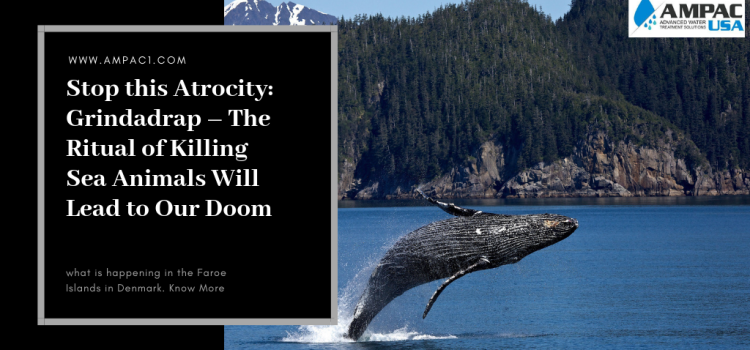

Humans have a bad habit of driving animals and plants extinct, just for our own benefit. But we think things have gone too far when killing sea animals happens for a ritual, with hundreds captured and mercilessly slaughtered by men with weapons.
That’s exactly what’s happening in the Faroe Islands, Denmark. An old ritual called Grindadrap takes place there. As part of it, whales and dolphins are killed so locals can eat their meat and prepare for harsh winters. For these folks, eating whale meat and blubber (that thick fat layer protecting dolphins and whales from cold) is their way of life, and they don’t see anything wrong with it. City officials even say it’s a necessary, sustainable action. We think the bloody ocean and 800 dead bodies, looking so sad, tell a different story.
Humans chase whales and dolphins close to shore, then drag them to the beach using a hook that pierces their blowholes. On the beach, more people use ropes to tie up the sea animals and sharp weapons to hack their arteries until they die, turning the water red with blood. It’s not just adults taking part; locals even train their kids to do it.
The Stand
Faroese authorities reacted to the outrage and worldwide protests by saying their whale catchers follow global principles of sustainable development and international law. Catchers must follow national laws and rules, have a license, own required equipment, and use specific methods. The hunt, they claim, causes little suffering. Each whale dies in just seconds, and a spinal lance ensures they lose consciousness before dying, avoiding pain.
The Reactions
Thankfully, most of the world doesn’t think killing hundreds of sea animals, no matter what the rules say, is a good idea. People from all over shared their thoughts on Twitter. Here are some tweets we noticed.
One user called the ritual a genocide. Another user worried these sea animals might disappear if this horror doesn’t stop.
One user urged PETA to act and stop the ritual, while another suggested boycotting the Faroe Islands until Grindadrap is gone for good!
An Old Ritual
This isn’t the first time this ritual has faced heavy criticism. Last year, people were also against it. On July 30, 2018, a hunt happened at the bay of Sandavágur on the western island of Vágar, which is also under the Faroe Islands government.
A UK-based group, the Blue Planet Society, criticized the ritual and condemned the killings. The group added that the people of the Faroe Islands need to learn to live in the 21st century, saying they lack empathy, respect, and that killing sea animals is just entertainment for them.
Even then, the Faroese government defended the ritual, calling it a natural part of Faroese life.
Can Laws Stop Grindadrap?
A global ban on commercial whaling has been in place since the 1980s, but it doesn’t apply here. Why? Because the meat from these killed sea animals isn’t sold; it’s only shared within the community. The EU ban on whaling also seems useless since the Faroe Islands aren’t part of the EU.
AMPAC USA criticizes what’s happening in the Faroe Islands. We hope someone finds a way to end this horror soon. We want a safer planet for everyone, for humans and for sea animals!
Sources
- https://edition.cnn.com/2018/08/17/europe/faroe-islands-whale-hunt-intl/index.html
- https://twitter.com/search?q=%20Grindadrap&src=typd&lang=en
- https://curlytales.com/denmarks-gruesome-mass-whale-slaughter-ritual-grindadrap-enrages-the-world/
Related reading: Avoid That Lead – Lead Free Water Strategies, Reverse Osmosis, Be Aware Corals are Dying: Stop Water Pollution Now, Lead in Drinking Water: Scope, Risks, and Reverse Osmosis Solutions.
Frequently Asked Questions
What is the Grindadrap ritual?
Grindadrap is an age-old whaling tradition practiced in the Faroe Islands, Denmark, where hundreds of whales and dolphins are driven ashore and slaughtered. Locals consume the meat and blubber to prepare for harsh winters, viewing it as a vital part of their way of life.
Where does the Grindadrap whale hunt occur?
The Grindadrap whale and dolphin hunt is exclusively performed in the Faroe Islands, an autonomous territory within the Kingdom of Denmark. This ritual takes place in coastal waters and on beaches across the islands, where sea animals are driven ashore for slaughter.
How do Faroese authorities justify the Grindadrap hunt?
Faroese authorities assert that the Grindadrap is a sustainable practice, conducted in line with international law and national regulations. They claim licensed catchers use mandatory equipment and methods, including a spinal lance, to ensure a quick death within seconds, minimizing animal suffering.
What are the primary threats to ocean health beyond rituals like Grindadrap?
Beyond specific hunting rituals, ocean health is severely degraded by industrial discharge, agricultural runoff, and pervasive plastic pollution. Additionally, ocean warming from climate change cumulatively threatens marine ecosystems, impacting global food security and water cycle stability.
How does ocean health impact global water security?
Ocean health is intrinsically linked to global water security, as oceans regulate climate, generate vital oxygen, and serve as a primary food source for billions. Degradation from pollution and climate change destabilizes the water cycle, directly threatening the availability and quality of fresh water resources worldwide. AMPAC USA’s 30+ years in water purification highlights the critical need for robust water management solutions in the face of such environmental challenges.
Which species are affected by the Grindadrap hunt?
The Grindadrap primarily targets long-finned pilot whales, along with Atlantic white-sided dolphins and other small cetaceans that migrate through the North Atlantic near the Faroe Islands. Conservation groups like Sea Shepherd have documented the hunts and argue that pilot whale meat is no longer a necessity within modern Faroese culture, given the availability of imported food and known mercury contamination in whale meat — framing the practice as a form of whale killing the islands could end.
AMPAC USA engineers custom water purification systems for commercial, industrial, and emergency applications — from 500 GPD to multi-million GPD. Trusted by municipalities, military, and industry worldwide.