Home Products Industries Applications Solutions Support Insights Contact Us
Back to Blog
May 27, 2019·6 min read
Review of perchlorate occurrence in large public drinking water systems in the United States of America

Review of perchlorate occurrence in large public drinking water systems in the United States of America

Review of perchlorate occurrence in large public drinking water systems in the United States of America

Quick Answer: Perchlorate is a chemical contaminant found in drinking water from military sites, rocket fuel manufacturing, and naturally from soil in arid regions. It interferes with thyroid hormone production. EPA set a maximum contaminant level of 0.056 mg/L (56 ppb) for perchlorate in 2024. Reverse osmosis and ion exchange are proven treatment technologies for perchlorate removal.

By:Luis, SJ (Luis, Steven J.)1 ] ; Miesner, EA (Miesner, Elizabeth A.)2 ] ; Enslin, CL (Enslin, Clarissa L.)1 ] ; Heidecorn, K (Heidecorn, Keith)3 ]

WATER SCIENCE AND TECHNOLOGY-WATER SUPPLY

Volume: 19

Issue: 3

Pages: 681-694

DOI: 10.2166/ws.2018.135

Published: MAY 2019

Document Type:Review

Abstract

When deciding whether or not to regulate a chemical, regulatory bodies often evaluate the degree to which the public may be exposed by evaluating the chemical’s occurrence in food and drinking water. As part of its decision-making process, the United States Environmental Protection Agency (USEPA) evaluated the occurrence of perchlorate in public drinking water by sampling public water systems (PWSs) as part of the first implementation of the Unregulated Contaminant Monitoring Rule (UCMR 1) between 2001 and 2005. The objective of this paper is to evaluate the current representativeness of the UCMR 1 dataset. To achieve this objective, publicly available sources were searched to obtain updated perchlorate data for the majority of large PWSs with perchlorate detections under UCMR 1. Comparison of the updated and UCMR 1 perchlorate datasets shows that the UCMR 1 dataset is no longer representative because the extent and degree of occurrence has decreased since implementation of UCMR 1. Given this finding, it seems appropriate for regulatory bodies engaged in decision-making processes over several years to periodically re-evaluate the conditions that prompted the regulatory effort, thereby ensuring that rules and regulations address actual conditions of concern.

http://cel.webofknowledge.com/InboundService.do?customersID=Alerting&smartRedirect=yes&mode=FullRecord&IsProductCode=Yes&product=CEL&Init=Yes&Func=Frame&action=retrieve&SrcApp=Alerting&SrcAuth=Alerting&SID=5DL5AZpsa38YxSkVeyc&UT=WOS%3A000462923600002

The post Review of perchlorate occurrence in large public drinking water systems in the United States of America appeared first on Facts About Water.

Source: Water Feed

What flow rates are available for emergency water treatment?

AMPAC USA's emergency systems range from 1,500 GPD portable units to 50,000+ GPD trailer-mounted systems. Military-specification units are available for forward operating base deployment, producing potable water meeting EPA and WHO drinking water standards from virtually any source.

Are emergency RO systems suitable for disaster relief operations?

Yes. AMPAC USA's emergency systems are used by FEMA, the U.S. military, and international NGOs for disaster relief. They treat flood water, contaminated groundwater, and brackish sources, removing bacteria, viruses, and chemical contaminants to produce safe drinking water on-site.

What power sources can emergency water purification systems use?

AMPAC USA's emergency systems can run on generator power (120/240V or 480V 3-phase), solar panels with battery backup, or vehicle power take-off (PTO). Low-power models consume as little as 0.5 kW, making them viable for off-grid deployment.

How durable are military-grade water purification systems?

AMPAC USA's military systems are built to MIL-SPEC standards with stainless steel frames, powder-coated components, and UV-resistant materials. They are designed to operate in temperatures from -20°F to 120°F and are vibration-tested for transport in military vehicles.

Conclusion

This post highlighted how emergency and military-grade water purification systems provide safe drinking water rapidly in the most challenging field conditions. For organizations requiring deployable water treatment capability, AMPAC USA engineers portable and trailer-mounted systems built to perform wherever they are needed. Contact our team at info@ampac1.com or (909) 548-4900 to discuss your emergency water treatment requirements.

Perchlorate in Drinking Water: Occurrence, Health Effects, and Treatment

Perchlorate (ClO4-) is an inorganic anion that occurs in drinking water from both anthropogenic and natural sources. The primary anthropogenic sources are aerospace and defense industries using ammonium perchlorate as a solid rocket propellant, explosives manufacturing, and historical use as a component in highway safety flares. Natural perchlorate forms in arid environments through photochemical reactions in the atmosphere and is found naturally in Chilean nitrate deposits used historically as fertilizer. Studies by the USGS and EPA have documented perchlorate in water supplies serving large portions of the US population, with the highest concentrations in areas near Defense Department installations in the Southwestern United States.

The primary health concern with perchlorate is competitive inhibition of iodide uptake in the thyroid gland. The thyroid needs iodide to produce thyroid hormones (T3 and T4), which regulate metabolism, growth, and development. At sufficient doses, perchlorate disrupts this uptake, potentially reducing thyroid hormone synthesis. Fetuses, infants, and individuals with iodine deficiency or hypothyroidism are considered most sensitive. After two decades of scientific debate and regulatory consideration, EPA finalized a Maximum Contaminant Level (MCL) of 0.056 mg/L (56 micrograms per liter) for perchlorate in April 2024 under the Safe Drinking Water Act.

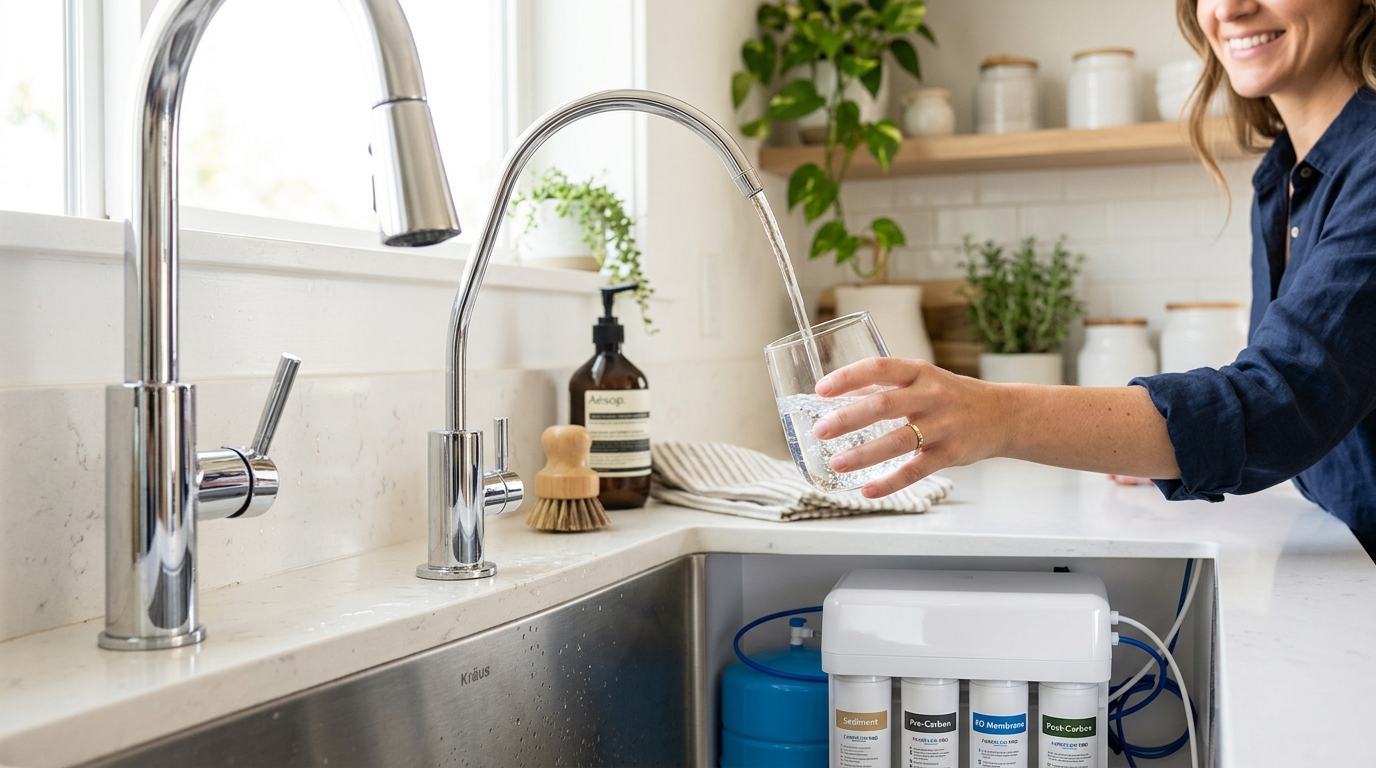
Treatment technologies for perchlorate removal from drinking water include ion exchange (highly effective, using selective resins), reverse osmosis (90%+ rejection), and biological treatment (bioreactors using perchlorate-reducing bacteria for large-scale applications). Point-of-use RO systems at the tap provide reliable individual protection independent of utility treatment investment timelines. AMPAC USA NSF-certified RO systems effectively reduce perchlorate to below the EPA MCL.

Frequently Asked Questions

Q: What is perchlorate and where does it come from?

A: Perchlorate is an inorganic anion (ClO4-) found in drinking water from rocket fuel and explosives manufacturing near defense facilities, historical flare use, naturally in arid soils, and Chilean nitrate fertilizers. It is also used medically to treat certain thyroid conditions.

Q: What health effects does perchlorate in water cause?

A: Perchlorate competitively inhibits iodide uptake in the thyroid gland, potentially reducing thyroid hormone production. Sensitive populations including pregnant women, infants, and those with low iodine intake or thyroid conditions are most vulnerable.

Q: What is the EPA drinking water standard for perchlorate?

A: In April 2024, EPA finalized a Maximum Contaminant Level (MCL) of 0.056 mg/L (56 micrograms per liter) for perchlorate in public water systems, completing a regulatory process that began in 1998.

Q: Does reverse osmosis remove perchlorate?

A: Yes. RO membranes reject perchlorate at 90%+ efficiency due to its ionic charge and size. For perchlorate-affected water, RO is one of the most reliable point-of-use treatment options. Specialized ion exchange resins with selective affinity for perchlorate achieve 99%+ removal for larger-scale applications.

Q: Which US states have the highest perchlorate contamination in water?

A: California, Nevada, and other Southwestern states with significant aerospace and defense manufacturing have the highest documented perchlorate contamination. The Massachusetts Military Reservation and other Northeast defense sites have also contributed to local groundwater contamination.

Q: Is perchlorate contamination regulated in bottled water?

A: FDA has not established a specific MCL for perchlorate in bottled water, though bottled water must meet EPA drinking water standards where applicable. With the 2024 EPA MCL for public water, FDA will likely establish equivalent standards for bottled water.

Scroll to Top