


Picking the right whole house reverse osmosis system in 2026 isn’t just about good taste anymore. The EPA now says PFOA and PFOS can’t be more than 4 ppt, they’re watching microplastics more closely, and we’re seeing more nitrate, arsenic, and chromium-6 in city water. Because of all this, a point-of-entry (POE) reverse osmosis system isn’t a fancy extra, it’s a smart buy for your home’s safety.
This guide shows you how to figure out what size whole house RO system you need in 2026, how to pick the right parts, and how to budget for it. We’ll cover everything from how many gallons per day (GPD) you need, to what pretreatment costs, membrane types, storage tanks, and the full cost of owning one. This is for homeowners and small-property managers in the U.S. who want clear, unbiased info before they talk to a seller.
Step 1 – Figure out your busiest times. The average U.S. home uses 70-100 gallons per person each day (EPA WaterSense). So, for a family of 4, that’s 280-400 GPD normally.
Step 2 – Add a buffer for busy times. Multiply your daily demand by 1.5-2.0 to handle those morning and evening water rushes. A 4-person home should aim for a 700-800 GPD whole house RO system with a 220-550 gallon storage tank.
Step 3 – Always test your water first. A full water analysis (for hardness, iron, manganese, chlorine, TDS, bacteria) tells you what pretreatment you’ll need. This often doubles the installed cost. Pretreatment is the biggest factor in your final price, plain and simple.
What a Whole House Reverse Osmosis System Actually Does
A whole house reverse osmosis (RO) system is a water treatment system that sits right where your city or well water comes into your home. You’ll usually find it near the water heater or pressure tank. This means every drop of water that goes to your kitchen tap, shower, washing machine, ice maker, or even your garden hose, first passes through this system. It’s totally different from an under-sink RO unit, which only treats one cold-water faucet.
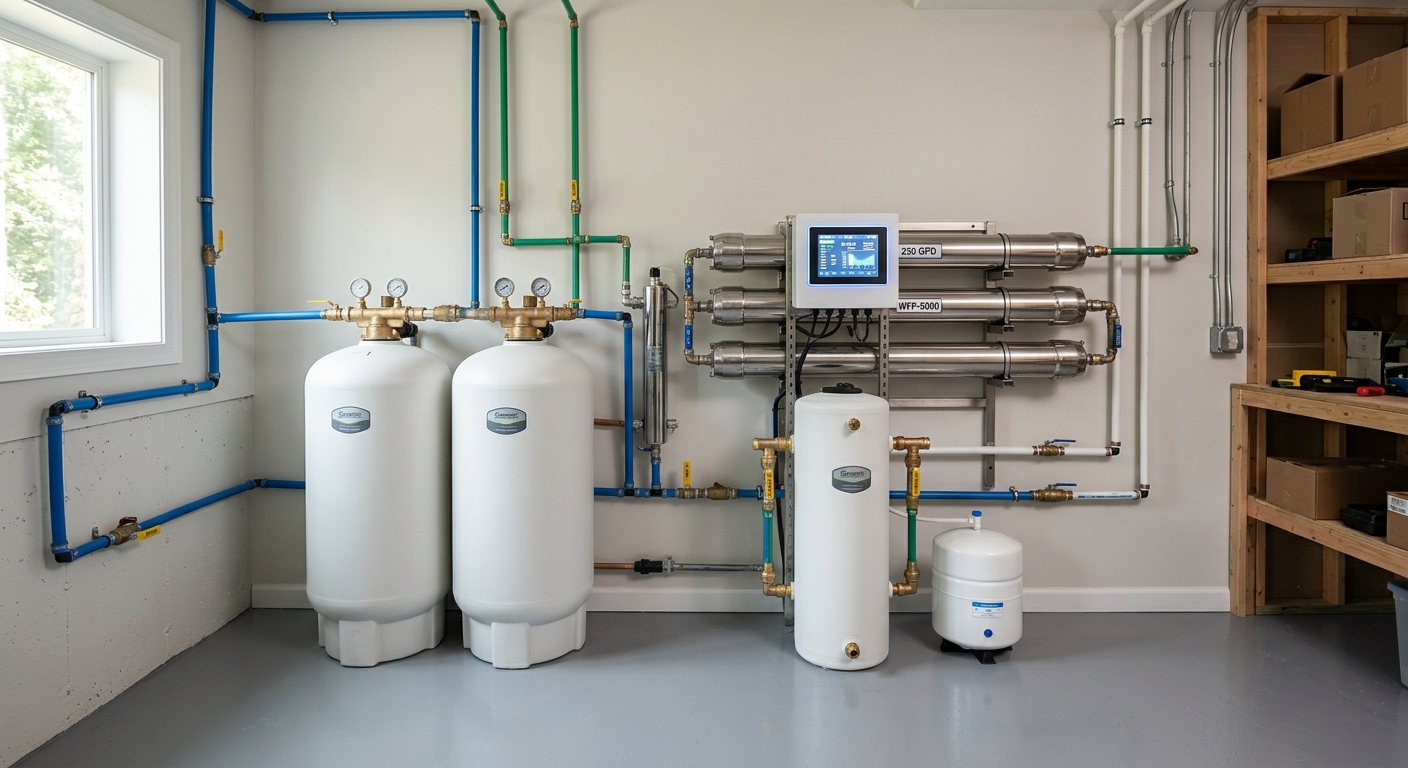
A complete POE RO setup has five main parts: sediment and carbon pre-filters, the RO membrane bank itself, a vented storage tank, a repressurization pump that sends treated water back to your home’s usual water pressure, and post-filtration (often UV disinfection or carbon polishing). Skip any of these, and you’ll either have low water pressure or poor water quality at your tap.
Step 1: Figure Out How Much Water You Really Use Every Day
The biggest mistake people make when sizing an RO system is using their yearly average instead of planning for peak hours. Whole house RO systems don’t make water on demand at full pressure. They make it slowly, filling up a buffer tank. Your system needs to be big enough to refill that tank between your busiest water uses.
| Household Size | Average Daily Demand | Recommended GPD Rating | Storage Tank |
|---|---|---|---|
| 1-2 people | 140-200 GPD | 500 GPD | 165 gallons |
| 3-4 people | 280-400 GPD | 700-800 GPD | 220 gallons |
| 5-6 people | 420-600 GPD | 1,000-1,500 GPD | 330 gallons |
| Large estate / multi-family | 800-1,500 GPD | 2,500-4,000 GPD | 550+ gallons |
Step 2: Test Your Water – Pretreatment Really Drives the Cost
RO membranes are built to remove dissolved salts and organic stuff. They aren’t meant to remove particles, hard water minerals that cause scale, or oxidized iron. Sending untreated well water or hard city water into an RO membrane is the quickest way to ruin a $400-$1,200 part in months, not years.
Before you even think about buying a whole house RO system, get a certified water analysis. Both the Water Quality Association (WQA) and NSF International have lists of labs. These test results tell you exactly what pretreatment you’ll need:
| Test Parameter | Threshold That Requires Pretreatment | Typical Pretreatment Step |
|---|---|---|
| Total hardness | Above 7 grains per gallon (120 mg/L) | Ion-exchange water softener upstream |
| Iron (dissolved) | Above 0.3 mg/L | Oxidation + filtration (Birm, manganese greensand) |
| Manganese | Above 0.05 mg/L | Greensand or catalytic carbon |
| Free chlorine | Above 0.1 mg/L | Activated carbon block prefilter |
| Chloramines | Any detectable amount | Catalytic carbon (longer contact time) |
| Sediment / turbidity | Above 1 NTU | 5-micron then 1-micron sediment filters |
| Hydrogen sulfide | Any detectable amount | Aeration or oxidation + carbon |
Pretreatment often adds $1,000-$3,500 to the total installed cost. Don’t think skipping it saves you money- it just means you’ll be replacing membranes every six to twelve months instead of every two to five years. Is that really saving money?
Step 3: Membrane Technology and Recovery Rate
Today’s thin-film composite (TFC) polyamide RO membranes get rid of 95-99% of total dissolved solids (TDS). For making drinking water clean enough to remove most regulated contaminants, the EPA, NSF International, and Water Quality Association all agree that reverse osmosis is the best available technology. Independent NSF/ANSI 58 tests confirm RO can reduce:
- Lead and arsenic – 95-99%
- Fluoride – 85-95%
- Nitrate and nitrite – 85-95%
- Chromium-6 – 95-99%
- PFAS (PFOA, PFOS, GenX) – usually over 90% in EPA Method 533/537.1 lab tests
- Microplastics – over 99%
Recovery rate – how much clean water you get from the raw water – is the second important membrane spec. Home systems that use one pass usually get 25-35% recovery. Commercial and industrial systems with concentrate recirculation can hit 50-75%, which drastically cuts down on wastewater. If your water company charges you by how much water you use and for sewer, the recovery rate directly affects your monthly bill. AMPAC USA’s commercial reverse osmosis systems are built with concentrate recycle valves specifically for this efficiency.
Step 4: Storage Tank and Repressurization
Reverse osmosis takes its time. A 1,000 GPD membrane makes about 0.7 gallons per minute. That’s way less than the 5-8 GPM you expect from a home tap. The vented storage tank holds the treated water at zero pressure, and a separate pump then builds up the water pressure for your home when you need it.
Sizing the tank is simple: it should hold roughly a full day’s worth of water for your household. So, a 4-person home needs 220-330 gallons of usable storage. Tanks that are too small make the RO system run constantly. Tanks that are too big just take up floor space and can lead to water sitting too long, which might encourage germ growth. That’s why a post-UV disinfection unit is a common safety step.
Step 5: Total Cost of Ownership
The price tag is just one part of the story. To get a realistic 10-year ownership cost, you need to add up the equipment, installation, pretreatment, membrane replacements, prefilter cartridges, electricity for the booster pump, and the wastewater portion of your utility bill.
| Cost Category | Typical Range | Frequency |
|---|---|---|
| Whole house RO system (700-1,500 GPD) | $3,500-$8,500 | One-time |
| Pretreatment package (softener, iron filter, sediment) | $1,000-$3,500 | One-time |
| Atmospheric storage tank + repressurization pump | $700-$2,200 | One-time |
| Professional installation | $800-$2,500 | One-time |
| Sediment and carbon prefilters | $80-$200 | Every 6-12 months |
| RO membrane replacement | $300-$1,200 | Every 2-5 years |
| UV lamp (if equipped) | $60-$120 | Annually |
| Electricity (booster + repressurization) | $60-$180 | Annually |
| Wastewater (extra utility cost) | $120-$360 | Annually |
Installation Considerations
Space
A complete whole house RO system with pretreatment and storage typically needs a 4 ft x 8 ft footprint with 7 ft ceiling clearance. Most installations live in the basement, garage, or a dedicated utility room near the main water inlet.
Drain
The system needs a drain connection for the concentrate stream. Most local plumbing codes require an air gap at the drain to prevent backflow contamination. Plan for a floor drain or a properly trapped washing-machine box within ten feet of the unit.
Permits and Plumbing
Whole house water treatment installations are regulated by local plumbing codes, and many jurisdictions require a permit and inspection. Some require backflow prevention testing. Verify your local code before purchasing – your supplier should be able to provide installation drawings that meet IAPMO and IPC standards.
Frequently Asked Questions
Why does whole house RO sizing matter more in 2026?
The EPA’s PFOA and PFOS limits are now capped at 4 ppt, microplastics are under closer scrutiny, and more nitrate, arsenic, and chromium-6 are showing up in city water, making a properly sized point-of-entry RO system a meaningful safety investment rather than a luxury upgrade.
What factors go into sizing a whole house RO system?
Daily gallons-per-day (GPD) demand, pre-treatment requirements, membrane type, and storage tank sizing, all balanced against total cost of ownership rather than just the upfront purchase price.
Get a Custom Sizing Recommendation
Whole house RO is one of the highest-impact water-quality investments a household can make in 2026, but the right answer depends entirely on your feed water, household demand, and existing plumbing. AMPAC USA – engineered and assembled in the United States, with manufacturing in North America – has been building commercial and industrial RO systems for over 35 years and supports residential whole-house projects with the same engineering rigor.
Send your latest water analysis and household details to our engineering team, or call (909) 762-8020. We will return a sizing recommendation, pretreatment specification, and installed-cost estimate – without any pressure to buy.
Sources: U.S. Environmental Protection Agency (EPA Drinking Water Treatment Technologies, EPA WaterSense), NSF/ANSI Standard 58 (Reverse Osmosis Drinking Water Treatment Systems), Water Quality Association (Technical Fact Sheets), American Water Works Association (AWWA Manuals of Practice).