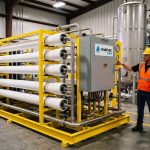

Quick Answer: Kids get lead exposure from a few places: their drinking water (10-30% in homes with lead pipes), dust in the house (from old lead paint breaking down), soil (especially in city areas near old factories), and even food (grown in bad soil or processed with lead). Advanced water treatment, like reverse osmosis, really helps with water quality here. AMPAC USA’s commercial and industrial systems are built to tackle these exact water treatment problems, and we have the certified, documented performance to prove it.
Author Full Names: Zartarian, Valerie; Xue, Jianping; Tornero-Velez, Rogelio; Brown, James
Source:ENVIRONMENTAL HEALTH PERSPECTIVES, 125 (9):10.1289/EHP1605SEP 2017
Language:English
Abstract: BACKGROUND: People are worried about lead in drinking water and other sources. Think about the Flint, Michigan, water crisis or the lead in soil problems in East Chicago, Indiana. In 2015, the U.S. Environmental Protection Agency (EPA)’s National Drinking Water Advisory Council (NDWAC) suggested setting a “health-based, household action level” for lead in drinking water, focusing on how it affects children.
OBJECTIVES: Our main goal was to create a modeling method that links exposure and dose. We wanted to figure out what lead levels in drinking water keep kids’ blood lead levels (BLLs) low, considering lead from water, soil, dust, food, and air. We also wanted to check our model’s estimates against real blood lead data, see how much each source contributed, and pinpoint the most important things that go into the model.
METHODS: We developed a modeling approach using the EPA’s Stochastic Human Exposure and Dose Simulation (SHEDS)-Multimedia and Integrated Exposure Uptake and Biokinetic (IEUBK) models. We used all the available data. For young children across the U.S., this analysis simulated exposures from many sources and estimated how much each source added to BLLs for different age groups and across all population levels.
RESULTS: Our modeled BLLs matched up well with national BLLs (with only a 0-23% difference). Our analysis showed how important ingesting soil and dust is, and how much lead kids get from those sources. Drinking water was also a big pathway, especially for babies.
CONCLUSIONS: This method helps us understand more about the connection between lead in drinking water and children’s BLLs. It can help guide national health standards for lead and local public health decisions. https://doi.org/10.1289/EHP1605.
The post Children’s Lead Exposure: A Multimedia Modeling Analysis to Guide Public Health Decision-Making appeared first on Facts About Water.
Source: Water Feed
Related Articles
- Exposure to Contaminants Among Private Well Users in North Carolina: Enhancing the Role of Public Health
- A Progress Report on Efforts to Address Lead by Public School Districts
- A decision analysis framework for estimating the potential hazards for drinking water resources of chemicals used in hydraulic fracturing fluids
- Water Filters That Remove Nitrates: A Complete Guide to Protecting Your Health
Frequently Asked Questions
How do children primarily get exposed to lead?
Children are exposed to lead through multiple environmental pathways, including drinking water (contributing 10-30% in homes with lead plumbing), house dust from deteriorating lead paint, and contaminated soil. Food grown in contaminated soil or processed with lead-containing materials also poses a risk.
How significant is drinking water as a source of lead exposure for children?
Drinking water can contribute 10-30% of a child’s total lead exposure, particularly in homes with lead plumbing. This pathway is especially significant for infants. Advanced water treatment technologies, such as reverse osmosis, are highly effective in removing lead from drinking water.
What advanced water treatment solutions address lead contamination?
Advanced water treatment technologies, especially reverse osmosis (RO), provide effective solutions for removing lead from water. AMPAC USA designs and manufactures commercial and industrial RO systems engineered with certified, documented performance to address these specific water quality challenges.
Besides water, what other environmental sources contribute to children’s lead exposure?
Significant non-water sources include house dust, primarily from deteriorating lead paint, and contaminated urban soils, often near former industrial sites. Food grown in contaminated soil or processed with lead-containing materials also contributes. Studies show soil and dust ingestion are major pathways.
What scientific methods are used to assess children’s lead exposure and blood lead levels?
Scientific assessments utilize coupled exposure-dose modeling approaches, such as the EPA’s Stochastic Human Exposure and Dose Simulation (SHEDS)-Multimedia and Integrated Exposure Uptake and Biokinetic (IEUBK) models. These models probabilistically simulate multimedia exposures to quantify relative contributions of various media to children’s blood lead levels.
AMPAC USA engineers custom water purification systems for commercial, industrial, and emergency applications — from 500 GPD to multi-million GPD. Trusted by municipalities, military, and industry worldwide.