
Industrial water treatment is the systematic process of removing contaminants, adjusting chemistry, and conditioning source water to meet the precise quality requirements of manufacturing, processing, and utility operations. A complete industrial water treatment system integrates multiple technologies – including media filtration, water softening, reverse osmosis, ultrafiltration, and chemical disinfection – applied in sequence based on source water characteristics and end-use purity targets. According to the US EPA’s Industrial Water Reuse guidelines, untreated process water containing dissolved solids above 500 mg/L, biological contaminants, or suspended solids above 50 NTU can cause equipment fouling, regulatory violations, and product quality failures that cost manufacturers millions annually.
Quick Summary: Industrial Water Treatment Essentials
- Core technologies: Filtration, softening, RO, UV disinfection, chemical dosing
- Key industries: Power, pharmaceuticals, food & dairy, semiconductor, oil & gas, municipal
- RO rejection rates: Up to 99.5% TDS removal in a single pass
- Compliance drivers: EPA Clean Water Act, FDA 21 CFR, USP Purified Water, NSF/ANSI standards
- AMPAC USA: over 30 years designing integrated treatment systems
- ROI drivers: Equipment protection, reduced chemical costs, wastewater minimization, regulatory compliance
Industrial Water Treatment: The Complete Guide for Manufacturing & Processing Facilities
Industrial operations across power generation, chemical processing, food production, semiconductor fabrication, and pharmaceutical manufacturing share a common dependency: consistent access to water that meets exacting quality standards. Industrial water treatment systems are the engineering infrastructure that transforms raw source water – whether municipal supply, groundwater, surface water, or reclaimed effluent – into a precisely conditioned resource aligned with each process’s specific requirements.
The Global Water Intelligence report on industrial water markets projects the sector to reach $14.2 billion by 2027, driven by tightening discharge regulations, water scarcity pressures in manufacturing-intensive regions, and the growing recognition that water treatment directly impacts product quality, equipment longevity, and sustainability reporting. This guide covers the full spectrum of industrial water treatment technologies, their selection criteria, and how integrated systems are designed for optimal performance.
Why Industrial Water Treatment Is Non-Negotiable
Unprocessed industrial water typically contains suspended solids (turbidity), dissolved minerals (hardness, alkalinity, silica, iron), organic matter (TOC), microbial contaminants, and in some cases heavy metals and industrial pollutants. When used directly in industrial processes without treatment, these contaminants produce predictable and costly consequences:
- Scaling and fouling: Calcium carbonate, calcium sulfate, and silica deposits on heat exchanger surfaces reduce thermal transfer efficiency by 10-30%, increasing energy consumption and requiring costly descaling shutdowns
- Corrosion: Dissolved oxygen, CO₂, chloride ions, and low pH water corrode metallic surfaces in pipework, boilers, and heat exchangers – the US Department of Energy estimates corrosion costs US industry over $270 billion annually
- Microbial contamination: Biofilm formation in cooling systems creates Legionella risk, while biological contamination in pharmaceutical or food process water creates regulatory and product safety failures
- Process quality failures: In semiconductor fabrication, food production, and pharmaceutical manufacturing, water impurities directly contaminate products, causing batch failures and recalls
- Regulatory non-compliance: EPA Clean Water Act discharge limits, FDA 21 CFR process water requirements, and USP monograph standards carry significant enforcement penalties for violations
The Industrial Water Treatment Process: Stage-by-Stage
Stage 1: Raw Water Intake and Pre-Treatment
The treatment process begins with source water characterization. A comprehensive feedwater analysis measures pH, TDS, hardness, alkalinity, iron, manganese, silica, SDI (Silt Density Index), turbidity, TOC, and microbial load. This data drives technology selection and system sizing for all downstream processes.
Pre-treatment prepares raw water for advanced treatment steps:
- Screening and sedimentation: Bar screens and settling basins remove large debris and allow suspended solids to settle by gravity, reducing inlet turbidity from hundreds to tens of NTU
- Coagulation and flocculation: Chemical coagulants (aluminum sulfate, polyaluminum chloride, ferric chloride) destabilize colloidal particles and aggregate them into filterable floc
- pH adjustment: Acid or caustic dosing optimizes pH for downstream membrane processes (target 6.5-7.5 for RO systems) and prevents scale formation
- Chlorination: Disinfectant dosing controls biological growth in raw water storage and pre-treatment infrastructure
Stage 2: Filtration – Removing Suspended Solids
Filtration is the primary barrier against particulate contamination. Industrial facilities employ multiple filtration technologies in series depending on source water quality and downstream requirements:
- Multi-media filtration (sand, anthracite, garnet): Removes suspended solids down to 10-25 microns; automated backwash maintains bed performance with minimal operator intervention. The US EPA recommends multi-media filtration as a baseline pre-treatment for surface water sources
- Activated carbon filtration: Removes chlorine, chloramines, and dissolved organic compounds (TOC) that would damage polyamide RO membranes or compromise product quality in food and pharmaceutical applications
- Cartridge and bag filtration (5-25 micron): Final polishing stage before RO membranes; protects high-pressure pump seals and membrane elements from residual particulates
- Ultrafiltration (UF) membranes (0.01-0.1 micron): Hollow-fiber UF modules remove bacteria, viruses, and colloids while operating at low pressure; increasingly used as pre-treatment for RO systems processing challenging surface water sources
Stage 3: Water Softening and Ion Exchange
For industries where calcium and magnesium hardness causes scaling on heat transfer surfaces or process equipment, water softening by cation exchange is the standard solution. Softening resin (strong acid cation resin in sodium form) exchanges calcium and magnesium ions for sodium ions at hardness removal efficiencies above 99%.
Ion exchange applications in industrial water treatment extend beyond softening:
- Demineralization: Sequential strong acid cation (SAC) and strong base anion (SBA) resin beds remove virtually all dissolved ions, producing deionized water with conductivity below 1 µS/cm – used in pharmaceutical, semiconductor, and power generation applications
- Nitrate removal: Selective anion exchange resins target nitrate for facilities with groundwater sources exceeding EPA’s 10 mg/L MCL for potable water
- Heavy metal removal: Chelating resins selectively remove lead, copper, nickel, and other heavy metals from industrial process water and wastewater streams
Stage 4: Reverse Osmosis – High-Purity Water Production
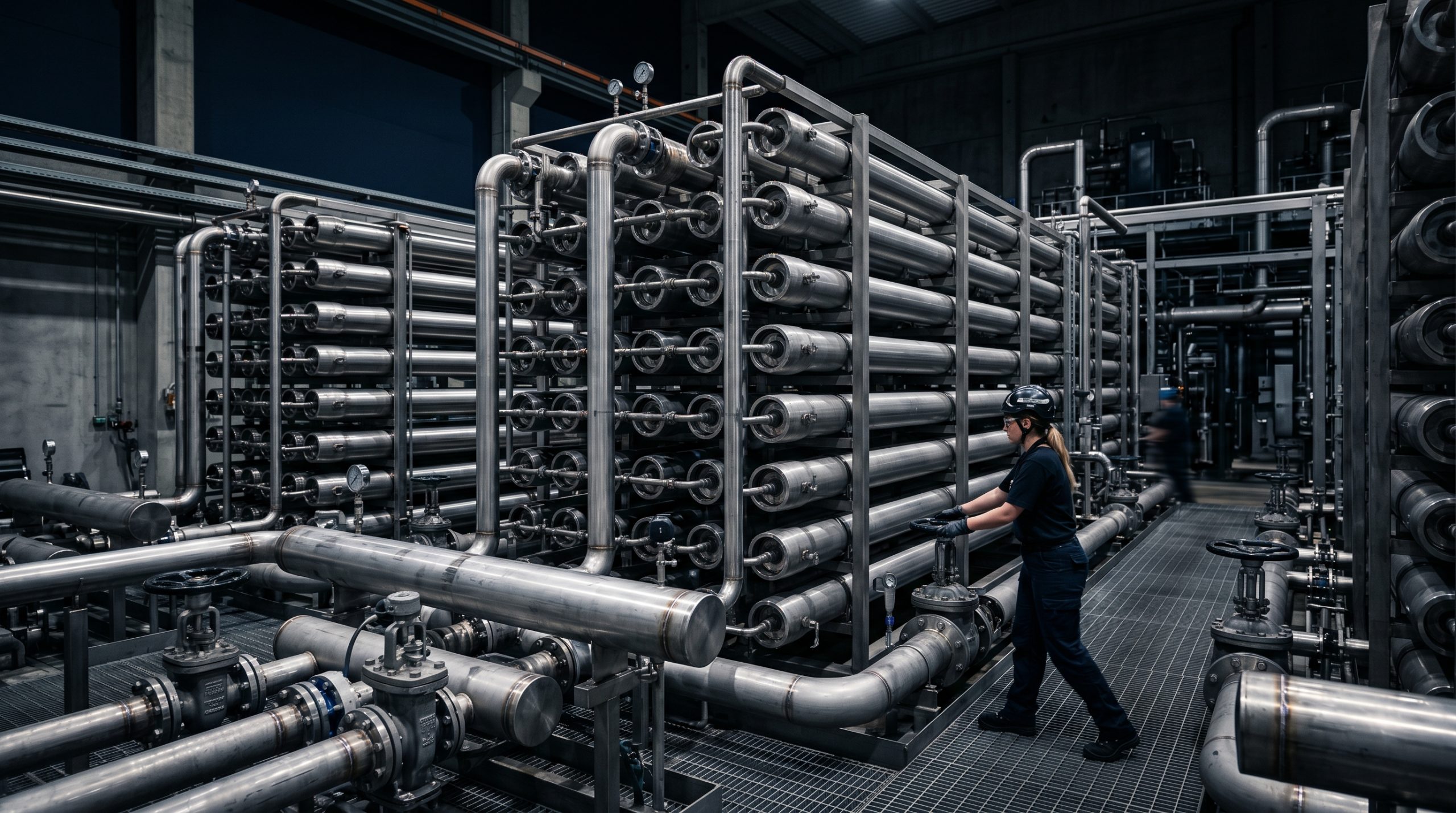
Reverse osmosis is the most widely deployed high-purity water technology in industrial applications, and for good reason: RO achieves 97-99.5% TDS removal in a single pass, operates continuously without chemical regeneration, and scales readily from 6,000 GPD to over 100,000 GPD per train.
Industrial RO systems apply 150-600 PSI hydraulic pressure to push pretreated water through thin-film composite polyamide membranes. AMPAC USA’s industrial reverse osmosis systems 6,000-100,000 GPD are designed with the following performance parameters as standard:
- Feed water TDS up to 5,000 mg/L
- Permeate conductivity typically 1-50 µS/cm depending on feed TDS
- System recovery 75-80% (brackish) or 40-50% (seawater)
- Operating pressure 150-400 PSI (brackish), 800-1,200 PSI (seawater)
- Membrane elements: Dow FILMTEC BW30-400, AXEON HF5-8040 (99.5% NaCl rejection)
- High-pressure pumps: Grundfos CR series stainless steel multistage
Unlike nanofiltration, which targets divalent ions (calcium, magnesium, sulfate), RO membranes reject monovalent ions including sodium and chloride – essential for desalination and ultrapure water applications. The RO membrane elements at the core of these systems are rated for 3-7 year service life with proper pre-treatment and maintenance.
Stage 5: Advanced Treatment – Post-RO Polishing
For applications requiring water purity beyond standard RO output, post-treatment systems are integrated downstream:
- Mixed-bed deionization (DI): Combined cation and anion resin in a single vessel produces ultrapure water with resistivity up to 18.2 MΩ·cm – required in semiconductor and microelectronics manufacturing
- Electrodeionization (EDI): Continuous DI using ion-selective membranes and electrical current; eliminates the need for chemical resin regeneration – preferred in pharmaceutical and power plant applications
- UV disinfection (254 nm): Low-pressure UV lamps deliver 40+ mJ/cm² UV dose to inactivate bacteria, viruses, and TOC reduction – required in pharmaceutical (USP Purified Water) and food processing applications
- Ultrafiltration polishing: Final UF pass removes residual bacteria and endotoxins from water for pharmaceutical manufacturing and biotech processes
Stage 6: Disinfection and Chemical Treatment
Controlling microbial growth throughout the distribution system requires ongoing chemical treatment:
- Chlorine and chloramine dosing: Residual disinfectant in distribution systems prevents biofilm regrowth; dosed to EPA-recommended levels of 0.2-4 mg/L free chlorine for potable water systems
- Biocide programs: Non-oxidizing biocides for closed cooling loops where oxidizing biocides are incompatible with system materials
- Corrosion and scale inhibitors: Blended phosphate and polymer programs in cooling towers reduce corrosion rates and prevent calcium carbonate and silica scale at concentration ratios above 3.5
- Oxygen scavengers: Sodium sulfite or DEHA (diethylhydroxylamine) dosing in boiler feed systems removes dissolved oxygen that causes pitting corrosion on boiler tube surfaces
Industrial Water Treatment by Sector
Power Generation
In the energy sector, water treatment is critical at multiple points in the generation cycle. Boiler makeup water for high-pressure steam generators must achieve conductivity below 0.1 µS/cm after RO plus mixed-bed DI or EDI polishing – silica levels above 0.02 mg/L at high pressures cause turbine blade deposits that reduce generation efficiency. Cooling towers require biocide programs, pH control (maintained at 6.8-7.5), and blowdown treatment to control Legionella risk and scale formation. Chiller makeup water treated by industrial RO eliminates mineral deposits that reduce chiller efficiency and shorten compressor life. AMPAC USA systems installed in power generation facilities have demonstrated cooling tower water savings of 25-40% through optimized blowdown recovery using RO.
Pharmaceutical Manufacturing
The pharmaceutical industry operates under the most stringent water quality standards in any manufacturing sector. USP Purified Water requires conductivity below 1.3 µS/cm at 25°C, TOC below 500 ppb, and bacterial endotoxin levels below 0.25 EU/mL for WFI. AMPAC USA’s pharmaceutical water systems can be specified with 316L electropolished stainless steel wetted surfaces, documentation packages and validation support including IQ/OQ/PQ protocols. Our systems have been deployed in FDA-regulated manufacturing facilities across North America and have supported ANDA, NDA, and BLA filings requiring detailed water system characterization data.
Food and Dairy Processing
In the food & dairy industry, water quality directly impacts product flavor, safety, and shelf life. Municipal water containing chloramines can react with food ingredients to produce off-flavors; water with high hardness leaves mineral deposits on food contact surfaces; and microbial contamination creates direct public health risks. Industrial RO systems remove TDS, chlorine, and organics to produce neutral, consistent process water complying with FDA 21 CFR Part 110 and USDA regulations. In dairy concentration applications, RO membranes are used to concentrate whey protein from 1% to 20-25% solids – recovering valuable protein while reducing evaporator energy costs by 40-60%.
Commercial and Light Industrial Applications
For facilities requiring lower flow rates, commercial RO systems in the 500-5,000 GPD range provide cost-effective process water treatment for restaurants, hotels, car washes, laboratory facilities, and light manufacturing operations. These systems use the same membrane technology and treatment principles as large industrial systems but in more compact, simplified configurations.
Designing an Integrated Industrial Water Treatment System
Effective system design begins with a comprehensive site assessment covering source water quality, flow rate requirements, regulatory constraints, available footprint, energy infrastructure, and total lifecycle budget. AMPAC USA’s engineering process follows a structured methodology:
- Feedwater analysis: Complete ion analysis, TDS, hardness, alkalinity, iron, silica, TOC, SDI, turbidity, and microbial characterization establish the treatment challenge baseline
- Technology selection matrix: Each treatment stage is selected based on the specific contaminants to be removed and the purity target for downstream processes
- System modeling: WAVE membrane system design software optimizes RO array configurations; mass balance modeling ensures recovery, reject, and permeate flows align with site water budget
- Modular and scalable design: Systems are designed for future capacity expansion; skid-mounted modules allow phased installation to manage capital expenditure
- GMP documentation (regulated industries): Design qualification (DQ), IQ/OQ/PQ protocols, change control procedures, and operator training materials are developed as part of the project deliverable
- Commissioning and validation: Factory Acceptance Testing (FAT) at AMPAC USA’s Woods Cross, Utah facility, followed by Site Acceptance Testing (SAT) and operator training at the installation site
AMPAC USA: 30+ years of Industrial Water Treatment Expertise
Founded in 1994 and headquartered in Woods Cross, UT, AMPAC USA has designed, manufactured, and commissioned industrial water treatment systems serving the power, pharmaceutical, military, food, and municipal sectors. Our engineering team holds deep expertise across the full spectrum of treatment technologies:
- Potable water components – selected for contact with potable water
- Quality management – covering design, manufacturing and testing
- Military-grade systems: deployments requiring ruggedized, field-deployable water treatment capability
- Regulatory expertise: Systems designed to FDA 21 CFR, USP Purified Water/WFI, EPA Clean Water Act, and international water quality standards
- Lifecycle support: Installation, commissioning, preventive maintenance contracts, operator training, and spare parts supply across our global installation base
From selecting the right pre-treatment train to specifying the correct RO membrane elements for your feed water chemistry, AMPAC USA engineers bring project-specific expertise that generic equipment suppliers cannot match.
Frequently Asked Questions: Industrial Water Treatment
What are the primary technologies used in industrial water treatment systems?
Industrial water treatment systems integrate multiple technologies such as media filtration, water softening, reverse osmosis (RO), ultrafiltration, and chemical disinfection. These are applied in sequence, tailored to source water characteristics and specific end-use purity targets. AMPAC USA designs these integrated systems, leveraging over 30 years of field experience.
What are the risks of using untreated water in industrial processes?
Using untreated water in industrial processes can lead to severe consequences, including equipment fouling, regulatory violations, and product quality failures. The US EPA warns that dissolved solids above 500 mg/L, biological contaminants, or suspended solids above 50 NTU can cost manufacturers millions annually. This underscores the critical need for precise water conditioning.
How effective is reverse osmosis (RO) for industrial water purification?
Industrial reverse osmosis systems are highly effective, capable of achieving up to 99.5% Total Dissolved Solids (TDS) removal in a single pass. This makes RO a cornerstone technology for producing ultra-pure water required in industries like pharmaceuticals, semiconductor manufacturing, and power generation. AMPAC USA engineers frequently deploy RO as a core component in advanced purification systems.
What regulatory standards govern industrial water quality?
Industrial water quality is governed by stringent regulations from bodies such as the EPA (Clean Water Act), FDA (21 CFR), and standards like USP Purified Water and NSF/ANSI. Compliance with these standards is a major driver for industrial water treatment, ensuring environmental protection, product safety, and operational integrity. AMPAC USA’s systems are designed to meet or exceed these critical benchmarks.
How does AMPAC USA ensure optimal industrial water treatment system performance?
AMPAC USA ensures optimal performance by designing integrated treatment systems based on over 30 years of field experience. Our engineers precisely match technologies like RO, filtration, and softening to source water characteristics and specific process requirements. This practical, knowledgeable approach guarantees systems that protect equipment, reduce costs, and ensure regulatory compliance.
Related Articles
- Industrial Carbon Water Filtration: The Ultimate Solution for Pure and Safe Water
- Boiler Feed Water Treatment: Why Industrial Facilities Need Reverse Osmosis
- Industrial Reverse Osmosis Systems & Water Treatment Systems
- Why Industrial Reverse Osmosis Treatment Is Vital for Pure Water Supply
Conclusion
Industrial water treatment rarely comes down to a single step — it’s the sequence that matters, from pretreatment that protects downstream equipment through to the RO and polishing stages that get water to the purity a given process actually needs. What that sequence looks like changes a lot by sector: a power plant’s boiler feedwater requirements aren’t the same as what a pharmaceutical or food and dairy facility needs, which is why a generic system rarely performs as well as one designed around the actual process it’s feeding. For a closer look at one common application, see our boiler feed water treatment guide. Contact our team at info@ampac1.com or (909) 548-4900 to discuss an industrial water treatment system built around your facility’s process.
AMPAC USA engineers custom water purification systems for commercial, industrial, and emergency applications — from 500 GPD to multi-million GPD. Trusted by municipalities, military, and industry worldwide.