
Reverse osmosis membranes are the heart of any RO water purification system. Whether you operate a residential under-sink unit or manage a large-scale industrial desalination plant, understanding RO membrane lifespan directly impacts your water quality, operating costs, and system reliability. This comprehensive guide covers everything you need to know about how long RO membranes last, what factors shorten or extend their service life, and exactly how to maintain them for peak performance.
How Long Do RO Membranes Last?
Residential RO membranes typically last 2 to 5 years under normal household conditions. Commercial RO membranes last 3 to 5 years, while industrial membranes can reach 5 to 7 years with proper pretreatment and maintenance. Seawater desalination membranes average 3 to 5 years due to harsher operating conditions. The actual lifespan depends on feed water quality, operating pressure, cleaning frequency, and membrane type. Thin-film composite (TFC) polyamide membranes generally outlast cellulose triacetate (CTA) membranes in most applications.
Understanding RO Membrane Types and Construction
Before discussing lifespan, it is essential to understand what you are working with. Modern reverse osmosis systems use two primary membrane materials, each with distinct characteristics that affect durability and longevity.
Thin-Film Composite (TFC) Polyamide Membranes
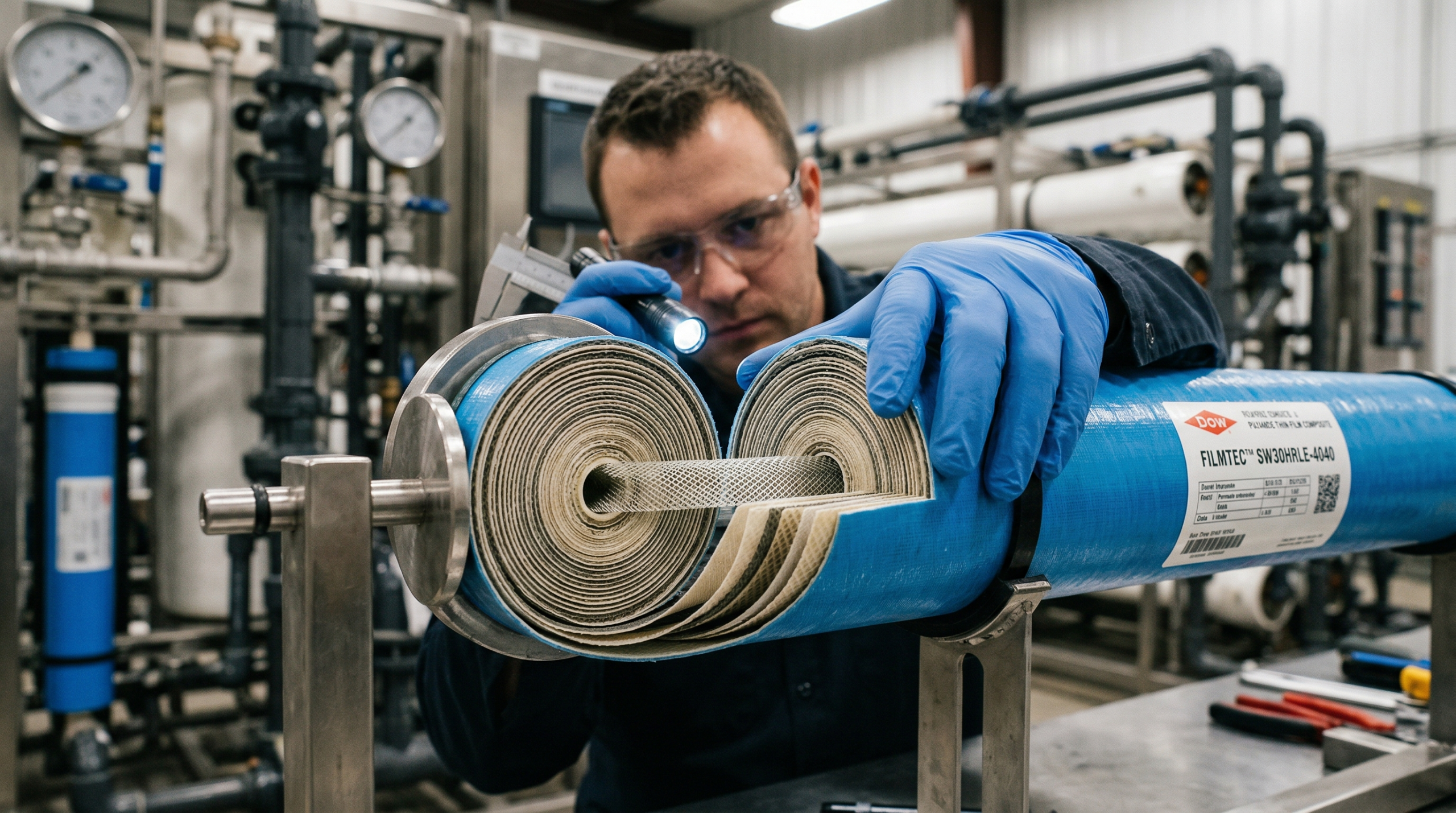
TFC membranes are the industry standard for the vast majority of RO applications today. They consist of three layers: a polyester support web, a microporous polysulfone interlayer, and an ultra-thin polyamide barrier layer where the actual separation occurs. This barrier layer is typically only 0.2 microns thick, yet it is responsible for rejecting 95% to 99.5% of dissolved solids from feed water.
TFC membranes offer superior rejection rates, higher flux (water production per unit area), and better resistance to biological fouling compared to CTA membranes. However, they are sensitive to chlorine exposure. Even low concentrations of free chlorine (above 0.1 ppm) will degrade the polyamide layer over time, which is why activated carbon pretreatment is critical in municipal water applications. According to membrane manufacturers and the American Water Works Association (AWWA), continuous chlorine exposure above 1,000 ppm-hours will cause irreversible damage to TFC membranes.
Cellulose Triacetate (CTA) Membranes
CTA membranes were among the earliest commercial RO membrane materials. They are constructed from cellulose acetate blends and offer moderate chlorine tolerance (up to 1.0 ppm free chlorine), making them simpler to operate in chlorinated municipal water supplies without extensive dechlorination. However, CTA membranes have lower salt rejection rates (typically 93% to 97%), are susceptible to biological degradation, and require a narrower pH operating range (pH 4 to 8) compared to TFC membranes (pH 2 to 11).
CTA membranes are still used in some residential point-of-use systems and specialized applications, but TFC has largely replaced them in commercial and industrial settings due to superior performance and longer operational life.
TFC vs. CTA Membrane Comparison
| Parameter | TFC Polyamide | CTA Cellulose Triacetate |
|---|---|---|
| Salt Rejection | 95% – 99.5% | 93% – 97% |
| Chlorine Tolerance | <0.1 ppm (sensitive) | Up to 1.0 ppm |
| pH Operating Range | 2-11 | 4-8 |
| Biological Resistance | Good | Poor (susceptible to biodegradation) |
| Typical Lifespan | 3-7 years | 2-4 years |
| Operating Pressure | 100-1,000 psi (varies by application) | 200-400 psi |
| Cost | Higher initial cost, lower lifecycle cost | Lower initial cost, higher lifecycle cost |
RO Membrane Lifespan by Application
RO membrane longevity varies significantly depending on the application, feed water source, and system design. The following table provides realistic lifespan expectations based on industry data and operational experience.
| Application | Typical Lifespan | Feed Water Source | Key Lifespan Factors |
|---|---|---|---|
| Residential (Point-of-Use) | 2-5 years | Municipal water | Chlorine exposure, sediment levels, usage volume |
| Commercial (Restaurants, Hotels, Offices) | 3-5 years | Municipal or well water | Higher throughput, pretreatment quality, maintenance frequency |
| Light Industrial | 3-5 years | Municipal, well, or surface water | Feed water variability, CIP cleaning schedule, antiscalant dosing |
| Heavy Industrial | 5-7 years | Various sources with full pretreatment | Professional maintenance, advanced pretreatment, monitoring systems |
| Seawater Desalination | 3-5 years | Ocean or brackish water | High salinity, biological fouling, scaling potential |
| Pharmaceutical / Ultrapure | 3-5 years | Pretreated municipal water | Strict validation requirements, frequent sanitization |
| Boiler Feed Water | 4-6 years | Softened municipal or well water | Consistent feed quality, lower fouling potential |
Key Takeaway
Industrial RO systems with comprehensive pretreatment trains and professional maintenance programs consistently achieve the longest membrane life. Residential systems, while having simpler feed water, often suffer from neglected prefilter changes and inconsistent maintenance, which shortens membrane lifespan below its potential.
Factors That Affect RO Membrane Lifespan
Multiple variables interact to determine how long your RO membrane will last. Understanding and controlling these factors is the key to maximizing your investment.
1. Feed Water Quality
Feed water quality is the single most important factor in membrane longevity. The U.S. Environmental Protection Agency (EPA) identifies several contaminants that are particularly damaging to RO membranes: high total dissolved solids (TDS), iron, manganese, silica, hardness minerals (calcium and magnesium), and microbiological organisms. Water with a Silt Density Index (SDI) above 5 will cause rapid fouling, and the EPA recommends maintaining SDI below 3 for optimal membrane performance.
Well water sources with high iron content (above 0.05 ppm) or hardness above 10 grains per gallon (gpg) require specific pretreatment such as iron filtration and water softening to protect RO membranes. Surface water sources introduce additional challenges including seasonal turbidity spikes, natural organic matter (NOM), and algal blooms that accelerate biofouling.
2. Operating Pressure and Recovery Rate
Operating RO systems at excessively high recovery rates concentrates dissolved solids in the reject stream, increasing the risk of scaling and fouling. The World Health Organization (WHO) guidelines for desalination operations recommend maintaining recovery rates within the membrane manufacturer’s specifications, typically 50% to 75% for brackish water and 35% to 50% for seawater. Running a system above these rates accelerates membrane degradation and reduces lifespan by 30% to 50%.
3. Chlorine and Oxidant Exposure
For TFC polyamide membranes, chlorine exposure is the most common cause of premature failure in municipal water applications. The damage is cumulative and measured in ppm-hours. Most manufacturers warrant their membranes up to 1,000 ppm-hours of free chlorine exposure. At 0.1 ppm continuous exposure, that limit is reached in approximately 10,000 hours (about 14 months). Proper carbon pretreatment or sodium metabisulfite (SMBS) injection is non-negotiable for TFC membrane protection.
4. Temperature
Feed water temperature affects membrane performance and longevity. Most RO membranes are rated for operation between 40°F and 113°F (4°C to 45°C). Higher temperatures increase permeate flux but also accelerate chemical degradation of the membrane polymer and promote biological growth. Every 10°F increase in feed water temperature roughly doubles the rate of chemical degradation reactions.
5. Biological Fouling
Biofouling accounts for more than 40% of all membrane fouling incidents, according to research published by the American Membrane Technology Association (AMTA). Bacteria form biofilms on the membrane surface that reduce flux, increase differential pressure, and can permanently damage the membrane structure. Biofouling is particularly problematic in warm water environments and systems with inadequate biocide pretreatment.
6. Scaling
Mineral scaling occurs when dissolved salts exceed their solubility limits in the concentrate stream and precipitate on the membrane surface. Calcium carbonate, calcium sulfate, barium sulfate, silica, and strontium sulfate are the most common scaling compounds. Antiscalant chemical dosing and proper system recovery rate control are essential to prevent scaling, which can cause irreversible membrane damage if not addressed promptly.
Signs Your RO Membrane Needs Replacement
Knowing when to replace an RO membrane saves money by avoiding poor water quality and unnecessary early replacement. Monitor these performance indicators to make data-driven replacement decisions.
Critical Performance Indicators
| Indicator | Warning Threshold | Replacement Threshold | What It Means |
|---|---|---|---|
| Decreased Permeate Flow | >10% decline from baseline | >15% – 20% decline after CIP cleaning | Membrane fouling or compaction that cleaning cannot restore |
| Increased TDS Passage (Salt Passage) | >10% increase from baseline | >50% increase or failure to meet water quality spec | Membrane degradation, O-ring leaks, or physical damage |
| Higher Differential Pressure | >15% increase from clean baseline | >50% increase after CIP cleaning | Irreversible fouling or feed spacer plugging |
| Permeate Conductivity Rise | Steady upward trend over weeks | Exceeds product water specification | Progressive membrane degradation |
| Normalized Salt Rejection Decline | <95% (from initial 97% – 99%) | <90% or below application requirement | End of useful membrane life for the application |
Key Takeaway
Always normalize performance data to account for changes in feed water temperature, pressure, and concentration. A decline in permeate flow during winter may simply reflect colder feed water, not membrane fouling. Use manufacturer normalization software (such as Hydranautics IMS Design, Toray DS2, or DOW ROSA) to track true membrane performance trends over time.
What Happens If You Don’t Replace the Membrane?
Continued use of a degraded membrane isn’t just inefficient – it’s counterproductive to the reason you installed the system:
- Rejection of lead, arsenic, PFAS, and nitrates falls proportionally with TDS rejection. An 80% rejection rate that was once 95% means significantly more contaminants reaching your glass.
- A fouled membrane increases operating pressure requirements, straining the system’s pump and fittings.
- Heavily fouled membranes can become a breeding site for biofilm, potentially adding bacteria to otherwise clean water.
CIP Cleaning Procedures for RO Membranes
Clean-in-place (CIP) cleaning is the most effective way to restore membrane performance and extend lifespan. A well-executed CIP program can add years of productive life to your membranes. The EPA and membrane manufacturers recommend cleaning whenever normalized permeate flow drops by 10% to 15%, normalized salt passage increases by 5% to 10%, or normalized differential pressure increases by 15%.
Low-pH Cleaning (for Inorganic Scaling)
Low-pH cleaning targets calcium carbonate, iron oxide, and other inorganic mineral deposits. A typical procedure uses 0.2% hydrochloric acid (HCl) or 2% citric acid at pH 2.0 to 3.0, circulated at low pressure (20 to 60 psi) and elevated temperature (77°F to 104°F / 25°C to 40°C) for 30 to 60 minutes. After circulation, the solution soaks in the membranes for 1 to 4 hours, followed by a second circulation period and a thorough freshwater rinse.
High-pH Cleaning (for Organic and Biological Fouling)
High-pH cleaning removes biofilm, natural organic matter, and colloidal fouling. A common formulation uses 0.1% sodium hydroxide (NaOH) combined with 0.025% sodium dodecyl sulfate (SDS) or a proprietary alkaline cleaner at pH 11.0 to 12.0. The solution is circulated and soaked following the same general procedure as low-pH cleaning. For heavy biofouling, some operators add 0.5% to 1.0% sodium EDTA to the alkaline solution to chelate metals that stabilize biofilm structures.
CIP Cleaning Best Practices
- Always perform low-pH cleaning before high-pH cleaning when both organic and inorganic fouling are present. High-pH cleaning first can set inorganic scale, making it harder to remove.
- Monitor the CIP return solution for color, turbidity, and pH. A darkening solution indicates foulant removal. Continue circulation until the return solution stabilizes.
- Never exceed the membrane manufacturer’s temperature and pH limits during CIP cleaning. TFC membranes typically tolerate pH 1 to 13 at temperatures up to 113°F (45°C), but always verify with the specific product data sheet.
- Use dedicated CIP tanks, pumps, and cartridge filters to prevent recontamination. NSF/ANSI-certified cleaning chemicals are recommended to avoid introducing new contaminants.
- Document every CIP event including date, chemicals used, concentrations, temperatures, duration, and pre/post-cleaning performance data.
RO Membrane Maintenance Schedule
Consistent maintenance is the difference between a membrane that lasts 2 years and one that lasts 7 years. The following schedule applies to commercial and industrial RO systems. Residential systems require a simplified version focusing on prefilter replacement and periodic sanitization.
| Frequency | Task | Details |
|---|---|---|
| Daily | Record operating parameters | Log feed pressure, permeate pressure, concentrate pressure, feed and permeate conductivity, feed temperature, permeate flow rate, and system recovery rate |
| Daily | Check pretreatment chemical levels | Verify antiscalant, dechlorination (SMBS or carbon), and pH adjustment chemical tank levels and dosing pump operation |
| Daily | Verify permeate water quality | Test permeate TDS or conductivity and compare against baseline and specification |
| Weekly | Inspect prefilters and cartridge filters | Check differential pressure across sediment and carbon prefilters; replace if differential pressure exceeds manufacturer limits |
| Weekly | Test feed water SDI | Measure Silt Density Index (SDI15) and ensure it remains below 3 for spiral-wound membranes |
| Weekly | Check for leaks | Inspect all fittings, O-rings, permeate tubes, and end caps for drips or weeping |
| Monthly | Normalize and trend performance data | Calculate normalized permeate flow, salt passage, and differential pressure. Compare to baseline and previous months to identify fouling trends |
| Monthly | Calibrate instruments | Verify accuracy of pressure gauges, flow meters, conductivity meters, pH probes, and temperature sensors |
| Monthly | Replace sediment prefilters | Replace 5-micron and 1-micron sediment cartridges (or as indicated by differential pressure) |
| Quarterly | Replace carbon prefilters | Replace granular or carbon block filters to maintain chlorine removal capacity. Test effluent for free chlorine to confirm removal |
| Quarterly | Inspect and clean CIP system | Drain, flush, and inspect CIP tank, pump, hoses, and cartridge filter housing |
| Semi-Annual | Perform CIP membrane cleaning | Conduct full CIP cleaning (or as indicated by 10% – 15% normalized flow decline). Perform both acid and alkaline cleaning stages |
| Annual | Comprehensive system inspection | Inspect pressure vessels, end caps, interconnectors, permeate tubes, brine seals, and thrust rings. Replace worn O-rings and seals |
| Annual | Membrane autopsy (if warranted) | Submit a sacrificial membrane element for third-party autopsy analysis to identify specific foulants and optimize pretreatment |
| Annual | Review and update maintenance SOP | Revise procedures based on the year’s operational data, cleaning results, and any equipment changes |
RO Membrane Replacement Costs
Understanding replacement costs helps you budget effectively and evaluate the return on investment of proper maintenance. The costs below include the membrane element only and do not account for labor, system downtime, or disposal fees.
| Application / Membrane Size | Cost Per Element | Typical System Configuration | Total Membrane Replacement Cost |
|---|---|---|---|
| Residential (1812 or 2012 element) | $50 – $150 | 1 membrane element | $50 – $150 |
| Small Commercial (2540 element) | $200 – $400 | 1-4 elements | $200 – $1,600 |
| Large Commercial (4040 element) | $400 – $800 | 2-12 elements | $800 – $9,600 |
| Industrial (8040 element) | $500 – $3,000 | 6-72+ elements per stage | $3,000 – $216,000+ |
| Seawater Desalination (8040 SW) | $800 – $3,000 | 6-8 per vessel, multiple vessels | $50,000 – $500,000+ |
When you factor in that proper maintenance can extend membrane life by 2 to 3 years, the cost savings become substantial. For an industrial system with 36 elements at $1,500 each, extending membrane life from 3 years to 6 years saves $54,000 in membrane costs alone, not counting reduced downtime and labor. AMPAC USA offers a full range of commercial reverse osmosis systems engineered with proper pretreatment trains to maximize membrane life.
How to Extend RO Membrane Lifespan
Based on guidance from the EPA, NSF International, and leading membrane manufacturers, these proven strategies will help you get the most years out of your RO membranes.
Invest in Proper Pretreatment
Pretreatment is the most cost-effective investment in membrane longevity. At minimum, RO pretreatment should include sediment filtration (5-micron cartridge or multimedia filter), activated carbon filtration or chemical dechlorination for TFC membranes, and antiscalant chemical dosing. For challenging feed water sources, additional pretreatment such as iron removal, water softening, ultrafiltration, or UV sterilization may be required. The NSF/ANSI 58 standard for residential RO systems and NSF/ANSI 61 for treatment chemicals provide a framework for selecting appropriate pretreatment components.
Maintain Consistent Operating Conditions
Avoid frequent start-stop cycling, which causes pressure surges and thermal stress on membrane elements. Industrial and commercial systems benefit from variable frequency drives (VFDs) on high-pressure pumps for smooth ramping. Keep recovery rates within manufacturer specifications and avoid operating at pressures exceeding the membrane’s rated maximum.
Monitor and Respond to Data Trends
Proactive operators who track normalized performance data and respond early to fouling trends consistently achieve longer membrane life than those who only react to visible problems. Install flow meters, pressure gauges, and conductivity monitors on every stage of the RO system and log data at least daily. Many modern RO systems include programmable logic controllers (PLCs) or SCADA systems that automate data logging and alarm triggers.
Clean Early and Clean Correctly
Do not wait until the membrane is severely fouled to perform CIP cleaning. Early cleaning at the first sign of fouling (10% normalized flow decline) is far more effective and less damaging than aggressive cleaning of heavily fouled membranes. Use the correct cleaning chemistry for the identified foulant type, and never mix incompatible chemicals.
Store Membranes Properly
If RO membranes must be removed from service for an extended period, proper preservation is critical to prevent biological growth and irreversible drying. Membrane elements should be stored in a 1% sodium metabisulfite (SMBS) solution in a sealed, opaque container at 40°F to 95°F (4°C to 35°C). Replace the preservation solution every 30 days and never allow membranes to freeze or dry out. Dried membranes suffer irreversible compaction and cannot be restored to original performance.
Residential RO Membrane Maintenance Tips
Homeowners often overlook RO system maintenance until water quality noticeably degrades. Following these simple guidelines will keep your residential RO system performing at its best and help your membrane reach its full 5-year potential.
- Replace sediment and carbon prefilters every 6 to 12 months. These filters protect the membrane from particulates and chlorine. Neglected prefilters are the number one cause of premature residential membrane failure.
- Replace the post-carbon polishing filter annually. This filter improves taste but does not protect the membrane. However, a saturated post-filter can harbor bacteria that backflow to the membrane.
- Test your permeate water quality every 6 months. Use an inexpensive TDS meter to measure product water quality. A sudden increase in TDS indicates membrane failure or O-ring bypass.
- Sanitize the system annually. During filter changes, flush the system with a dilute hydrogen peroxide or sodium hypochlorite sanitizing solution per the manufacturer’s instructions to control bacterial growth inside the system housing.
- Check the storage tank pressure. Residential RO storage tanks contain a pressurized air bladder that should maintain 5 to 8 psi when empty. Low tank pressure reduces water delivery flow and causes the system to cycle excessively, wearing out components faster.
AMPAC USA provides a complete selection of replacement filters and membrane elements for residential and commercial RO systems, along with technical support to help you choose the right products for your system.
When to Replace vs. When to Clean
Deciding between cleaning and replacement requires analyzing performance data objectively. The general rule: if a properly executed CIP cleaning restores at least 90% of the membrane’s normalized baseline performance, the membrane still has useful life remaining. If performance does not recover adequately after cleaning, or if the membrane has reached its rated service life and shows steady degradation trends, replacement is the cost-effective choice.
For industrial systems, submitting a representative membrane element for professional autopsy analysis provides definitive information about the type and extent of fouling or degradation. This data is invaluable for optimizing pretreatment and extending the life of replacement membranes. Many membrane autopsy services also provide cleaning recommendations tailored to the specific foulants identified.
Key Takeaway
Never replace a membrane that can be cleaned back to acceptable performance. Conversely, do not keep cleaning a membrane that is past its effective service life. Track cleaning recovery rates over time. When CIP cleaning recovers less than 85% of baseline performance, start planning for membrane replacement and budgeting the cost.
Environmental Considerations and Membrane Disposal
Used RO membrane elements are classified as non-hazardous solid waste in most jurisdictions and can be disposed of in standard landfills. However, environmental best practices encourage recycling. Several companies now accept used membranes for recycling programs where the plastic and fiberglass components are recovered. Some spent industrial membranes can be repurposed for less demanding filtration applications such as wastewater treatment or irrigation water polishing.
The EPA encourages water treatment facilities to include membrane end-of-life planning in their overall environmental management systems. Documenting membrane replacement, disposal, or recycling contributes to sustainability reporting and may support compliance with state or local environmental requirements.
📚 References & Further Reading
- DOW Filmtec Membrane Technical Manual
- NSF/ANSI 58 Certification Standards
- WaterWorld: RO Membrane Fouling & Replacement Guide
- AMPAC USA – RO Membrane Replacement Service
Frequently Asked Questions About RO Membrane Lifespan
What factors determine how long an RO membrane lasts?
The lifespan of an RO membrane is primarily determined by feed water quality, operating pressure, and the frequency of cleaning. Membrane type also plays a crucial role, with Thin-Film Composite (TFC) membranes generally offering better longevity than Cellulose Triacetate (CTA) membranes in most applications. Proper pretreatment is essential to mitigate factors like fouling and scaling that shorten membrane life.
How does chlorine impact the lifespan of RO membranes?
Chlorine significantly degrades Thin-Film Composite (TFC) polyamide membranes, which are the industry standard. Even low concentrations above 0.1 ppm can cause irreversible damage over time. According to AWWA, continuous exposure exceeding 1,000 ppm-hours will severely compromise TFC membrane integrity, necessitating activated carbon pretreatment.
What is the typical lifespan for commercial and industrial RO membranes?
Commercial RO membranes typically last 3 to 5 years, while industrial membranes can achieve 5 to 7 years with proper pretreatment and maintenance. Seawater desalination membranes average 3 to 5 years due to the harsher operating conditions they face. AMPAC USA engineers emphasize that consistent monitoring and cleaning are key to maximizing these lifespans.
What are Thin-Film Composite (TFC) membranes, and why are they common?
TFC membranes are the industry standard for RO systems, composed of a polyester support, a microporous polysulfone interlayer, and an ultra-thin polyamide barrier layer, typically 0.2 microns thick. This design allows them to reject 95% to 99.5% of dissolved solids, offer superior flux, and resist biological fouling, making them highly effective for diverse water purification needs, from municipal to offshore applications.
Why is activated carbon pretreatment important for RO systems?
Activated carbon pretreatment is critical for RO systems, especially those using Thin-Film Composite (TFC) membranes, because TFC membranes are highly sensitive to chlorine. Chlorine concentrations above 0.1 ppm can irreversibly damage the polyamide layer, leading to reduced performance and premature membrane failure. This pretreatment step protects the membrane from oxidative degradation.
Protect Your Investment with the Right RO System
Maximizing RO membrane lifespan starts with choosing a system engineered for your specific water source and application. AMPAC USA designs and manufactures commercial reverse osmosis systems with integrated pretreatment, CIP cleaning systems, and advanced monitoring instrumentation that protect your membranes and deliver consistent water quality year after year.
Whether you need a compact system for a restaurant, a high-capacity unit for manufacturing, or a full-scale seawater desalination plant, AMPAC’s engineering team will design a solution tailored to your feed water conditions and production requirements. Every system includes comprehensive documentation, operator training, and ongoing technical support to keep your membranes performing at their best.
AMPAC USA has been engineering water purification solutions since 1994. Contact our team at (909) 548-4900 or visit ampac1.com for system specifications and pricing.
Related Articles
- Whole House Reverse Osmosis Systems: 2026 Sizing & Buyer's Guide
- Microplastics in Drinking Water: Can Reverse Osmosis Remove Them? [2026 Research]
- PFAS in Drinking Water: How Reverse Osmosis Removes Forever Chemicals in 2026
Conclusion
How long your RO membrane lasts really comes down to what you’re feeding it — chlorine exposure, scaling minerals, and biological fouling will eat into that lifespan faster than age ever will. The good news is most of the damage is preventable: solid pretreatment, correct operating pressure, and staying on top of CIP cleaning before performance drops off. If you’re already seeing the warning signs discussed above, the section on when to replace versus when to clean covers the decision in more detail. Contact our team at info@ampac1.com or (909) 548-4900 to discuss membrane replacement or a maintenance plan for your system.