

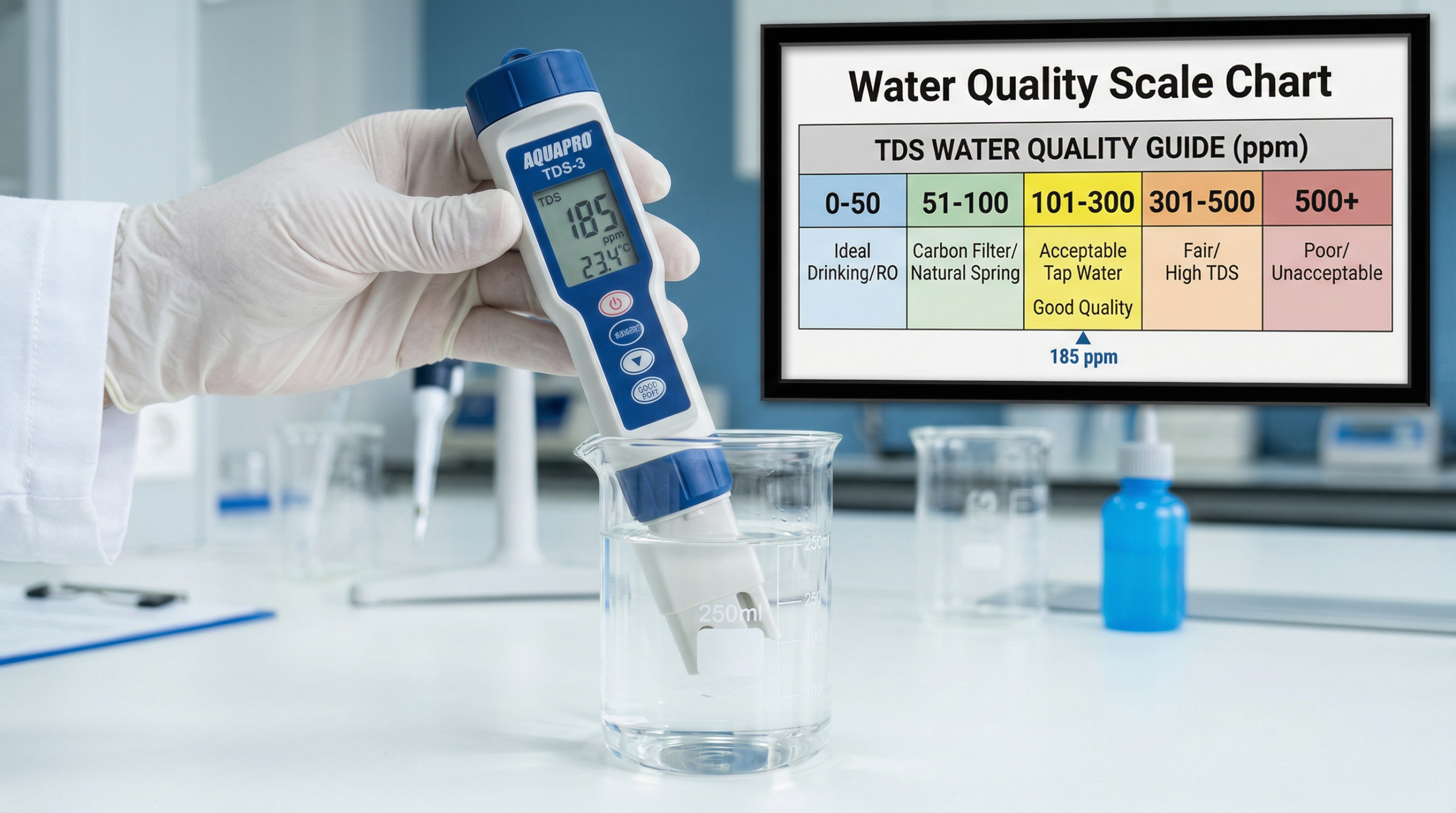
TDS Levels in Drinking Water: What They Mean and Why They Matter [Complete Guide]
Quick Answer: Total Dissolved Solids (TDS) measures the concentration of dissolved minerals, salts, metals, and organic matter in water, expressed in parts per million (ppm) or milligrams per liter (mg/L). The World Health Organization (WHO) classifies drinking water with TDS below 300 ppm as “excellent,” while the U.S. EPA sets a secondary standard of 500 ppm. The ideal TDS range for drinking water is 50-150 ppm, which provides essential minerals while avoiding the taste, scaling, and health concerns associated with high TDS. Reverse osmosis (RO) systems reduce TDS by 90-99%, making them the most effective residential and commercial water purification technology available.
Whether you have tested your tap water and found unexpectedly high TDS readings, or you are evaluating water treatment options for your home or business, understanding TDS is essential for making informed decisions about water quality. TDS affects everything from how your water tastes to the lifespan of your plumbing and appliances, and in some cases, your health.
This complete guide explains what TDS is, how to measure it, what different TDS levels indicate about your water quality, and how reverse osmosis technology effectively reduces TDS to produce clean, great-tasting drinking water.
What Is TDS in Drinking Water?
Total Dissolved Solids (TDS) refers to the combined concentration of all inorganic and organic substances dissolved in water. These substances pass through a filter with a pore size of 2 micrometers or smaller and remain in the water in a dissolved state. TDS is measured in parts per million (ppm), which is equivalent to milligrams per liter (mg/L). One ppm means one milligram of dissolved solids per liter of water.
According to the U.S. Environmental Protection Agency (EPA), TDS is classified as a secondary contaminant with a recommended maximum level of 500 ppm. Secondary contaminants are not considered direct health threats at the recommended levels, but they affect the aesthetic qualities of water, including taste, odor, and appearance. However, the World Health Organization (WHO) guidelines and the National Science Foundation (NSF) both recognize that TDS composition matters as much as total concentration, since TDS can include both beneficial minerals and harmful contaminants.
Common Substances That Contribute to TDS
TDS is not a single contaminant but a composite measurement. The dissolved substances that make up your water’s TDS reading come from natural geological sources, municipal treatment processes, agricultural runoff, and plumbing infrastructure. Understanding these individual contributors provides a more complete picture of what your TDS number actually represents.
| Substance | Typical TDS Contribution (ppm) | Source | Health/Quality Impact |
|---|---|---|---|
| Calcium (Ca) | 20-100 | Limestone, gypsum deposits | Beneficial for bones; causes hardness and scale |
| Magnesium (Mg) | 10-50 | Dolomite, magnesite rock | Essential mineral; contributes to water hardness |
| Sodium (Na) | 10-200 | Salt deposits, water softeners, road salt | Taste impact above 200 ppm; concern for hypertension |
| Potassium (K) | 1-10 | Feldspar minerals, fertilizer runoff | Essential electrolyte; beneficial at normal levels |
| Bicarbonate (HCO3) | 50-300 | Carbonate rock dissolution | Alkalinity buffer; affects taste above 300 ppm |
| Chloride (Cl) | 10-250 | Salt deposits, seawater intrusion, road salt | Salty taste above 250 ppm; corrosive to pipes |
| Sulfate (SO4) | 10-250 | Gypsum, industrial discharge | Laxative effect above 500 ppm; bitter taste |
| Silica (SiO2) | 5-30 | Sand, quartz dissolution | Scaling in boilers; generally harmless in drinking water |
| Nitrate (NO3) | 0-45 | Agricultural fertilizer, septic systems | Health hazard above 10 ppm (EPA MCL); methemoglobinemia risk in infants |
| Iron (Fe) | 0-5 | Iron-bearing rock, corroded pipes | Metallic taste; staining above 0.3 ppm |
| Fluoride (F) | 0-4 | Natural deposits, municipal addition | Dental benefit at 0.7 ppm; fluorosis risk above 4 ppm |
WHO TDS Water Quality Classification Chart
The World Health Organization (WHO) published widely referenced TDS guidelines for drinking water palatability in its “Guidelines for Drinking-water Quality” document. These classifications are based on taste panels and consumer acceptance studies conducted across multiple countries. The following chart summarizes the WHO palatability ratings by TDS level.
| TDS Level (ppm) | WHO Classification | Taste/Quality Description | Recommended Action |
|---|---|---|---|
| Less than 50 | Flat / Demineralized | Lacks mineral flavor; may taste flat or empty | Consider remineralization for taste and health benefits |
| 50-150 | Ideal Range | Clean, crisp taste with balanced mineral content | No treatment needed; this is the optimal target for RO systems |
| 150-300 | Excellent | Good taste; acceptable mineral content | Generally no treatment required for taste |
| 300-600 | Good | Acceptable taste; noticeable mineral presence | May benefit from water softening or basic filtration |
| 600-900 | Fair | Increasingly poor taste; scaling and staining likely | Water treatment recommended; RO system advised |
| 900-1,200 | Poor | Unpleasant taste; potential health concerns from specific contaminants | RO treatment strongly recommended |
| Greater than 1,200 | Unacceptable | Unpalatable; possible health risks with prolonged consumption | RO treatment required before consumption |
Key Takeaway: While the EPA sets a secondary standard of 500 ppm TDS, the WHO classification system provides a more nuanced view. The ideal range for drinking water is 50-150 ppm, which balances mineral content for taste and health benefits while avoiding scaling, staining, and aesthetic issues. Water below 50 ppm may taste flat and lacks beneficial minerals, while water above 600 ppm typically requires treatment.
How TDS Meters Work
TDS meters are inexpensive, portable instruments that provide an instant estimate of the total dissolved solids in a water sample. Understanding how these devices work helps you interpret readings accurately and recognize their limitations.
Electrical Conductivity Method
Most handheld TDS meters do not directly measure dissolved solids. Instead, they measure the electrical conductivity (EC) of the water and apply a conversion factor to estimate TDS. Dissolved minerals and salts form ions in water, and these ions conduct electricity. The higher the ion concentration, the greater the conductivity, and thus the higher the estimated TDS.
The standard conversion factor used by most TDS meters is 0.5 to 0.7, meaning the meter multiplies the EC reading (in microsiemens per centimeter, or uS/cm) by this factor to produce a TDS reading in ppm. For example, a water sample with an EC of 600 uS/cm would produce a TDS reading of approximately 300-420 ppm, depending on the conversion factor used.
Gravimetric Method (Laboratory Standard)
The most accurate method for measuring TDS is the gravimetric (evaporation) method defined by Standard Method 2540 C, published by the American Public Health Association (APHA). In this method, a known volume of water is filtered through a 2-micrometer filter, evaporated at 180 degrees Celsius, and the remaining residue is weighed. This laboratory method provides the true TDS value and is used by certified water testing laboratories for regulatory compliance.
Limitations of Handheld TDS Meters
While TDS meters are useful screening tools, they have important limitations that consumers should understand. TDS meters cannot identify specific contaminants in your water. A reading of 300 ppm could represent 300 ppm of harmless calcium bicarbonate or it could include harmful levels of lead, arsenic, or nitrate. Two water samples with identical TDS readings can have vastly different safety profiles. Additionally, TDS meters do not detect non-ionic contaminants such as many organic chemicals, pesticides, pharmaceuticals, and pathogens, which do not conduct electricity and will not register on a TDS meter.
For a complete understanding of your water quality, the Water Quality Association (WQA) and the EPA both recommend comprehensive laboratory testing in addition to TDS screening. Certified laboratories can provide detailed breakdowns of individual contaminant concentrations.
What High TDS in Drinking Water Indicates
Elevated TDS levels serve as a general indicator that your water contains a significant concentration of dissolved substances. While high TDS is not automatically dangerous, it signals potential quality issues that warrant further investigation. The specific health and quality implications depend entirely on which substances are contributing to the elevated TDS reading.
Taste and Aesthetic Issues
Water with TDS above 500 ppm frequently produces noticeable taste complaints. High sodium levels create a salty flavor. Elevated sulfate concentrations produce a bitter taste. Excess iron and manganese cause metallic flavors and can stain laundry, fixtures, and dishes. According to the EPA, aesthetic complaints are the most common reason consumers seek water treatment solutions, and elevated TDS is the underlying cause in many cases.
Scaling and Infrastructure Damage
High TDS water that is rich in calcium and magnesium (hard water) causes mineral scale buildup in pipes, water heaters, boilers, and appliances. The U.S. Geological Survey (USGS) classifies water hardness as follows: 0-60 ppm is soft, 61-120 ppm is moderately hard, 121-180 ppm is hard, and above 180 ppm is very hard. Scale accumulation reduces the efficiency of water heaters by up to 25%, shortens appliance lifespans, and increases energy costs. In commercial settings, scaling can be even more costly, leading to expensive descaling treatments and equipment replacement.
Potential Health Concerns
While the EPA considers TDS a secondary (non-enforceable) standard, certain individual components of TDS carry primary (enforceable) maximum contaminant levels. Nitrate above 10 ppm poses serious risks to infants. Lead at any detectable level is a health concern, with an action level of 15 parts per billion (ppb). Arsenic above 10 ppb increases cancer risk with long-term exposure. Fluoride above 4 ppm can cause skeletal fluorosis. A high TDS reading could mask the presence of these regulated contaminants within the total measurement.
What Low TDS in Drinking Water Indicates
Water with very low TDS (below 50 ppm) has its own set of characteristics and considerations. While ultra-pure water is essential for certain industrial and pharmaceutical applications, it may not be ideal for drinking purposes without remineralization.
Extremely low TDS water tastes flat or empty because the dissolved minerals that give water its characteristic flavor are absent. Some studies cited by the WHO suggest that long-term consumption of demineralized water (below 10 ppm TDS) may contribute to reduced intake of essential minerals like calcium and magnesium, although this effect can be offset by dietary intake. Additionally, very low TDS water is slightly more aggressive (corrosive) and can leach minerals from pipes and storage containers.
This is why quality residential reverse osmosis systems from AMPAC USA include optional remineralization stages that add beneficial calcium and magnesium back into the purified water, targeting the ideal 50-150 ppm range that provides the best combination of taste and mineral content.
TDS Levels by Water Source
TDS varies dramatically by source. Understanding typical TDS ranges for different water sources helps you set realistic expectations and determine whether treatment is necessary for your specific situation.
| Water Source | Typical TDS Range (ppm) | Primary Dissolved Substances |
|---|---|---|
| Rainwater | 5-30 | Atmospheric gases, dust particles |
| Mountain spring water | 50-250 | Calcium, magnesium, bicarbonate from rock contact |
| Municipal tap water (U.S. average) | 100-500 | Treatment chemicals, pipe minerals, source water minerals |
| Well water (shallow aquifer) | 200-1,500 | Calcium, magnesium, iron, sulfate, nitrate |
| Well water (deep aquifer) | 500-5,000 | Sodium, chloride, sulfate, fluoride, silica |
| Brackish water | 1,000-10,000 | Sodium chloride, sulfate, calcium |
| Seawater | 30,000-40,000 | Sodium chloride (85%), magnesium, sulfate |
| Brine / hypersaline | 40,000-300,000+ | Concentrated sodium chloride, other salts |
| RO-treated water | 5-50 | Trace minerals that pass through membranes |
| Distilled water | 0-5 | Near-zero dissolved solids |
| Bottled spring water | 50-300 | Natural mineral content from source |
How Reverse Osmosis Reduces TDS
Reverse osmosis is the most effective technology for reducing TDS in drinking water, achieving 90-99% rejection of dissolved solids. Understanding how RO works and why it excels at TDS reduction helps explain why it is the treatment method recommended by the WQA, the NSF International, and water treatment professionals worldwide.
The RO Filtration Process
Reverse osmosis works by forcing water through a semi-permeable membrane with pores approximately 0.0001 micrometers (1 Angstrom) in size. This is small enough to block dissolved ions, molecules, and virtually all contaminants while allowing water molecules to pass through. The process requires pressure to overcome the natural osmotic pressure of the feed water. For municipal tap water with TDS of 200-500 ppm, typical operating pressures range from 40-80 psi.
A complete residential RO system typically includes multiple treatment stages that work together to produce high-quality drinking water:
- Sediment Pre-Filter (5 micron): Removes suspended particles, rust, and sand that could damage the RO membrane
- Carbon Block Pre-Filter: Removes chlorine, chloramines, and volatile organic compounds (VOCs) that degrade RO membranes
- RO Membrane: The primary TDS reduction stage, rejecting 90-99% of dissolved solids, heavy metals, bacteria, and viruses
- Post-Carbon Filter: Final polishing stage that removes any residual taste or odor from the storage tank
- Remineralization Stage (optional): Adds back beneficial calcium and magnesium to achieve the ideal 50-150 ppm TDS range
TDS Rejection Rates by Contaminant
RO membranes do not reject all dissolved substances equally. Rejection rates vary by ion charge, molecular size, and membrane type. The following table shows typical rejection rates for common TDS-contributing substances using a standard thin-film composite (TFC) RO membrane, as documented by membrane manufacturers and NSF International testing protocols.
| Contaminant | RO Rejection Rate | Feed Water Example (ppm) | Permeate After RO (ppm) |
|---|---|---|---|
| Sodium (Na) | 95-98% | 100 | 2-5 |
| Calcium (Ca) | 96-99% | 80 | 0.8-3.2 |
| Magnesium (Mg) | 96-99% | 40 | 0.4-1.6 |
| Chloride (Cl) | 94-97% | 150 | 4.5-9.0 |
| Sulfate (SO4) | 97-99% | 100 | 1.0-3.0 |
| Bicarbonate (HCO3) | 90-96% | 200 | 8.0-20.0 |
| Nitrate (NO3) | 85-95% | 30 | 1.5-4.5 |
| Fluoride (F) | 90-97% | 2 | 0.06-0.2 |
| Lead (Pb) | 96-99% | 0.015 | 0.00015-0.0006 |
| Arsenic (As) | 92-99% | 0.01 | 0.0001-0.0008 |
| Silica (SiO2) | 85-95% | 20 | 1.0-3.0 |
Key Takeaway: Reverse osmosis achieves 90-99% TDS reduction depending on the specific contaminants present, membrane condition, water pressure, and temperature. A household with feed water at 500 ppm TDS can expect RO permeate between 5-50 ppm, well within the ideal drinking water range. Higher rejection rates are achieved with newer membranes, adequate pressure (minimum 40 psi recommended), and proper pre-filtration to protect the membrane.
Ideal TDS for Drinking Water: The 50-150 ppm Target
Based on WHO palatability guidelines, mineral balance research, and taste panel studies, the ideal TDS range for drinking water is 50-150 ppm. This range represents the optimal balance between several factors that affect water quality and health.
At 50-150 ppm, water contains enough dissolved minerals to provide a pleasant, clean taste without the flat flavor associated with demineralized water. This range also delivers meaningful amounts of calcium, magnesium, and other trace minerals that contribute to daily dietary intake. The WHO’s “Nutrients in Drinking Water” report acknowledges that drinking water can be a significant source of calcium and magnesium, particularly in populations with limited dietary access to these minerals.
Water in the 50-150 ppm range is also non-scaling and non-corrosive, meaning it will not damage plumbing or leave mineral deposits on fixtures and appliances. This neutral profile extends the life of water-using appliances and reduces maintenance costs.
| TDS Range | Taste | Mineral Content | Corrosivity | Scaling Tendency | Overall Rating |
|---|---|---|---|---|---|
| 0-25 ppm | Flat, empty | None | High | None | Not recommended for drinking |
| 25-50 ppm | Very clean | Minimal | Moderate | None | Acceptable with remineralization |
| 50-150 ppm | Crisp, balanced | Beneficial | Low | None | Ideal for drinking |
| 150-300 ppm | Mineral-forward | Adequate | Low | Low | Good for drinking |
| 300-500 ppm | Noticeable | High | Low | Moderate | Acceptable; treatment beneficial |
| 500+ ppm | Unpleasant | Excessive | Low | High | Treatment recommended |
How to Test Your Water’s TDS
Testing your water’s TDS is straightforward and can be done at home with a handheld meter or through a certified laboratory for more comprehensive results. Here are the primary methods available.
Method 1: Handheld TDS Meter (Home Testing)
A handheld TDS meter costs between $10 and $30 and provides instant readings. To use one, turn on the meter, submerge the probes in a water sample at room temperature, wait for the reading to stabilize (typically 5-10 seconds), and record the displayed value in ppm. For the most accurate results, calibrate the meter periodically using a calibration solution (typically 342 ppm NaCl standard), test water at room temperature (77 degrees F / 25 degrees C), and take multiple readings to confirm consistency.
Method 2: Certified Laboratory Testing
For a complete water quality picture, submit a sample to a state-certified laboratory. Laboratory testing provides a detailed breakdown of individual contaminant concentrations, not just a total TDS number. The EPA recommends laboratory testing for private well owners at least once per year and anytime there is a noticeable change in water taste, odor, or appearance. Laboratory tests typically cost $30-$150 for a comprehensive mineral and contaminant panel.
Method 3: Municipal Water Quality Report
If you receive municipal water, your water utility is required by the EPA to publish an annual Consumer Confidence Report (CCR), also known as a Water Quality Report. This report includes TDS measurements and individual contaminant levels. You can request a copy from your water utility or find it on the EPA’s website. However, note that the CCR reflects water quality at the treatment plant. TDS can increase between the plant and your tap due to pipe corrosion and distribution system conditions.
TDS and Water Treatment Technologies Compared
Not all water treatment methods address TDS. Understanding which technologies reduce TDS and which do not helps you select the right system for your specific water quality concerns.
| Treatment Technology | TDS Reduction | Typical Removal Rate | Best Application | Cost Range (Residential) |
|---|---|---|---|---|
| Reverse Osmosis (RO) | Yes | 90-99% | Comprehensive TDS and contaminant removal | $200-$1,500 |
| Distillation | Yes | 95-99% | Small-volume purification; laboratory use | $100-$500 |
| Deionization (DI) | Yes | 90-99% | Laboratory and industrial ultrapure water | $50-$300 (cartridge) |
| Activated Carbon Filter | No | 0-5% | Chlorine, VOC, taste/odor removal only | $20-$200 |
| Sediment Filter | No | 0% | Particulate removal only (not dissolved solids) | $10-$50 |
| UV Purification | No | 0% | Bacterial and viral disinfection only | $100-$400 |
| Water Softener (Ion Exchange) | Minimal | 0-5% | Hardness reduction (Ca/Mg swapped for Na) | $500-$3,000 |
| Nanofiltration (NF) | Partial | 50-90% | Partial TDS reduction; hardness removal | $300-$1,000 |
As the table demonstrates, reverse osmosis is the only widely available residential technology that achieves comprehensive TDS reduction at an affordable price point. Carbon filters and UV systems address specific contaminant types but do not reduce dissolved solids. Water softeners exchange hardness minerals for sodium, which changes the TDS composition but does not significantly reduce the total concentration.
TDS in Well Water vs. Municipal Water
The source of your water significantly affects both TDS levels and the types of dissolved substances present. Well water and municipal water present different TDS challenges that require different treatment approaches.
Well Water TDS Considerations
Private wells draw from groundwater aquifers where water has been in contact with geological formations for months to thousands of years. This extended contact time dissolves minerals from surrounding rock, often resulting in TDS levels of 500-2,000 ppm or higher. The USGS reports that approximately 20% of private wells in the United States exceed the EPA’s 500 ppm TDS secondary standard. Well water TDS also tends to fluctuate seasonally and can increase over time as aquifer chemistry changes.
Common well water TDS contributors include calcium and magnesium from limestone aquifers, iron and manganese from sedimentary formations, sulfate from gypsum deposits, and nitrate from agricultural activity. Well owners have no municipal treatment safety net and are responsible for their own water quality testing and treatment.
Municipal Water TDS Considerations
Municipal water systems treat source water to meet EPA primary drinking water standards, but treatment processes can add TDS through chlorine disinfection, fluoridation, and pH adjustment chemicals. The distribution system itself adds TDS as water flows through aging pipes that may leach copper, lead, and iron. Municipal water TDS typically ranges from 100-500 ppm, though some regions with brackish source water may have higher levels.
How AMPAC USA RO Systems Optimize TDS Reduction
AMPAC USA designs and manufactures residential reverse osmosis systems that are specifically engineered to reduce TDS to the ideal 50-150 ppm drinking water range. AMPAC systems feature high-rejection TFC membranes rated for 96-99% TDS removal, multi-stage pre-filtration to extend membrane life and maintain peak rejection performance, optional remineralization stages that add back beneficial calcium and magnesium after RO treatment, and NSF-rated components that meet or exceed industry quality standards.
For homes with well water or municipal water exceeding 500 ppm TDS, AMPAC residential RO systems provide an effective, reliable, and cost-efficient solution. Systems are available in capacities from 50 GPD for small households to 800+ GPD for large homes and light commercial applications. Each system is backed by AMPAC’s engineering team, which can recommend the optimal configuration based on your specific feed water TDS and contaminant profile.
Frequently Asked Questions About TDS in Drinking Water
What is a safe TDS level for drinking water?
The EPA sets a secondary standard of 500 ppm TDS for drinking water, which is based on aesthetic considerations rather than direct health effects. The WHO classifies water below 300 ppm as excellent and below 600 ppm as good for drinking. However, the ideal TDS range for optimal taste and mineral balance is 50-150 ppm. A TDS reading alone does not determine safety because it does not identify specific contaminants. Water with 400 ppm TDS from calcium and magnesium is safe, while water with 200 ppm TDS that includes elevated lead or arsenic is not. Always test for specific contaminants in addition to TDS.
Does low TDS water mean the water is safe?
No. Low TDS does not guarantee safe water. TDS meters measure dissolved mineral ions but cannot detect many dangerous contaminants, including bacteria, viruses, parasites, most pesticides, pharmaceuticals, and certain organic chemicals. Water with a TDS of 20 ppm could still contain harmful levels of bacteria or chemical contaminants that do not conduct electricity and therefore do not register on a TDS meter. Comprehensive water testing through a certified laboratory is the only way to confirm water safety.
Can you drink zero TDS water?
Zero TDS water (such as laboratory-grade deionized or distilled water) is safe for occasional consumption but is not recommended as your primary drinking water source over long periods. The WHO notes that demineralized water tastes flat, may be slightly more corrosive to plumbing, and does not contribute dietary minerals. However, it is not dangerous to drink. Many bottled water brands and quality RO systems add minerals back to achieve 30-100 ppm TDS for improved taste and mineral content. AMPAC USA offers remineralization options for all residential RO systems.
How often should I test my water’s TDS?
For private well owners, the EPA recommends annual water testing that includes TDS along with a comprehensive contaminant panel. If you have an RO system, testing the permeate TDS monthly helps you monitor membrane performance. A gradual increase in permeate TDS indicates the membrane may need replacement. For municipal water users, checking TDS quarterly or whenever you notice taste changes provides useful monitoring data. Your water utility’s annual Consumer Confidence Report also provides TDS data for your service area.
Why is my TDS reading different from my water utility’s report?
Several factors can cause your at-home TDS reading to differ from your utility’s published numbers. TDS can increase as water travels through the distribution system, picking up minerals from aging pipes. Your home’s internal plumbing (especially older copper or galvanized steel pipes) adds dissolved metals. Temperature differences between the utility’s testing conditions and your home affect conductivity readings. Additionally, the conversion factor your TDS meter uses may differ from the laboratory method your utility employs. Differences of 10-20% are common and not a cause for concern.
Does boiling water reduce TDS?
No, boiling water does not reduce TDS. In fact, boiling increases TDS concentration because water evaporates while the dissolved solids remain behind in a smaller volume of water. If you boil one liter of 300 ppm water down to half a liter, the TDS of the remaining water will be approximately 600 ppm. Boiling is effective for killing bacteria and parasites but has no effect on dissolved minerals, salts, or chemical contaminants. Only technologies like reverse osmosis, distillation (which captures the evaporated water), or deionization can effectively reduce TDS.
What TDS level indicates hard water?
TDS and water hardness are related but not the same measurement. Hardness specifically measures calcium and magnesium concentration, while TDS includes all dissolved substances. Water with 300 ppm TDS could be soft (if the TDS is mostly sodium and chloride) or hard (if the TDS is mostly calcium and magnesium). That said, in most natural water sources, calcium and magnesium are significant TDS contributors. The USGS hardness scale classifies water as soft (0-60 ppm as CaCO3), moderately hard (61-120 ppm), hard (121-180 ppm), and very hard (above 180 ppm). A separate hardness test or full mineral analysis provides more accurate hardness information than a TDS reading alone.
Take Control of Your Water Quality
Understanding TDS is the first step toward ensuring your household or business has access to clean, great-tasting water. Whether your water source is a private well with elevated minerals or a municipal supply with treatment chemical residuals, a properly sized reverse osmosis system can reduce TDS by 90-99% and deliver water in the ideal 50-150 ppm range.
AMPAC USA has been designing and manufacturing water treatment systems in the United States for over 20 years. Our residential reverse osmosis systems are engineered for maximum TDS reduction, long membrane life, and reliable performance. Every system is backed by our technical support team, which can help you select the right configuration based on your water test results.
Ready to improve your water quality? Contact AMPAC USA for a free water quality consultation. Send us your water test results and our engineers will recommend the ideal RO system for your TDS level and water chemistry. Call us at 909-548-4900 or request a quote online today.