

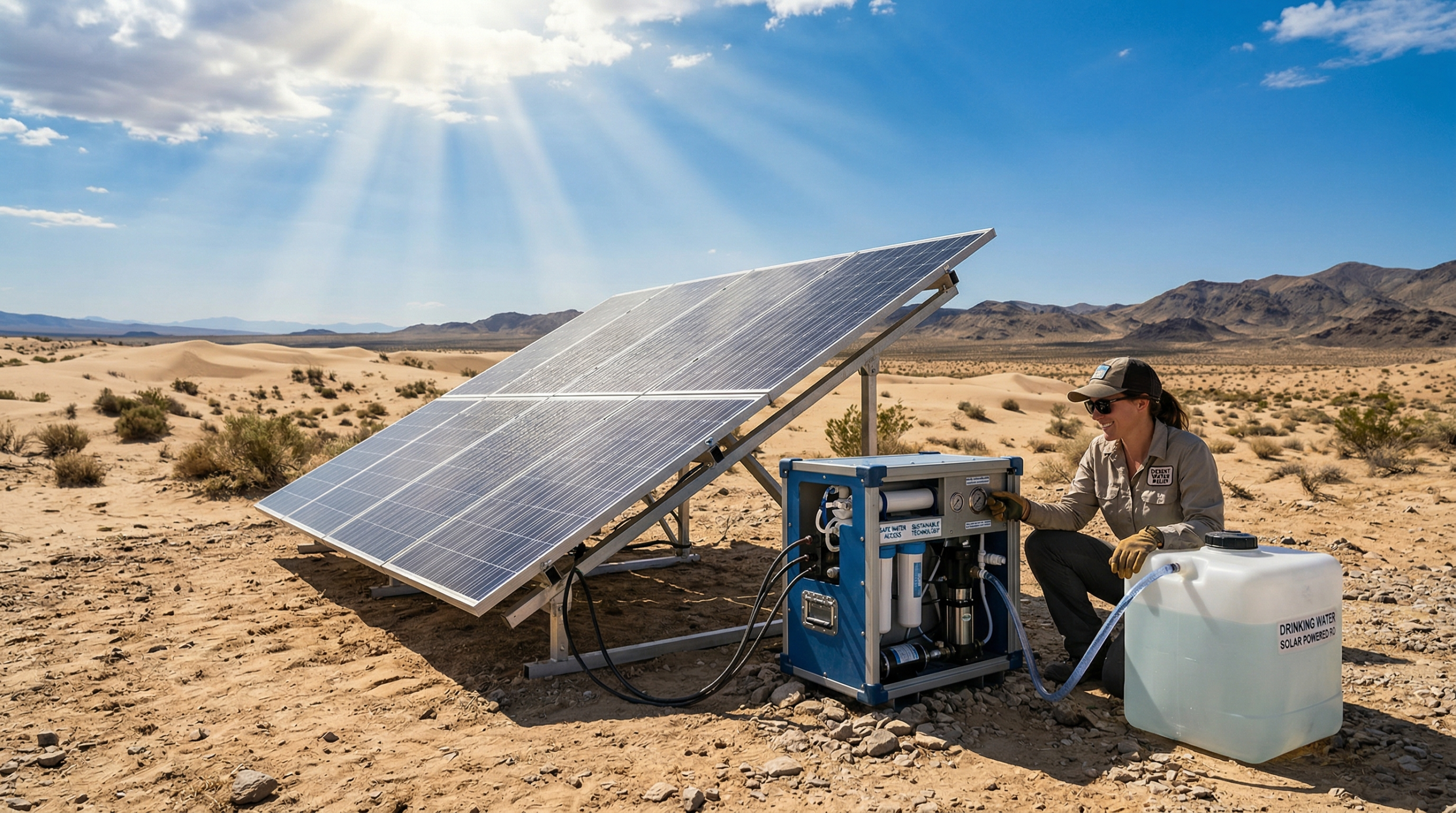
The convergence of falling solar panel costs, improved battery storage, and energy-efficient reverse osmosis membranes has made solar-powered water purification a practical reality in 2026. The International Renewable Energy Agency (IRENA) reports that solar PV module prices have dropped 90% since 2010, while RO membrane efficiency has improved 30-40% over the same period. This combination makes off-grid water treatment economically competitive with — and often cheaper than — diesel-powered alternatives for communities without reliable electricity.
How Solar-Powered Reverse Osmosis Works
A solar RO system consists of four core components: photovoltaic (PV) panels that convert sunlight to electricity, a battery bank that stores energy for cloudy periods and nighttime operation, a charge controller that regulates power flow, and the RO unit itself (high-pressure pump, membranes, pre-filters, and controls). Modern RO systems require 3-6 kWh of electricity per 1,000 gallons from brackish sources, and 8-14 kWh per 1,000 gallons from seawater.
Solar Panel Sizing for RO Systems
| RO Capacity | Water Source | Solar Array | Battery Bank | People Served |
|---|---|---|---|---|
| 150 GPD | Brackish | 200-300W | 1-2 kWh | ~40 |
| 500 GPD | Brackish | 500-750W | 2-4 kWh | ~125 |
| 1,000 GPD | Brackish | 1,000-1,500W | 4-6 kWh | ~250 |
| 2,000 GPD | Brackish | 2,000-3,000W | 8-12 kWh | ~500 |
| 500 GPD | Seawater | 1,500-2,000W | 5-8 kWh | ~125 |
| 2,000 GPD | Seawater | 5,000-7,000W | 15-20 kWh | ~500 |
Solar RO vs. Diesel RO: 10-Year Cost Comparison
| Cost Factor | Solar RO (1,000 GPD) | Diesel RO (1,000 GPD) |
|---|---|---|
| Equipment | $12,000-$20,000 | $6,000-$12,000 |
| Fuel/Energy (10yr) | $0 | $20,000-$50,000 |
| Maintenance (10yr) | $5,000-$10,000 | $15,000-$30,000 |
| Battery Replacement | $3,000-$5,000 (once at year 8-10) | N/A |
| 10-Year Total | $20,000-$35,000 | $41,000-$92,000 |
| Cost per Gallon | $0.003-$0.005 | $0.006-$0.012 |
| Carbon Emissions | Zero | 2.5-5 kg CO2/1,000 gal |
The breakeven point where solar becomes cheaper than diesel typically occurs at 18-30 months. Over 10 years, solar saves 40-60% on total costs while producing zero carbon emissions.
Applications for Solar-Powered Water Purification
Remote and Rural Communities
An estimated 2 billion people worldwide lack safely managed drinking water, primarily in rural areas without grid electricity. Solar RO provides a sustainable solution that communities can operate independently — no fuel supply chains, no grid dependency, minimal technical expertise required.
Island Nations and Coastal Communities
Small island nations face acute water scarcity with limited freshwater aquifers and expensive diesel imports. Solar-powered seawater RO eliminates fuel dependency while harnessing abundant tropical sunshine. Countries like the Maldives, Tuvalu, and Caribbean nations are adopting solar SWRO for municipal supply.
Military and Disaster Relief
Solar RO eliminates the logistical burden of fuel supply chains in remote deployments. A solar-battery-RO unit operates indefinitely without resupply — critical for forward operating bases and disaster relief camps. AMPAC USA military-spec solar RO systems meet MIL-STD-810 environmental standards for shock, vibration, and extreme temperatures.
Agriculture and Livestock
Farms in arid regions use solar RO to desalinate brackish well water for livestock (cattle need TDS below 3,000 ppm) and crop irrigation. The system runs during peak sun hours when water demand is highest, with battery backup for extended operation.
Design Best Practices
- Store water, not electricity: It is 3-5x cheaper to fill water tanks during peak sun than to store electricity in batteries for nighttime RO operation. Design for daytime production with large storage tanks.
- Use variable frequency drives (VFDs): VFDs adjust pump speed to match available solar power — producing more water in bright sun, less in clouds, without battery dependence.
- Size for the worst month: Design solar capacity for the lowest-production month, not the annual average. Oversize the array 20-30% for seasonal buffer.
- Choose LiFePO4 batteries: Despite higher upfront cost, LiFePO4 batteries last 8-12 years with 3,000+ cycles — the lowest cost-per-cycle at $0.08-$0.12/kWh over lifetime.
- Plan for 1-3 autonomy days: Battery capacity should cover 1-3 cloudy days for critical water supply applications.
Frequently Asked Questions
Can solar panels power a seawater desalination system?
Yes. A 5-7 kW solar array with 15-20 kWh battery storage powers a 2,000 GPD seawater RO system producing enough fresh water for 500 people daily. Solar desalination plants up to 100,000+ GPD are operating in the Middle East, Australia, and Pacific islands.
What happens on cloudy days?
Battery storage provides continuity. A system with 2-3 days of autonomy operates through extended overcast weather. Modern panels still produce 15-25% of rated power on cloudy days. Variable speed drives allow reduced-capacity operation rather than complete shutdown.
How long do solar RO systems last?
Solar panels carry 25-30 year warranties (0.3-0.5% annual degradation). The RO frame and pumps last 15-20 years. Membranes need replacement every 3-7 years. LiFePO4 batteries last 8-12 years. Overall system lifespan: 20+ years with component replacements.
Can I retrofit solar onto my existing RO system?
Yes. Most existing RO systems accept solar power by adding panels, charge controller, battery bank, and inverter matched to the system’s power draw. AMPAC USA offers solar conversion consulting for existing installations.
Is solar RO better than well drilling?
Often yes. Well drilling costs $5,000-$50,000+ with no freshwater guarantee. Coastal wells frequently produce brackish water requiring treatment anyway. Solar RO provides guaranteed water quality from any source with predictable costs and zero dry-well risk.
Go Off-Grid with AMPAC USA Solar Water Purification
AMPAC USA designs solar-compatible RO systems from portable 150 GPD units to large-scale 100,000+ GPD installations. Our engineering team provides complete system design including solar array sizing, battery specification, and integration with existing infrastructure.
Contact AMPAC USA for a free solar RO consultation. Call (909) 762-8020 or request a custom proposal online.