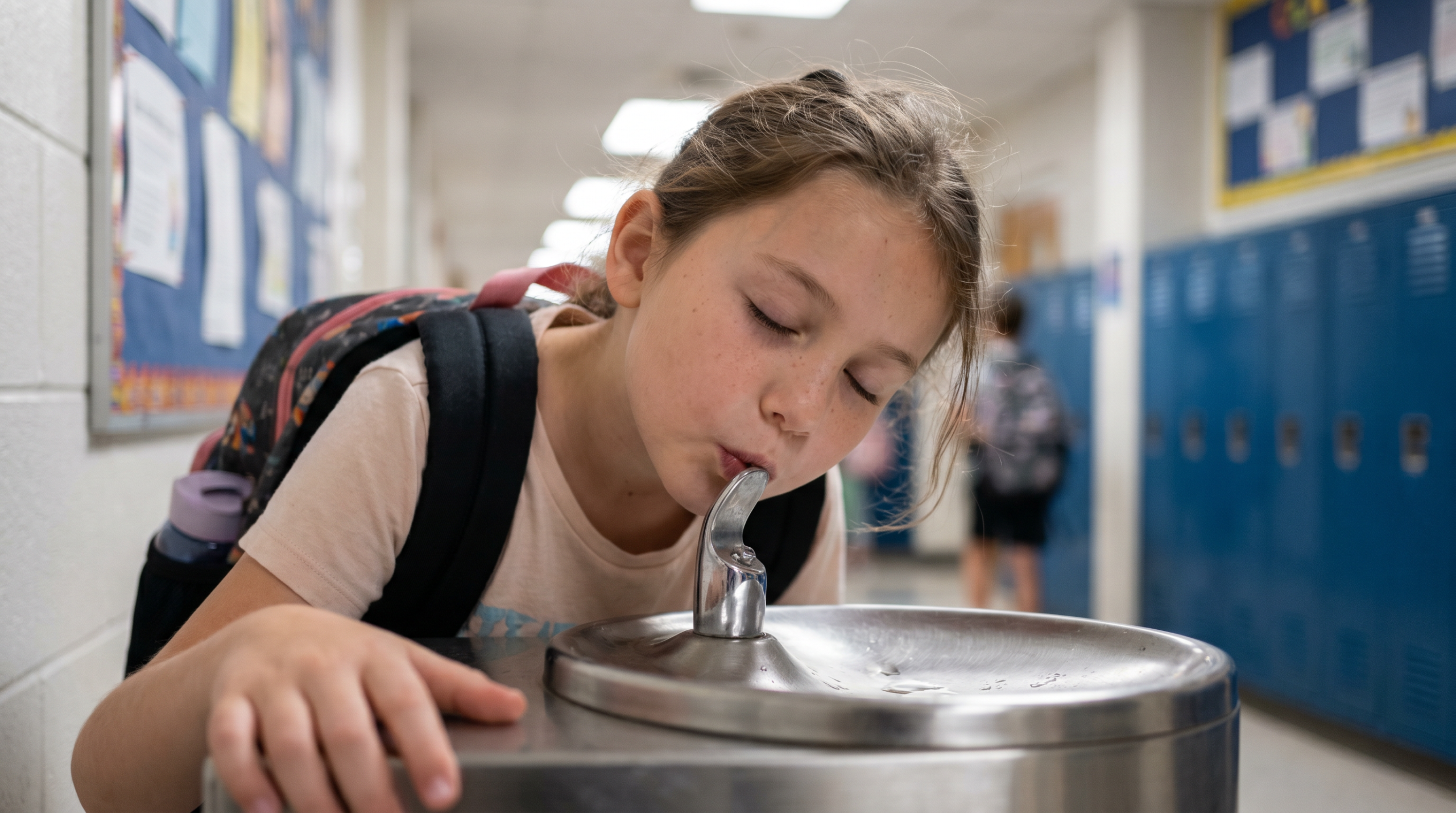

Every parent dropping their kid off at school assumes the water fountains are safe. That assumption has taken some serious hits recently. An ABC News analysis of 7,758 EPA-regulated school water systems found 77% had some level of lead contamination. That’s not a fringe problem — that’s the majority of schools in this country. And lead is just the beginning.
So what is reverse osmosis water, why does it matter for kids, and how are schools actually using it to fix their water problems? Let’s break it down plainly.
What Is Reverse Osmosis — And Why It Makes Sense for Schools
Reverse osmosis (RO) is a water purification process that pushes water through a semi-permeable membrane with pores so small (0.0001 microns) that only water molecules pass through. Everything else — dissolved lead, arsenic, PFAS, nitrates, bacteria, viruses — gets blocked and flushed away.
For kids, this matters more than it does for adults. Children absorb lead at a higher rate than adults. Their developing nervous systems are more vulnerable to the neurological damage lead causes. And since kids drink more water relative to their body weight, their cumulative exposure from contaminated fountains adds up fast.
A standard carbon filter — the kind you find in basic pitchers and many school fountain attachments — doesn’t touch lead, nitrates, or PFAS. It improves taste and reduces chlorine. That’s useful, but it’s not what schools with aging pipes need. Reverse osmosis removes over 95% of lead, over 90% of nitrates, and 95–99% of PFAS compounds in a single pass.
The Scale of the Problem in U.S. Schools
The contamination picture isn’t getting better fast enough. Here’s where things stand heading into 2026:
- Lead: 77% of EPA-regulated school water systems tested positive for some lead. In Texas alone, 78% of tested schools and daycares found lead in their drinking water as of late 2024. And as of the last GAO survey, only 43% of U.S. school districts had even tested their water for lead.
- PFAS: The EPA estimates 158 million Americans — many of them served by municipal systems that supply schools — face PFAS-contaminated tap water. In April 2024, the EPA finalized the first enforceable limits for PFAS in drinking water, setting maximums of 4 parts per trillion for PFOA and PFOS.
- Nitrates: Agricultural runoff contaminates well water and some municipal sources. A 2025 study analyzing 350,000 Iowa birth records found measurable harm at just 0.1 mg/L — one percent of the EPA’s current “safe” limit. Schools in farming regions using well water or contaminated municipal supply are particularly exposed.
The new Lead and Copper Rule Improvements (LCRI), finalized in October 2024, reduced the action level for lead from 15 ppb to 10 ppb and requires utilities to replace 100% of lead service lines within 10 years. Water utilities must complete sampling plans for schools by 2027, with full sampling required by 2032. That’s still years away — and it only covers pipe replacement, not treatment at the point of use.
Point-of-Use vs. Centralized RO Systems for Schools
When schools install RO, they generally choose between two approaches:
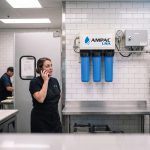
Point-of-use (POU) systems sit at individual fountains, drinking stations, or sink faucets. A student drinks from a fountain; the water has already passed through the RO membrane in the unit mounted behind it. These are lower cost per unit ($1,000–$5,000 installed, depending on configuration) and faster to deploy, but a large school needs many of them to provide coverage across all locations.
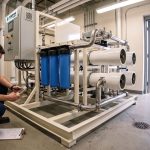
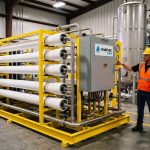
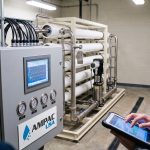
Centralized systems treat water for an entire building or campus before it reaches any fixture. The cost is significantly higher — a medium-sized school building can run $25,000–$100,000+ for a centralized system — but it provides uniform protection at every faucet, not just designated drinking stations. Cafeterias and food preparation areas benefit equally.
For most K-12 schools with lead pipe concerns, the practical answer is POU units at drinking fountains and kitchen fixtures first, with a path toward centralized treatment over time. Universities often go centralized from the start.
What RO Actually Removes (And What It Doesn’t)
It’s worth being specific, because “reverse osmosis removes contaminants” is the kind of vague claim that doesn’t help anyone make a decision.
| Contaminant | RO Removal Rate |
|---|---|
| Lead | 95% |
| PFOA/PFOS | 90–99% |
| Short-chain PFAS | 90% |
| Nitrates | 83–92% |
| Arsenic | ~95% |
| Bacteria | 99% |
| Dissolved metals (general) | 95–99% |
What RO doesn’t do particularly well: removing volatile organic compounds (VOCs) and some pesticides in single-membrane configurations. Adding an activated carbon post-filter — standard on well-designed systems — addresses that gap. No single technology is perfect; RO paired with a carbon stage covers the vast majority of contaminants present in U.S. school water.
Funding Available for Schools Right Now
Here’s something many school administrators don’t know: there’s substantial federal funding available specifically for water treatment upgrades. The Bipartisan Infrastructure Law allocated $10 billion for PFAS and emerging contaminant relief, including $4 billion through the Drinking Water State Revolving Fund (DWSRF). Schools can access grants through the Water Infrastructure Improvements for the Nation (WIIN) Act and state-level revolving funds.
Colorado, for example, runs the “Test and Fix Water for Kids” program under HB22-1358, providing free testing, remediation, and technical assistance to schools and childcare facilities. Washington State actively tracks and publishes lead-in-school-water data. New Jersey passed state-level mandates for filtration after testing found at least one outlet exceeding lead limits in 300 schools across 95 districts.
If your school district hasn’t applied for WIIN Act funding or DWSRF support for water treatment, it’s worth investigating — especially with the 2027 sampling plan deadlines approaching.
Explaining RO to Kids: The Simple Version
If you need to explain reverse osmosis to children — for a school science project, a classroom discussion, or a curious kid asking questions — here’s the clearest way to put it:
Imagine trying to separate sand from water. You’d pour it through a strainer. Now imagine the holes in the strainer were so incredibly tiny that even things you can’t see — invisible chemicals, dissolved metals — can’t squeeze through. Only water molecules are small enough. That’s basically what a reverse osmosis membrane does. Water gets pushed through under pressure, and everything your body shouldn’t drink gets left behind.
Kids tend to ask: “Where does the bad stuff go?” It gets flushed out in the drain water. The system doesn’t store contaminants — it continuously rinses them away. Clean water comes out one pipe, contaminated reject water leaves through another.
The Bottom Line for Schools and Parents
Waiting for infrastructure replacement and regulatory compliance timelines to solve school water contamination isn’t a strategy — it’s a gamble with children’s health. Point-of-use RO systems are available now, work immediately, and are funded in part through existing federal and state programs.
If you’re a school administrator or a parent asking questions at school board meetings, the right question isn’t “Is our water safe?” — it’s “Have we tested it, and what treatment is in place at the point of use?”
Looking to equip your school’s cafeteria, kitchen, or drinking stations with NSF-certified RO filtration? Explore AMPAC USA’s commercial RO systems — designed for high-volume, continuous-use applications and built to the standards that school and institutional water requires.
Related Articles
- Ensure Safe drinking water with Ampac USA 4 Stage Reverse Osmosis System
- Does Reverse Osmosis Remove Sulfur? Safe Well Water Treatment Guide
- Reverse Osmosis – Safe Drinking Water
- Water Softener vs Reverse Osmosis: Which Do You Need? | AMPAC USA
Frequently Asked Questions
What specific contaminants do reverse osmosis systems remove from school drinking water?
RO systems effectively remove a wide range of harmful contaminants from school drinking water, including lead from aging pipes, chlorine, nitrates, and microbial pathogens. This comprehensive filtration ensures water is free from visible and invisible impurities, bad odors, and tastes, providing pure water for students and staff.
What types of reverse osmosis systems are suitable for educational institutions?
Both point-of-use (POU) and centralized reverse osmosis systems are viable solutions for K-12 schools and universities. POU systems provide purified water at specific locations like drinking fountains, while centralized systems treat all incoming water for the entire facility. AMPAC USA engineers can design custom solutions based on the institution’s specific needs and water demand.
How do reverse osmosis systems ensure drinking water quality in schools meets EPA standards?
Reverse osmosis technology utilizes a semi-permeable membrane to filter out dissolved solids, heavy metals, and microscopic contaminants, consistently delivering water that meets and often exceeds EPA drinking water standards. This rigorous purification process ensures that students and staff have access to consistently safe and pure water.
Why is it crucial for schools to provide purified drinking water, especially for children?
Providing purified drinking water is crucial because children have weaker immune systems and are less able to discern water quality, making them highly susceptible to waterborne illnesses. Schools have a responsibility to protect students’ health, and installing an RO system mitigates risks from impure water, safeguarding their well-being and the institution’s reputation.
What makes AMPAC USA a trusted provider of reverse osmosis systems for schools?
With over 30 years of experience, AMPAC USA designs and manufactures commercial/industrial RO systems, leveraging direct field expertise from installations on military bases, luxury resorts, and municipalities across 150+ countries. Our engineers ensure robust, reliable, and high-performance systems tailored to the unique demands of educational environments.
AMPAC USA engineers custom water purification systems for commercial, industrial, and emergency applications — from 500 GPD to multi-million GPD. Trusted by municipalities, military, and industry worldwide.